
You finally did it. After months of SEO work, blog posts, and link building, your Sydney business is sitting at the top of Google’s search results. The traffic is pouring in. Analytics looks fantastic.
But your phone isn’t ringing. Your contact form is empty. Your sales team is asking where the leads went.
This is one of the most frustrating and common problems facing business owners today, and it almost always comes down to one overlooked issue: website UX. Sydney businesses tend to deprioritise it in favour of chasing rankings. Ranking #1 gets people to your door. It does not make them walk inside, and it certainly does not make them buy.
If your website is generating clicks but not clients, the problem usually is not your SEO strategy at all. It is what happens after someone lands on your page. Understanding modern Website UX Sydney strategies ensures that high search visibility translates directly into measurable revenue.
Wondering if your website has a UX problem? Keep reading; the signs are usually hiding in plain sight.
Traffic vs. Conversions: The Myth of the #1 Ranking
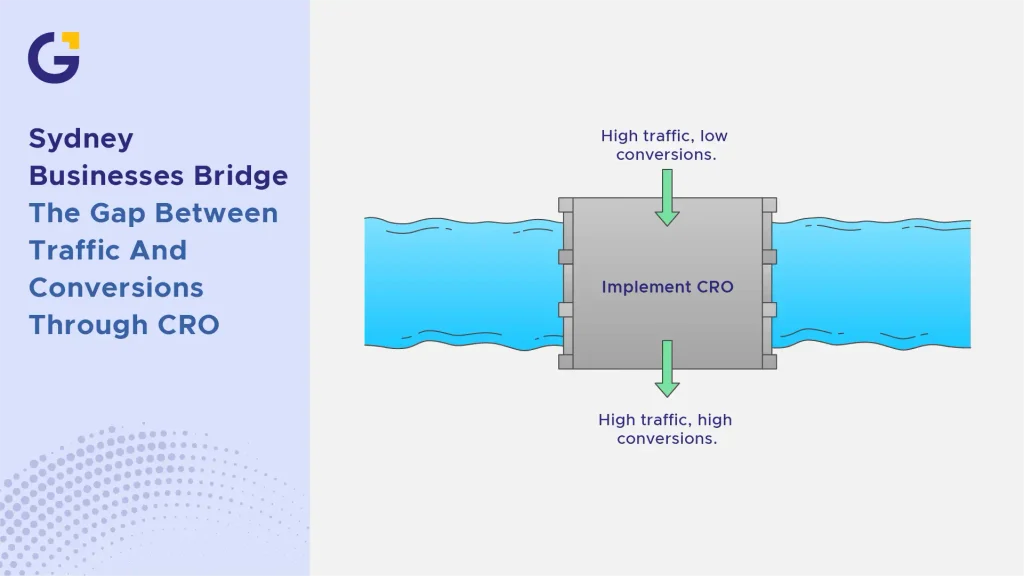
There is a dangerous assumption in digital marketing: that ranking #1 automatically equals business growth. It doesn’t. Ranking #1 means Google trusts your page enough to show it first. It says nothing about whether your website actually convinces someone to take action once they arrive.
This is where conversion rate optimisation comes in. SEO gets potential customers to your website; CRO focuses on what happens once they arrive. SEO and CRO are two different disciplines solving two different problems, and confusing them is costing Sydney businesses real revenue every single day. As Australian direct-response marketing expert Sabri Suby often points out, traffic is merely vanity if your landing page fails to guide users toward a decisive outcome.
Example Case: A Sydney-based plumbing company ranked #1 for “emergency plumber Sydney” and saw traffic triple within six months. Yet their booking rate stayed flat. An audit revealed their mobile CTA button was below the fold on a page that took 6.8 seconds to load, meaning most mobile users left before ever seeing the “Book Now” option.
- Traffic answers: “Are people finding you?”
- Conversion rate answers: “Are they taking action once they arrive?”
A site can win at one and completely fail at the other.
The 5 Reasons High-Ranking Websites Fail to Convert
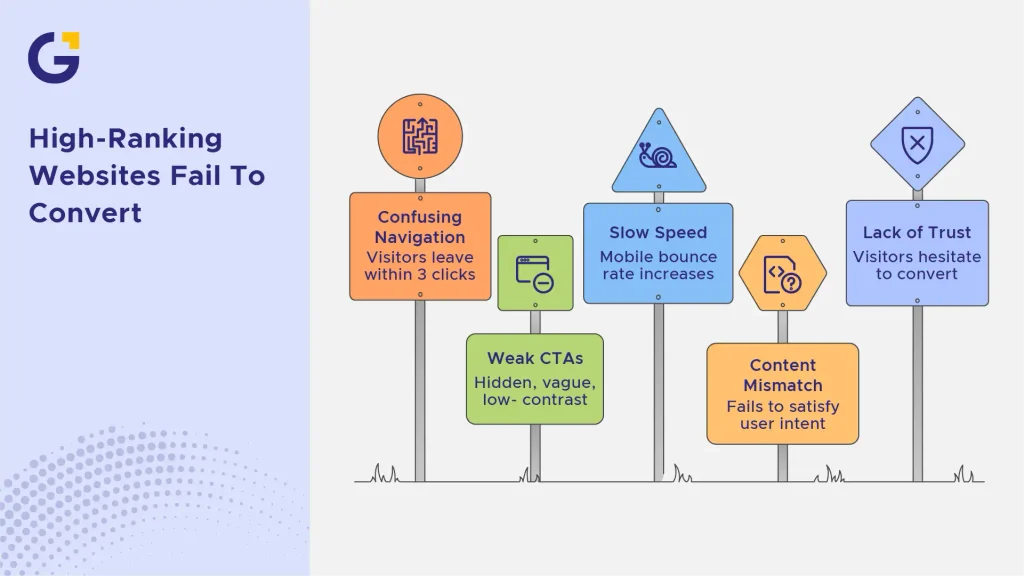
Most high-ranking websites that fail to convert share the same handful of structural and psychological problems. Below are the five most common culprits we see repeatedly during CRO audits across Sydney businesses.
1. Confusing Information Architecture & Navigation
If a visitor cannot find what they need within two to three clicks, they leave. It’s that simple. Confusing menus, buried service pages, and unclear category structures actively push potential customers away.
Good information architecture is invisible. Visitors simply find what they’re looking for without thinking about it. Bad architecture forces people to hunt, guess, and eventually give up. According to research from the Nielsen Norman Group, users decide whether to stay on a webpage within the first 10 to 20 seconds based almost entirely on clarity.
Example Case: An e-commerce store selling homewares had over 40 subcategories crammed into a single dropdown menu. Heatmap tracking showed users repeatedly clicking on non-interactive banner images, trying to “find” navigation that wasn’t there.
- Symptom: High website traffic, no sales and high bounce rates on primary landing pages.
- Symptom: Low pages-per-session despite sustained top-three search rankings.
2. Weak or Hidden Calls to Action (CTAs)
Many Sydney websites bury their CTA below three scrolls of text, use vague language like “Learn More” instead of “Get a Free Quote,” or use low-contrast buttons that visitors’ eyes simply skip past.
A CTA needs to be visible, specific, and repeated at logical points throughout the page, not just once at the very bottom. If your conversion path feels clunky, reviewing effective layout frameworks in our guide on UI/UX for B2B businesses: 10 page patterns that convert can help streamline your lead funnel.
- Weak CTA example: A grey “Submit” button blending into the background.
- Strong CTA example: A bold, contrasting “Get Your Free Quote Today” button placed above the fold and after key content sections.
3. Slow Page Speed and Poor Mobile Responsiveness
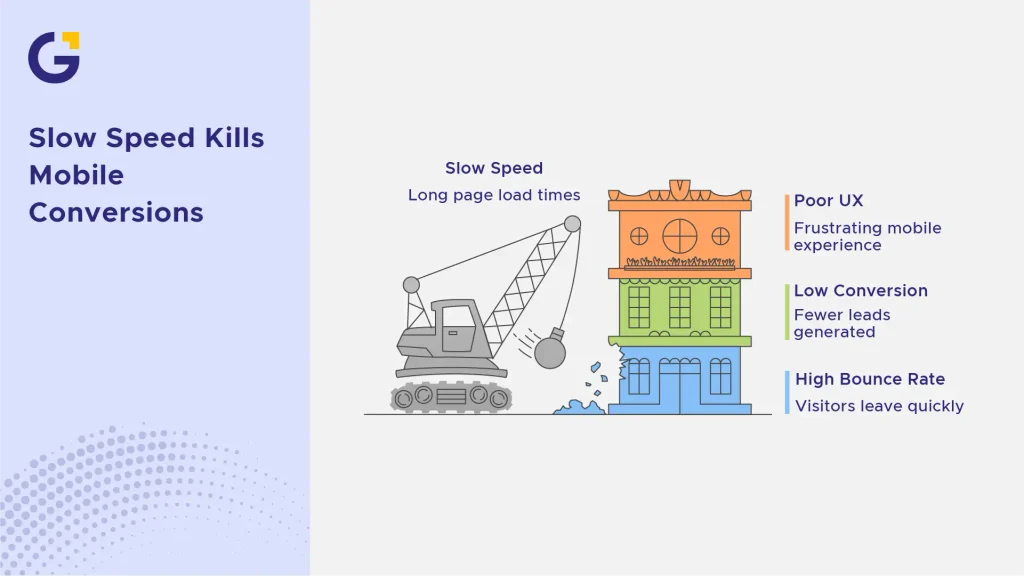
Google’s own research shows that as page load time goes from 1 second to 5 seconds, the probability of a mobile visitor bouncing increases by 90 percent. Given that most Sydney searches now happen on mobile, this is not a minor technical detail; it’s a conversion killer. If slow load times are driving visitors away, resolving technical bottlenecks with a dedicated Website Speed Optimisation for Sydney Businesses: What Actually Affects Leads audit is essential.
Poor mobile responsiveness, meaning tiny text, unclickable buttons, and forms that don’t fit the screen, compounds the problem further. You can test your real-world performance metrics using Google PageSpeed Insights.
Example Case: A Sydney legal firm’s contact form required pinch-to-zoom on mobile just to fill in the “phone number” field. Their mobile conversion rate was less than one third of their desktop rate. Read our full breakdown on Why Your Small Business Website Is Losing Mobile Visitors (Mobile UX Checklist for Sydney to uncover common mobile friction points.
4. Content That Doesn’t Match User Intent
Ranking for a keyword and satisfying the intent behind that keyword are two entirely different hurdles. If someone searches for an urgent service in Sydney, they expect clear pricing, proof of work, and immediate contact methods- not a 2,000-word essay on company history.
When messaging fails to align with user expectations, bounce rates spike, and visitors return to search results. To convert visitors effectively, Sydney brands must align landing page copy with user psychology. Discover how to fix messaging disconnects in our guide on Why Your Sydney Business Website Gets Traffic But Zero Phone Calls (And How to Fix It). Crafting clear messaging through a structured B2B content strategy ensures your value proposition resonates instantly.
- Match intent directly: Provide clear solutions above the fold.
- Remove fluff: Answer key customer questions clearly and early.
- Strengthen trust: Include clear social proof near conversion points.
5. Lack of Trust Signals and Clear Value Proposition
Even if a visitor finds your page and navigates it easily, they will hesitate to fill out a form or make a purchase if your site lacks credibility. First-time visitors are naturally sceptical, especially in competitive service markets like Sydney.
Without clear trust badges, client testimonials, security certifications, and a distinct value proposition, visitors simply head back to Google to find a competitor who looks more legitimate. Incorporating trust markers across your site is crucial; learn more in our guide on Trust Signals Every Sydney Small Business Website Needs Before Customers Enquire.
- Prominently display reviews, partner logos, and industry accreditations.
- Highlight your Unique Selling Proposition (USP) right in the hero section.
- Implement simple proof items; see our analysis of 7 Quick Trust Signals That Turn Casual Sydney Visitors into Instant Leads.
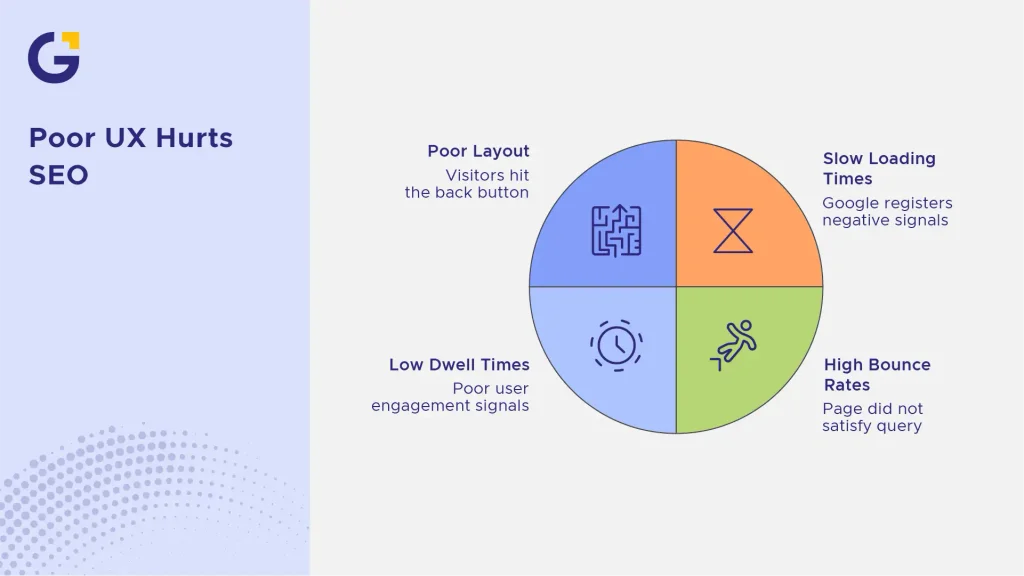
How Poor UX Secretly Hurts Your SEO Over Time
Many business owners view user experience and search engine optimisation as completely separate tasks. UX and SEO are not completely separate. A page can rank well and still fail to satisfy the person who lands on it. If visitors cannot find the information they expected, use the page easily, or complete the next step, the traffic generated by SEO has little business value.
When visitors land on your site and immediately hit the back button because of poor layout or slow loading times, Google registers this as a negative signal. High bounce rates, low dwell times, and poor user engagement signal to search engines that your page did not satisfy the user query.
Over time, poor UX can degrade rankings you worked hard to build. A comprehensive Reduce website bounce rate strategy combines technical site health with intuitive user journeys, ensuring your pages remain highly visible while actively converting visitors.
Ready to Turn Your Search Traffic Into Paying Clients?
Driving organic traffic to your website is only half the battle. If your digital presence isn’t built to guide visitors seamlessly from interest to action, even the highest rankings won’t generate meaningful business growth.
At Genix Digital, we bridge the gap between traffic and conversions. Whether you need specialised layout refinements from a dedicated CRO agency Sydney or an end-to-end rebuild through our Custom web development Sydney solutions, we help Australian businesses turn more website visitors into enquiries and customers.
If you are ready to evaluate how intuitive user journeys can improve website conversion rate performance across your entire domain, reach out to our team at Genix Digital today for a comprehensive website audit.
Frequently Asked Questions
Why am I getting high website traffic but no sales or leads?
High traffic without conversions usually indicates a mismatch between target keywords and page content, poor website navigation, unclear calls to action (CTAs), or a frustrating mobile user experience.
How does User Experience (UX) affect Google rankings?
Google evaluates user engagement metrics like dwell time, bounce rate, and user interactions. If users land on your site and leave immediately due to poor UX, Google may gradually drop your rankings.
What is information architecture and why does it matter for SEO?
Information architecture is how content is organised and structured on your website. Clear architecture helps both users and search engine crawlers find essential pages within 2 to 3 clicks.
Can improving UX fix a high bounce rate?
Yes. Simplifying navigation, speeding up page load times, using clear headings, and placing prominent CTAs directly address the main causes of high bounce rates.
What is the difference between SEO traffic and conversion rate optimisation (CRO)?
SEO brings potential customers to your website, while CRO ensures that once visitors arrive, they easily find what they need and take action (such as filling out a form or making a purchase).
How can I tell if my website’s navigation is confusing to users?
High bounce rates on key landing pages, low time spent on page, and heatmaps showing users clicking non-clickable elements are clear indicators that your navigation needs improvement.

 1 Jul 2026
 20 Min Read