
Australian businesses are facing a structural shift in digital marketing. Search engine results are delivering fewer website clicks, paid advertising costs continue to rise across Meta and Google, and consumer purchasing journeys are changing rapidly. Tools like ChatGPT, Claude, and Google Gemini have shifted user behaviour from browsing traditional web pages to seeking immediate, AI-generated answers.
The primary challenge for Australian business leaders and marketers in 2026 is clear: how to maintain consistent qualified lead generation and online revenue as traditional search traffic shrinks.
This comprehensive guide outlines the top digital marketing trends in Australia for 2026. It incorporates current Australian search benchmarks, growth channel data, and actionable execution strategies designed to help Australian small-to-medium enterprises (SMEs) and corporate brands scale predictably.
Key Takeaways: Australian Digital Marketing Landscape in 2026
- Search is Omnichannel: Australian consumers no longer rely solely on Google. Discovery is distributed across Google AI Overviews, TikTok, YouTube, and AI answer engines.
- Zero-Click Search is the Baseline: Over 26% of Google searches ending in AI summaries do not produce a website visit. Marketing strategies must focus on brand presence inside AI citations, not just organic click-throughs.
- Creative Quality Drives Paid Ad Performance: Algorithmic ad targeting on Meta and Google Ads relies heavily on high-volume creative variations and immediate intent matching rather than hyper-narrow audience targeting.
- First-Party Data is Essential: With tightening Australian Privacy Act regulations and third-party cookie deprecation, capturing direct customer data via custom CRMs and automated lead workflows is critical for sustainable ROI.
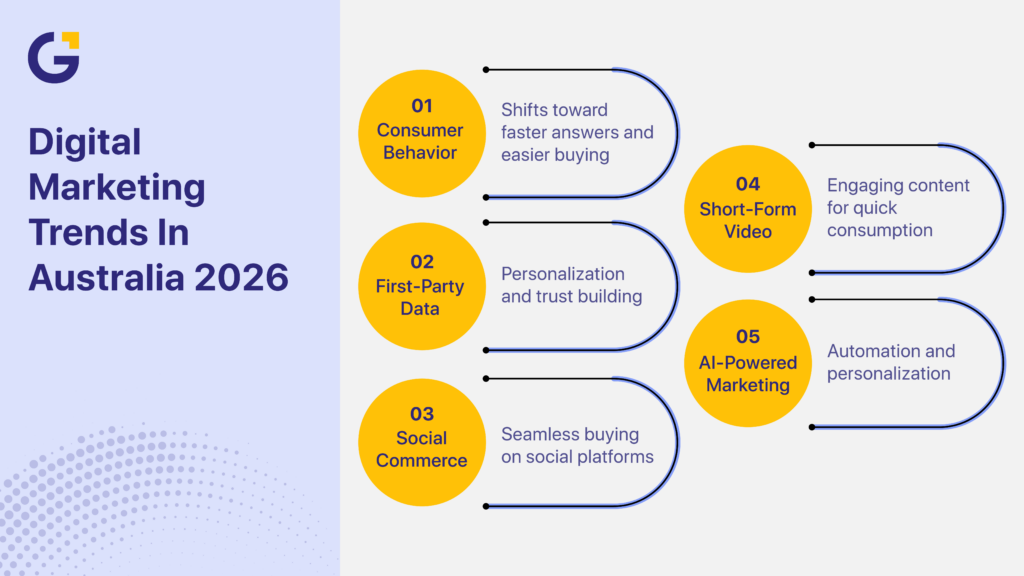
What Are The Top Digital Marketing Trends In Australia For 2026?
The top digital marketing trends in Australia for 2026 centre on AI-powered marketing automation, generative search optimisation (GEO), short-form video discovery, social commerce, and privacy-compliant first-party data strategies.
Australian consumer online behaviour has fundamentally transitioned toward frictionless experiences. Users demand immediate answers, hyper-personalised content, and frictionless native purchasing without navigating complex multi-page conversion funnels.
2026 Core Growth Pillars for Aussie Brands:
- 1. Generative Search & AEO: Google AI Overviews, ChatGPT & Perplexity citations.
- 2. Short-Form Video & Social: TikTok SEO, Instagram Reels, YouTube Shorts.
- 3. Conversion-Driven UX/CRO: On-site speed, dynamic lead forms, friction-free booking.
- 4. First-Party Data Systems: CRM integrations, server-side tracking, email automation.
Leading Australian enterprises and SMEs are abandoning fragmented, single-channel tactics. Successful brands are instead implementing unified systems that integrate professional SEO services, targeted performance ads, strategic content, and optimised web design.
Real-World Impact: A Sydney commercial services client adopting this unified system experienced an 18% reduction in raw website session volume due to zero-click AI summaries, but achieved a 34% increase in total qualified phone enquiries and online bookings. Traffic quality and conversion architecture have officially superseded pure hit counts.
Which Marketing Channels Are Growing Fastest in Australia in 2026?
Market data from industry intelligence bodies like IAB Australia indicates that marketing budgets are shifting heavily toward interactive, visual, and AI-driven platforms.
| Growth Channel | Primary Audience Focus | 2026 Strategic Value for Australian Businesses |
| Short-Form Video Search (TikTok & Reels) | Gen Z, Millennials, Suburban Families | High discovery rate; acts as a primary search engine for product reviews and local service recommendations. |
| Generative Search Platforms (Google AI, Perplexity) | High-Intent B2B & B2C Researchers | Captures users at the final decision stage before purchase or consultation booking. |
| Social Commerce In-App Checkout | Retail & Ecommerce Buyers | Eliminates funnel drop-offs by converting users directly inside Instagram and TikTok. |
| Retail Media Networks | Australian Supermarket & Retail Shoppers | Allows brands to target high-intent buyers using direct point-of-sale data. |
| Direct Messaging & Chat Lead Nurturing | B2B, Healthcare, Professional Services | Delivers immediate response times via automated SMS, WhatsApp, and web-chat workflows. |
Key Australian Digital Marketing Benchmarks & SEO Statistics for 2026
To benchmark digital marketing performance accurately in the Australian marketplace, businesses must align with realistic national metrics:
- Mobile Device Engagement: According to Australian digital activity reports published by Red Search, Australians spend over 6 hours per day on mobile devices, with internet penetration reaching 97.1% and active social media usage standing at 77.9%.
- Zero-Click Impact: National search data audited by Semrush reveals that approximately 26% of Google queries containing AI summaries resolve without a click-through to a target site, compared to 16% for traditional organic listings.
- Organic Search CTR Shift: Average organic CTR for the #1 position on traditional Google desktop queries sits between 22% and 28%, but drops below 14% when a Google AI Overview occupies the top position.
- Paid Ads Conversion Benchmark: Across Australian B2B and service sectors, conversion rates on dedicated landing pages range between 4.5% and 8.2%, whereas non-optimised general service pages struggle below 1.5%.
How is AI Changing Digital Marketing in Australia Right Now?
AI in Australian marketing has matured beyond simple copy generation. It is now deeply embedded across predictive campaign bidding, audience segmentation, real-time creative generation, and search engine evaluation.
Leading global management consultancies like McKinsey & Company confirm that over 75% of enterprise organisations now deploy AI tools within at least one business operational function.
Human Strategy vs. AI Execution Balance
- AI Operational Execution:
- Ad variation testing & multivariate copy iteration.
- Predictive bidding adjustments & audience analytics.
- Schema markup, structured data, and code generation.
- Human Touch & Brand Leadership:
- Brand voice, positioning, and emotional resonance.
- Authentic video spokespeople & on-camera expertise.
- Strategic business direction & ethical customer relationships.
Case Example: A Melbourne ecommerce brand used AI tools to generate 20 ad copy variations, which were curated and refined by a senior copywriter. The campaign achieved a 27% improvement in Return on Ad Spend (ROAS) without raising ad spend.
Why is Search Changing Beyond Google in Australia?
Search behaviour is decentralising. While Google remains the dominant high-intent search tool in Australia, discovery is now distributed across multiple platforms depending on user demographics and intent.
Australian Search Intent Map (2026)
| Search Platform | Dominant User Intent in Australia | Best Content Format |
| Google Search & AI Overviews | Direct service inquiries, local business searches, immediate purchases | Clear service landing pages, structured FAQs, Schema markup |
| TikTok & Instagram Reels | Product discovery, lifestyle trends, local food/trades recommendations | Authentic vertical video, caption keyword optimisation |
| YouTube & YouTube Shorts | Detailed product comparisons, educational guides, DIY tutorials | Long-form expert reviews, concise short summaries |
| AI Answer Engines (ChatGPT/Perplexity) | Technical research, strategic planning, comparative analysis | Unambiguous factual text, authoritative citations, clear table structures |
To maintain visibility, businesses must implement a comprehensive approach that extends beyond traditional search engines. For a deeper breakdown of optimising for these platforms, read our guide on SEO, AEO, GEO: The New Era of Search in 2026 and Beyond.
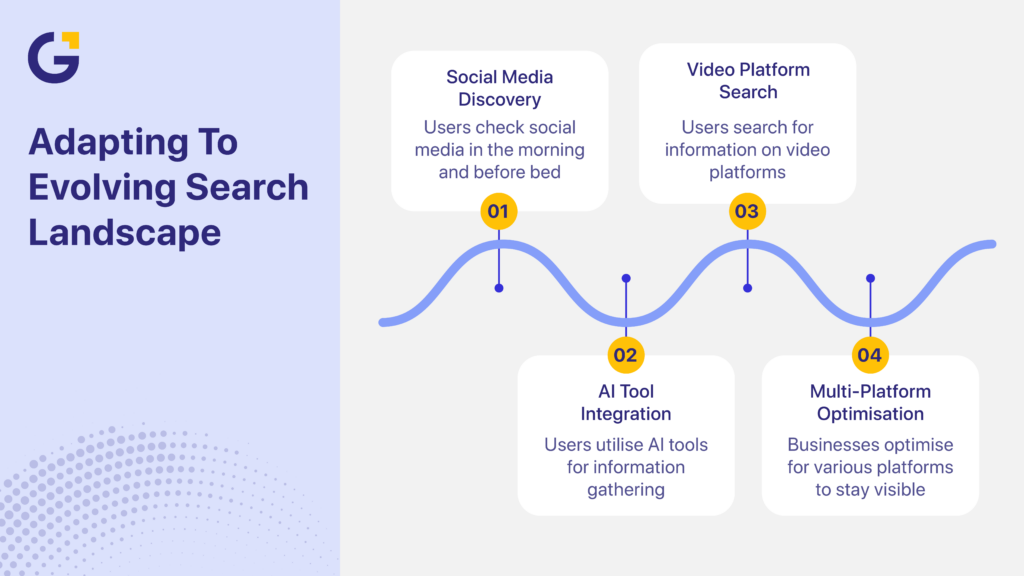
What is Zero-Click Search and How Does It Affect Australian Businesses?
Zero-click search occurs when a user obtains their complete answer directly on the Search Engine Results Page (SERP) or inside an AI summary, eliminating the need to click on any website link.
- Traditional SERP Journey: User Query → SERP Links → Clicks Website → Reads Content → Converts.
- 2026 Zero-Click SERP Journey: User Query → AI Overview Answers Query Directly → Brand Impressed (No Click) → High-Intent Direct Search Later.
Strategic Implications for Australian SMEs
- Traffic Volume Drops, Intent Rises: Informational blogs seeking simple traffic will see declining visits. However, users who do click through possess significantly higher purchase intent.
- Brand Citation is the New Page #1: Appearing as a cited source within Google AI Overviews or ChatGPT responses establishes instant market authority.
- Structured Data is Mandatory: Implementing detailed Organisation, Product, FAQ, and Service Schema helps search engines parse and quote your brand accurately.
Brisbane Law Firm Example: A Brisbane legal practice restructured its content headers to answer specific statutory questions directly at the top of each page. Total organic sessions dropped by 12%, but direct contact form submissions grew by 22% because cited snippets drove highly targeted brand inquiries.
Why Is Short-Form Video Marketing Dominating In Australia?
Short-form vertical video (under 60 seconds) is currently the highest-performing organic social acquisition channel in Australia. It combines high user engagement with algorithmic discovery that doesn’t depend on existing follower counts.
Video Best Practices vs. Ineffective Approaches
- What Works:
- Authentic, unscripted footage featuring real business founders or field technicians.
- Direct answers to common customer objections in the first 3 seconds (e.g., “How much does roof restoration actually cost in Sydney?”).
- Clear text captions optimised for platform search algorithms.
- What Fails:
- Polished, corporate TV-style ads with slow, cinematic intros.
- Generic stock video compilations accompanied by robotic AI voiceovers.
- Videos lacking clear calls-to-action or localised relevance.
For actionable steps on ranking your video assets on social platforms, explore our detailed playbook on TikTok SEO in Australia: How to Rank Your Videos in 2026.
How Is Social Commerce Changing How Australians Buy Online?
Social commerce enables Australian consumers to discover, evaluate, and purchase products natively within social applications like Instagram, TikTok, and Facebook without redirecting to an external browser window.
Funnel Efficiency Shift:
- Traditional Ecommerce: Social Ad → External Landing Page → Cart Page → Account Creation → Checkout (High Drop-Off Rate)
- Social Commerce: In-App Discovery → Native Product Tag → One-Touch Payment (High Conversion Rate)
Core Benefits for Australian Retailers
- Frictionless Mobile Checkout: Integrating native payment solutions (Apple Pay, Google Pay, Shop Pay) reduces cart abandonment rates.
- In-App Lead Generation: Service-based businesses can capture instant phone and email inquiries directly inside Facebook and TikTok native lead forms.
- Instant Customer Support: Utilising direct messaging automation inside Instagram converts casual inquiries into orders within minutes.
Why Does Content Quality Matter More Than Content Volume Now?
Publishing high volumes of low-quality, automated blog posts no longer generates organic search value. Search engines and AI discovery tools prioritise original insights, verifiable credentials, and direct answers over repetitive, keyword-stuffed articles.
| High-Value Content Characteristics | Low-Value Volume Characteristics |
| Direct answers in the opening paragraph | Generic, fluffy introductory text |
| Unique, verifiable business data and statistics | Spun or rephrased generic AI text |
| Clear E-E-A-T signals & author credentials | Keyword stuffing without user value |
| Comprehensive Schema markup & structured data | Thin, duplicate location landing pages |
To secure long-term rankings in Google Australia, brands must focus on topical authority, publishing detailed guides that address every aspect of a specific subject rather than creating dozens of shallow pages.
How Are Paid Ads Changing For Australian Businesses In 2026?
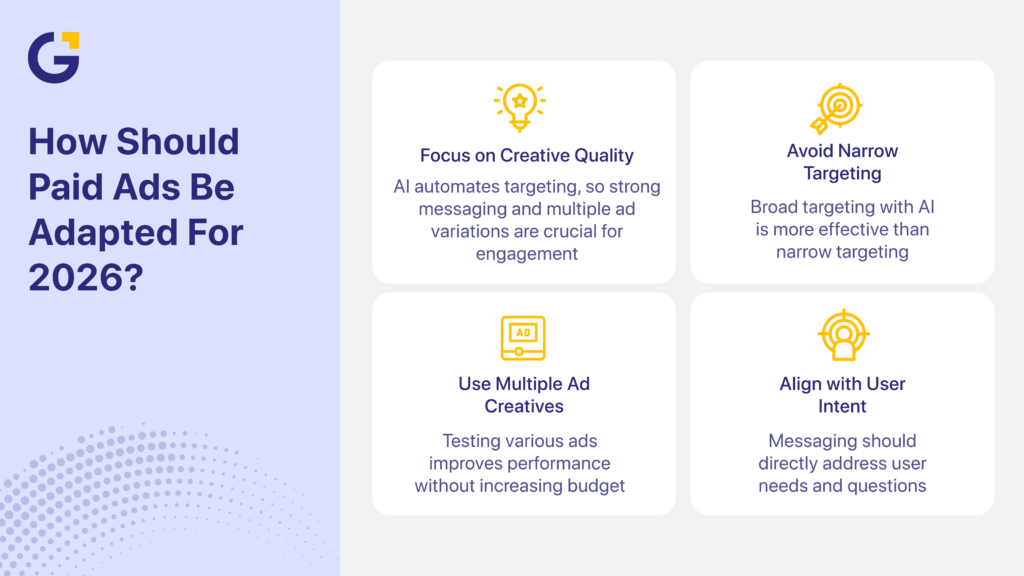
Performance marketing across Google Ads and Meta Ads (Facebook/Instagram) is undergoing a major shift. Machine learning algorithms now handle audience targeting automatically, placing the responsibility for campaign success back on ad creative quality and conversion architecture.
2026 Paid Ads ROI Formula:
Paid Ads ROI = Creative Diversity + Clear Messaging Alignment + Specialised CRO Landing Page
What Drives Paid Ad Success in 2026
- Multivariate Creative Testing: Launching 6 to 10 visual and messaging variations per ad set to allow algorithms to match specific ads with appropriate user profiles.
- Intent-Driven Offer Positioning: Addressing specific customer pain points directly in ad headlines rather than relying on generic brand claims.
- Tight Landing Page Alignment: Directing ad traffic to specialised landing pages that mirror the exact headline, imagery, and offer displayed in the advertisement.
To review common budget leaks in paid search campaigns, consult our guide on avoiding PPC pitfalls through tailored paid ads management services.
High-Converting Customer Engagement Workflows for Paid Traffic
Acquiring paid clicks is only half the equation. Australian businesses must implement fast customer engagement workflows to turn paid ad visitors into qualified leads and sales.
Modern Lead Capture Flow:
Paid Ad Click → Specialised Landing Page → Instant SMS/WhatsApp Nurture → Automated CRM Lead Routing
Proven Workflows for Aussie Ecommerce and B2B Brands
- The 5-Minute Lead Callback Workflow: Automatically triggering an SMS or phone notification to sales teams the second a web form is submitted. Inquiries contacted within 5 minutes convert at a 9x higher rate.
- Dynamic In-App Messenger Retargeting: Retargeting users who clicked a Meta ad but didn’t complete a purchase with a direct Messenger discount code or product consultation link.
- Automated Post-Click Nurture Sequences: Sending tailored email and SMS sequences based on specific product pages visited or lead magnet downloads.
For a broader breakdown of turning web visitors into inquiries, read our guide on Conversion Rate Optimisation (CRO) Strategies for Australian Websites.
How Are Privacy Changes Affecting Digital Marketing In Australia?
Privacy-first marketing is now mandatory in Australia. Regulatory bodies like the Office of the Australian Information Commissioner (OAIC) and the ACCC continue to enforce stricter guidelines regarding consumer data tracking, transparency, and consent.
With third-party tracking cookies deprecated across modern web browsers, Australian businesses must shift toward First-Party Data strategies.
The First-Party Data Engine:
- Custom Email Subscriber Lists
- Direct Customer CRM Profiles (HubSpot / Klaviyo)
- Transactional Purchase Histories
- Server-Side GA4 Event Analytics
- Result: Sustainable retargeting, personalisation, and high campaign ROI.
Actionable First-Party Data Strategies
- Implement server-side Google Analytics 4 (GA4) tagging to capture accurate site performance data.
- Build direct customer relationships through email newsletters, loyalty incentives, and SMS subscriptions.
- Utilise robust Customer Relationship Management (CRM) tools to segment leads based on verified past purchases rather than broad third-party tracking metrics.
For a step-by-step roadmap on navigating cookie deprecation, view our full guide on First-Party Data Strategies for Australian Businesses After Cookie Deprecation.
Why Does Your Website Matter More In 2026 Than Ever Before?
Your website is the primary conversion hub for your entire marketing strategy. Every social video, paid ad, organic search listing, and email campaign ultimately directs potential customers back to your digital property.
Conversion Hub Architecture:
Traffic Sources (SEO, Google Ads, TikTok, Meta, Email, AI Overviews) → Your Website Conversion Hub (Sub-2 Second Load Speed, Local Social Proof, Dynamic Booking Forms) → Qualified Leads & Revenue
Essential Features of a High-Converting Australian Website
- Sub-2 Second Page Load Speeds: Mobile visitors abandon sites that take longer than 3 seconds to render.
- Unambiguous Value Propositions: Clearly stating who you serve, where you operate, and what problem you solve within the first viewport screen.
- Strong Local Trust Signals: Displaying verified Australian reviews, industry certifications, physical office addresses, and local client logos prominently.
- Frictionless Mobile Conversion Paths: Offering single-click phone calls, simplified 3-field contact forms, and instant booking widgets.
If your site is generating traffic but failing to produce leads, review our custom website design and CRO solutions.
What Digital Marketing Trend Should Australian SMEs Focus On First?
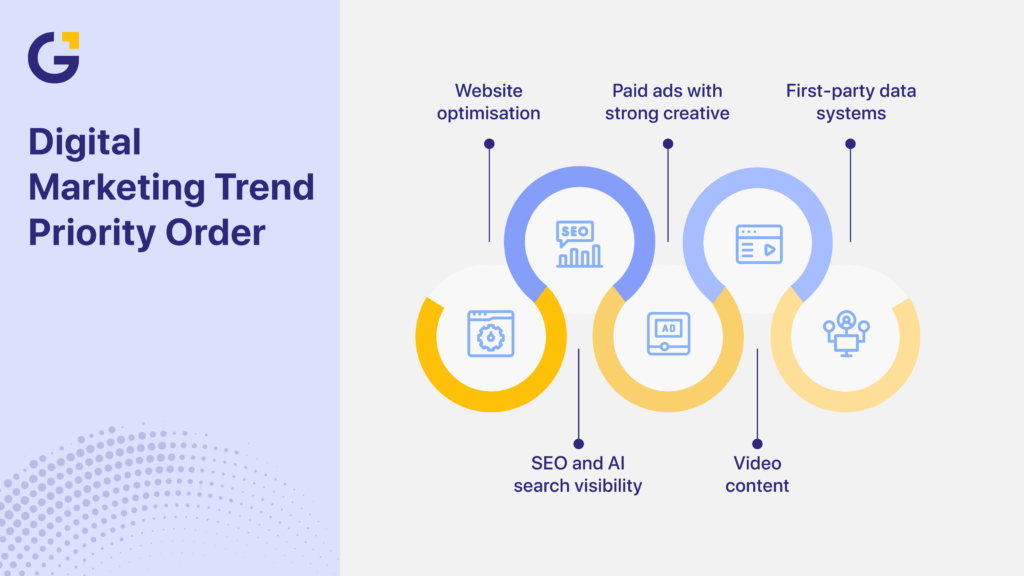
Australian SMEs with limited marketing budgets should prioritise Website Conversion Rate Optimisation (CRO) first, followed immediately by Generative Search Visibility (SEO & AEO).
Priority Execution Roadmap for Australian Businesses
- Step 1: Fix Website Conversion Friction (CRO & UX) – Ensure existing visitors can easily contact your business.
- Step 2: Optimise SEO & Schema for AI Search Visibility – Capture high-intent queries and search engine AI citations.
- Step 3: Upgrade Paid Ads Creative & Messaging Diversity – Scale lead volume with targeted advertisements.
- Step 4: Deploy Short-Form Video Content Strategy – Build visual brand discovery on TikTok and Instagram.
- Step 5: Build Automated First-Party CRM Workflows – Retain customers and maximise lifetime customer value.
Fixing conversion bottlenecks on your website ensures that every dollar spent on paid ads or organic search delivers maximum ROI. Increasing ad spend on a poorly converting website simply accelerates budget loss.
How Should Australian Businesses Adapt Their Strategy for 2026?
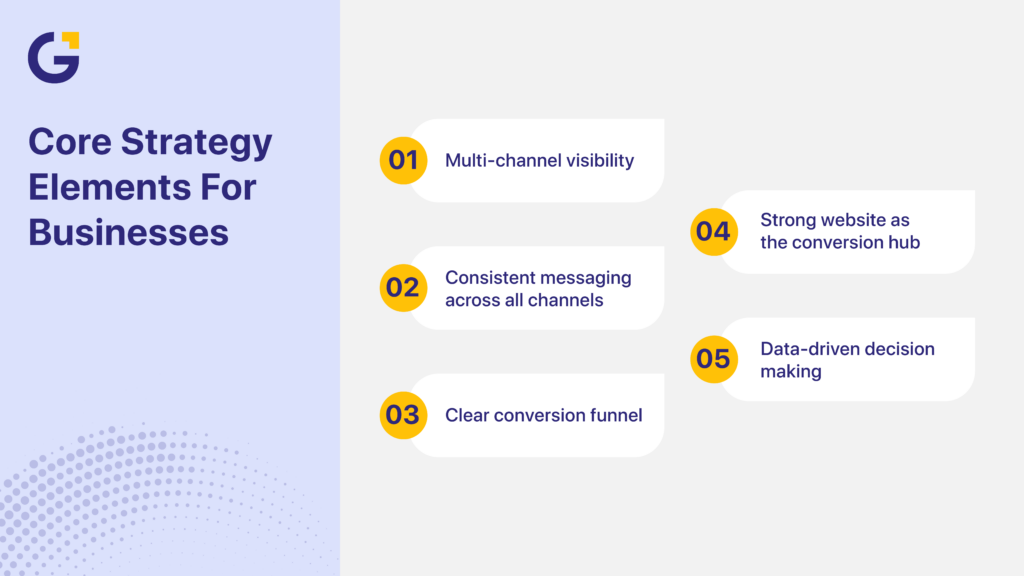
Adapting successfully to the 2026 landscape requires building an integrated, omnichannel marketing system. Isolated marketing tactics produce fragmented results, inconsistent messaging, and wasted budget.
| Journey Stage | Primary Channel Focus | Strategic Objective |
| Awareness | SEO, AI Search, TikTok & Reels Video | Get discovered by targeted prospective clients |
| Consideration | In-Depth Content, Retargeting Ads | Build brand trust and answer key objections |
| Conversion | Optimised Landing Pages, Dynamic Forms | Convert traffic into qualified inquiries and sales |
| Retention | Email Automation, CRM Nurture | Drive repeat orders and ongoing referrals |
Core Execution Checklist for Australian Business Owners
- Unify Channel Messaging: Ensure your brand’s unique value proposition, pricing terms, and promotional offers match across Google Ads, Meta Ads, social media profiles, and website pages.
- Optimise for Local Intent: Service-based businesses operating in specific Australian metropolitan areas (Sydney, Melbourne, Brisbane, Perth, Adelaide) must align location-specific landing pages with verified Google Business Profile listings.
- Audit Key Performance Indicators (KPIs): Transition from tracking vanity metrics (impressions, clicks, total site visits) to tracking revenue-focused metrics (Cost Per Lead, Cost Per Acquisition, Customer Lifetime Value).
How Genix Digital Helps Australian Businesses Grow in 2026
Navigating rapid shifts in digital marketing requires strategic clarity, technical expertise, and continuous optimisation. At Genix Digital, we help Australian businesses replace scattered tactics with predictable, high-performing marketing systems.
Our specialists deliver end-to-end strategy across:
- Generative SEO & AEO Strategy: Securing top organic rankings and AI overview citations.
- Performance Paid Advertising: Scaling ROI across Google Ads, Meta, and social commerce platforms.
- Conversion-Driven Web Design: Building fast, high-converting digital assets tailored to Australian consumers.
- Data-Driven Content Marketing: Creating high-quality content assets that establish category dominance.
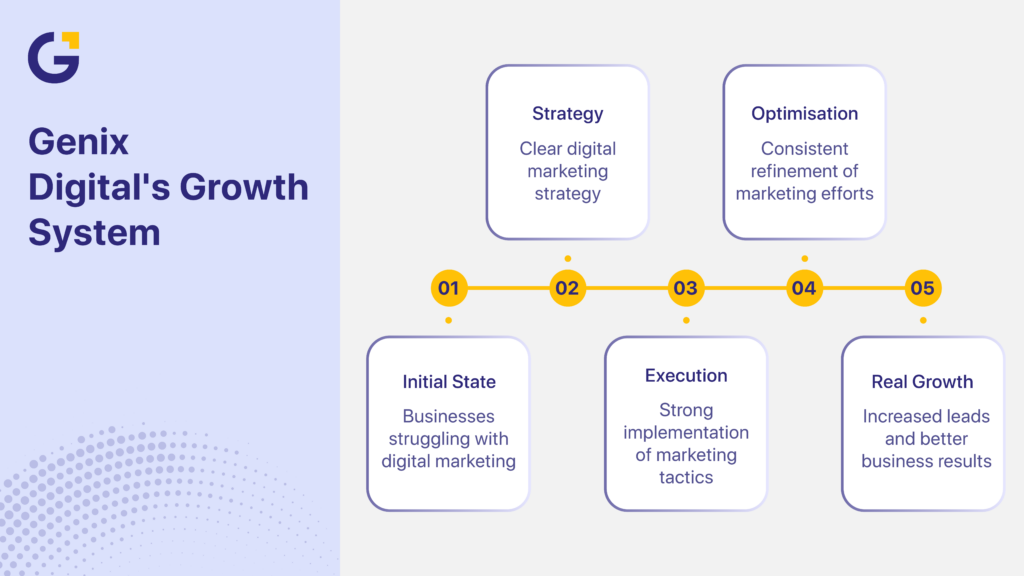
Ready to supercharge your digital marketing strategy for 2026? Book a Strategic Consultation with Genix Digital today to build your custom growth playbook.
Frequently Asked Questions
1-What are the top digital marketing trends in Australia for 2026?
The top digital marketing trends in Australia for 2026 include AI-driven search engine optimisation (AEO/GEO), zero-click search adaptations, short-form video discovery on TikTok and Reels, social commerce in-app purchases, and privacy-compliant first-party data strategies.
2-Which marketing channels are growing fastest in Australia in 2026?
The fastest-growing marketing channels in Australia include short-form vertical video platforms (TikTok, Instagram Reels, YouTube Shorts), generative search answer engines (Google AI Overviews, Perplexity), native social commerce channels, and retail media advertising networks.
3-What are the latest digital marketing strategies for Australian businesses this year?
The most effective strategy is implementing an integrated, omnichannel system that combines AI search visibility, high-converting website UX, multivariate paid ad creative testing, and automated CRM lead nurture workflows.
4-What are the top digital marketing tactics used by agencies in Australia?
Leading Australian agencies focus heavily on Conversion Rate Optimisation (CRO), implementing Schema markup for AI summaries, leveraging server-side tracking for privacy compliance, and creating direct messaging automated response funnels for paid ad traffic.
5-How is AI changing digital marketing in Australia?
AI automates repetitive execution tasks such as multivariate ad creative generation, predictive campaign bidding, and search intent analysis. However, overall marketing strategy, brand positioning, and authentic human video content remain firmly human-led to maintain local trust.
6-Why is short-form video important for Australian brands?
Short-form video aligns with modern mobile content consumption habits across Australia. It delivers higher organic reach than static social media posts and builds immediate trust with local buyers when featuring real team members and authentic customer solutions.
7-How do privacy changes affect Australian business marketing?
Amendments to the Australian Privacy Act and third-party cookie deprecation mean brands can no longer rely on broad web tracking. Businesses must collect direct first-party data via custom CRM workflows, server-side GA4 analytics, and opt-in email and SMS channels.
8-How are Australian digital marketing benchmarks changing in 2026?
Traditional website traffic metrics are declining due to zero-click search results. However, conversion rates and lead quality from optimised landing pages are increasing, making Cost Per Lead (CPL) and Customer Acquisition Cost (CAC) the primary benchmarks for measuring campaign success.




 23 Mar 2026
 8 Min Read