

What is paid advertising? It’s any marketing you pay for to appear in front of an audience in search results, social feeds, or video platforms instead of earning that visibility for free. For Australian small and medium businesses, it’s usually the fastest way to reach the right customer at the right moment. This guide covers what paid advertising is, how it works, what it costs in Australia, and how to start paid advertising step by step.
What Is Paid Advertising?
Paid advertising means paying to promote your business on digital platforms like Google, Facebook, LinkedIn or TikTok. Instead of waiting for organic traffic to build over months, you bid on ad placements, and your business appears in front of a targeted audience based on their location, interests or search intent, often within hours of launching a campaign.
This is the key difference from organic marketing like SEO: paid advertising buys visibility immediately, while organic visibility is earned over time and keeps working after you stop actively investing in it. Most businesses eventually use both; more on that trade-off further down this guide.
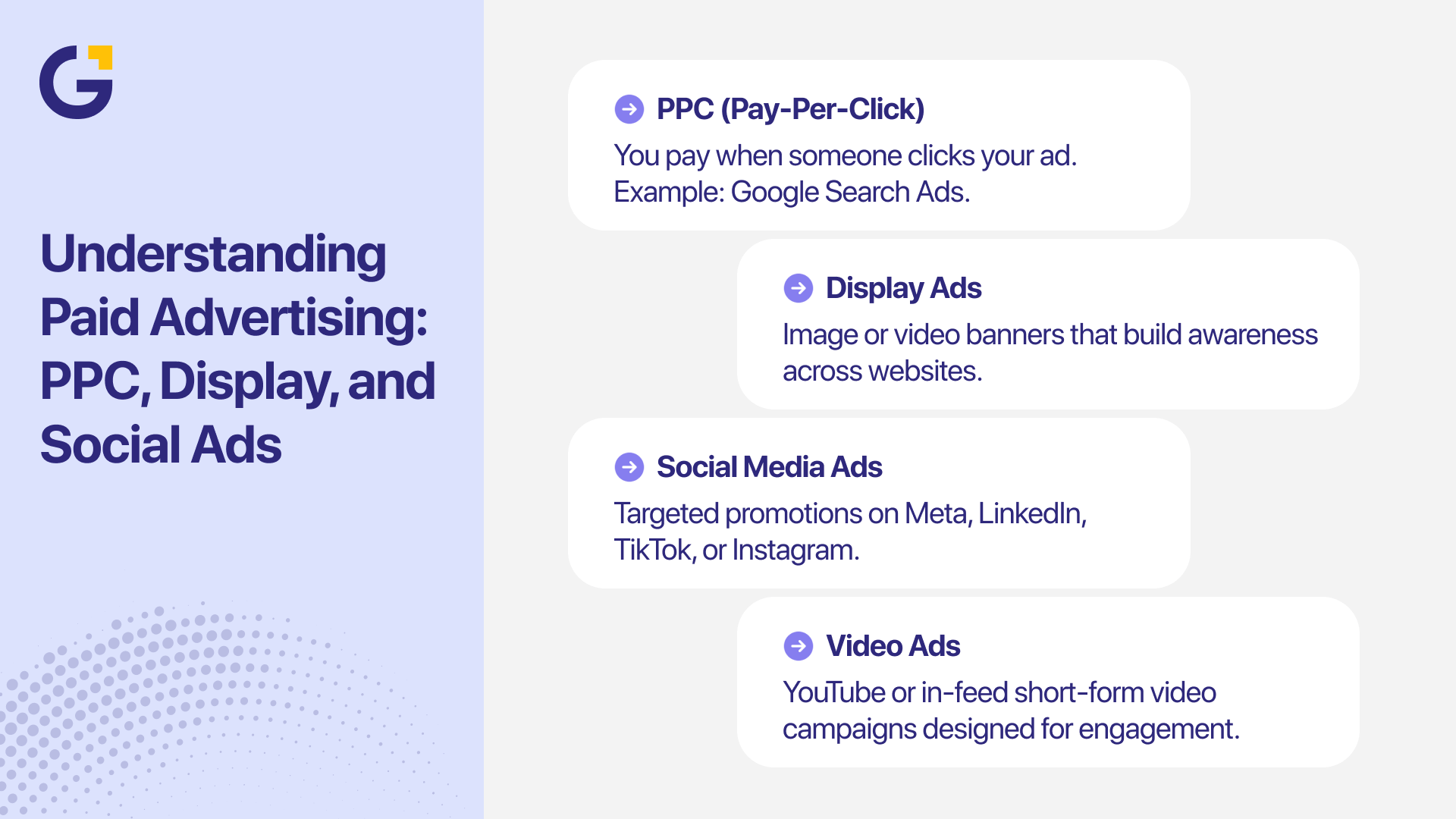
At a format level, paid advertising falls into four broad types:
- PPC (Pay-Per-Click): you pay only when someone clicks your ad, e.g. Google Search Ads.
- Display Ads: image or video banners that build awareness across websites.
- Social Media Ads: targeted promotions on Meta, LinkedIn, TikTok or Instagram.
- Video Ads: YouTube or in-feed short-form video campaigns built for engagement.
How Does Paid Advertising Work?
Behind the platform, every paid ad follows roughly the same path from advertiser to customer:
1. Advertiser sets up a campaign: choosing a goal, audience and budget.
2. Auction: when someone in your target audience is in the right context (a search, a scroll, a video), platforms like Google and Meta run a real-time auction among advertisers targeting that same person.
3. Ad placement: the winning ad (based on bid amount and ad quality/relevance, not just the highest bidder) is shown.
4. Click: the person clicks through to your website or landing page.
5. Landing page: they land on a page built to match what the ad promised.
6. Conversion: they take the action you wanted: a purchase, a form submission, a call, or a booking.
Understanding this chain matters because a weak link anywhere a broad audience, a low-quality ad, or a mismatched landing page can waste spend even if every other part of the campaign is done well.
How to Start Paid Advertising in 7 Steps|Quick Overview
If you’re wondering how to start paid advertising without wasting your first month’s budget, here’s the process in outline; each step is covered in more detail further down this guide.
- Define your goal: awareness, leads or sales
- Choose the right platform(s) for your audience
- Set your audience targeting
- Write and design your ad
- Work out your budget using the cost guide below
- Align your landing page with the ad
- Track performance and optimise weekly

Why Paid Advertising Still Works in 2026
Paid advertising remains a major growth channel in 2026, with global digital ad spend reaching US$790.35 billion in 2024 according to Statista’s Digital Advertising: Market Data & Analysis report, and forecast to grow to US$1.13 trillion by 2029. That growth is a strong signal that small and medium Australian businesses can still compete for attention on Google, Meta and TikTok, the same platforms larger competitors use without needing an enterprise-sized budget.
Benefits of Paid Advertising for Small and Medium Businesses in Australia
Paid advertising gives Australian SMEs a level playing field with larger competitors. You can start small, test campaigns, and scale up as results come in.
Top benefits include:
- Immediate visibility on search engines and social media
- Control over audience, budget and message
- Measurable performance through clicks, conversions and ROI
- Flexibility to pause, edit or A/B test in real time
As marketing expert Neil Patel often emphasises, the key to paid advertising isn’t about increasing your budget, but about spending strategically and meticulously tracking the results.
How Paid Ads Fit Into Your Marketing Funnel
Paid ads accelerate every stage of your customer journey.
| Funnel Stage | Campaign Example | Goal |
| Awareness | YouTube video ad | Introduce your brand |
| Consideration | Google Display ad | Show product value |
| Conversion | Search ad or remarketing | Drive sales or inquiries |
| Loyalty | CRM or email remarketing | Keep customers engaged |
At Genix Digital, campaigns are built to match these stages, driving awareness first, then guiding leads through conversion and loyalty. Loyalty-stage remarketing often overlaps with email marketing, so pairing paid ads with a structured email sequence can meaningfully lift repeat purchases. See our breakdown of how much email marketing costs in 2026 if you’re budgeting for both channels together.
Step 1: Setting Your Goals: Awareness, Leads, or Sales
Before spending a dollar on ads, it’s essential to define what success looks like for your campaign. Clear goals not only guide your targeting and creative choices but also make it easier to measure what’s working.
- Brand Awareness: Focus on impressions, reach, and engagement to get your business in front of new audiences, ideal for startups or new product launches.
- Lead Generation: Capture details from interested prospects through clicks, form submissions, or sign-ups a strong fit for service-based businesses like real estate agencies, law firms, or clinics.
- Sales: Measure tangible outcomes such as purchases, bookings, or return on ad spend (ROAS), the priority for e-commerce stores and local retailers tracking direct sales performance.
Each objective requires a slightly different ad setup, budget focus, and creative style. For instance, a real estate agency might aim for 100 qualified leads a month using Google Search Ads, while a local café chain might prioritise foot traffic tracked through Google Maps and local search campaigns.
Step 2: Which Paid Advertising Platform Should You Choose?
Each platform has its own strengths, audience behaviour and best use case. Rather than picking based on trends, start from your goal:
| Goal | Best Starting Platform | Why |
| Local leads | Google Search | High purchase intent — people are actively looking for your service |
| eCommerce | Google Shopping + Meta | Combines search intent with visual product discovery |
| B2B | Google + LinkedIn | Search captures active buyers; LinkedIn adds professional/role-based targeting |
| Brand awareness | Meta + YouTube | Wide reach with strong visual storytelling |
A quick rundown of each: Google Ads is best for intent-driven searches (e.g. “plumber near me”); Meta Ads (Facebook & Instagram) is ideal for brand storytelling and retargeting; LinkedIn Ads works well for B2B services and recruitment; TikTok Ads engages younger audiences with creative video; and YouTube Ads is excellent for visual storytelling and brand recall.
Pro tip: start with one platform that matches your goal from the table above. Our Google Ads, Meta Ads, Instagram Ads and LinkedIn Ads teams can help you decide, then expand once you have consistent performance data.
Step 3: Audience Targeting Basics: Demographics, Interests & Behaviour
The secret to effective ad targeting and conversion tracking lies in knowing exactly who your audience is and what motivates them. The more specific your targeting, the less money you waste showing ads to people who aren’t likely to convert.
• Demographics: age, gender, income level, location, or job title. A trades business in Sydney might focus on males aged 25–45 in specific suburbs, while a fitness studio might target women aged 18–35 within a 10km radius.
• Interests: hobbies, values, or topics people follow online; a café can target “coffee lovers” and “remote workers”, while an eco-product store might reach people interested in sustainability.
• Behaviours: how people act online, purchase history, device usage, or previous site visits; especially powerful for retargeting campaigns that remind past visitors to complete a purchase or booking.
Platforms like Meta Ads Manager and Google Ads use tracking tools (often called pixels or tags) to monitor user interactions after a click. Over time, this data helps you fine-tune targeting accuracy, a process known as conversion tracking.
Step 4: Crafting High-Converting Ad Copy and Creatives
Great ads tell a story in seconds:
- Hook early: start with a bold claim or question.
- Keep it simple: one message per ad.
- Use visuals that stop the scroll; people process images 60,000× faster than text.
- Add urgency: use time-limited offers or strong calls to action.
Example: “Get your free website audit today and discover how your competitors rank!”
Tools like Canva and Meta Creative Hub help non-designers create professional-looking ad creatives, but for video-led platforms like YouTube and TikTok, working with a dedicated video content team often lifts performance further.

Step 5: How Much Does Paid Advertising Cost in Australia?
Cost is usually the first real question once the basics make sense, and it deserves more than a flat “$30 a day” answer. Paid advertising is typically priced using one of three models:
• CPC (Cost Per Click): you pay per click, common on Google Search and Meta. Search Engine Journal reports the average CPC across all industries on Google and Microsoft Ads is around US$5.26, with higher-competition sectors like legal services averaging $8.58 and lower-cost categories like arts and entertainment around $1.60.
• CPM (Cost Per Mille / per 1,000 impressions) is common for awareness campaigns on Display, YouTube and Meta, where you’re paying for reach rather than clicks.
• CPA (Cost Per Acquisition) is what you pay per actual conversion (a lead or sale), which is really the number that matters most once a campaign is optimised.
What you should actually spend depends on a few Australia-specific factors: your industry’s competition level (legal, finance and home services generally cost more per click than niche retail), your target location (metro Sydney/Melbourne CPCs typically run higher than regional areas), and your customer value (a $3,000 average sale can justify a much higher cost-per-click than a $30 one).
A simple starting-budget formula
Decide how many leads or sales you want per month, divide by your landing page’s expected conversion rate to estimate the clicks you’ll need, then multiply by your industry’s average CPC. For example: if you want 20 leads a month, your landing page converts at 5%, and your industry’s average CPC is $3, you need roughly 400 clicks at $3 each; that’s around $1,200 a month before management fees.
If you’re just testing a new offer rather than solving for a lead target, a $30–$50 daily budget is a reasonable starting point to gather early data before committing to the formula above.
Step 6: Landing Page Alignment for Paid Campaigns
Even the best ad fails if your landing page doesn’t convert. Make sure your page:
- Loads in under 3 seconds
- Matches the ad’s promise (headline and offer)
- Includes a clear CTA (e.g. “Book a free consultation”)
- Works seamlessly on mobile
Small, easy-to-miss issues often do the most damage here. See our breakdown of website design mistakes that hurt credibility, and our mobile UX checklist for Sydney small businesses if most of your ad traffic arrives on a phone.
For example, if your ad promotes “Affordable SEO Packages“, your landing page should show pricing tiers and a simple form to request a quote.
Step 7: How to Know If Your Ads Are Working
Once a campaign is live, performance shows up as a chain of metrics, and it’s worth reading them in order, because a problem early in the chain explains most problems further down it:
- CTR (Click-Through Rate): Are enough of the right people clicking your ad? A low CTR usually means weak targeting or unappealing creative.
- CPC (Cost Per Click): How much is each click costing you? Rising CPC often signals more competition or a lower ad relevance score.
- CVR (Conversion Rate): Of the people who click, how many actually convert on your landing page? A good CTR with a poor CVR usually points to a landing page problem, not an ad problem.
- CPA (Cost Per Acquisition): How much did that conversion actually cost you?
- ROAS (Return on Ad Spend): For every dollar spent, how many dollars came back in revenue?
- Profit after ad spend, product cost and any agency or platform fees: is the campaign actually making the business money?
Use dashboards from Google Ads, Meta Ads Manager, or Looker Studio to track this chain or see our list of the best marketing automation tools in Australia if you want reporting and remarketing to run with less manual work.
Common Mistakes Beginners Make in Paid Advertising
- Skipping keyword research or using broad match too early.
- Ignoring ad testing; always compare two versions (A/B testing).
- Sending traffic to the homepage instead of a tailored landing page.
- Failing to track conversions with a proper setup.
- Stopping too early; most campaigns need 2–4 weeks to stabilise.
Avoiding these mistakes helps save money and improves campaign learning speed. For a deeper look at where budgets typically leak once a campaign is live, see our guide to Common PPC Mistakes Australian Businesses Make.
Paid Advertising vs SEO: Which Should You Choose?
This is one of the first questions most beginners actually have, and the honest answer is that they solve different problems:
| Paid Advertising | SEO | |
| Speed | Visibility within hours of launching | Usually takes months to build |
| Cost pattern | Pay for every click, stops when budget stops | Upfront investment, keeps working after |
| Control | Precise targeting, easy to test and change | Slower to adjust, less direct control |
| Best for | Immediate leads, sales, launches, promotions | Long-term, compounding organic traffic |
Most established businesses eventually run both: paid advertising for immediate, controllable demand, and SEO to reduce reliance on ad spend over time. If you’re only choosing one to start with, paid advertising usually makes sense when you need leads quickly or are testing a new offer; SEO makes more sense if you’re building toward long-term, lower-cost traffic and can wait a few months to see results.
Paid Advertising for Australian Businesses: What to Consider
A few things are genuinely different about running paid ads in the Australian market, rather than just following generic global advice:
- GST: budget in GST-inclusive terms when comparing quotes or setting a monthly cap, since ad platform invoices and agency fees are usually quoted plus GST.
- Advertising standards: claims in your ads still need to comply with Australian Consumer Law; avoid unverified “best in Australia” or guaranteed-results claims that could be considered misleading.
- Time zones: if you’re targeting both east coast and WA/SA audiences, schedule ads (and any live chat or phone follow-up) around the 1.5–3 hour gap so leads aren’t left waiting overnight.
- Platform habits: Google still dominates high-intent local search in Australia, Meta remains the broadest reach platform across age groups, and TikTok usage continues to grow fastest among under-35 Australian audiences, which is relevant when deciding where to start.
- Local landing pages: for businesses serving multiple cities or suburbs, ads that point to a location-specific landing page (rather than one generic page) typically convert better with an Australian audience used to seeing local details, trading hours, service area, and local reviews.
How Genix Digital Helps Businesses Launch & Optimise Paid Ads
Setting up a campaign is easy. Getting results takes experience. At Genix Digital, we combine strategy, creative design, and real-time optimisation. Our team manages:
- Keyword and audience research
- Ad design and copywriting
- Campaign setup and monitoring
- Monthly performance reports
- Conversion tracking and remarketing
Whether you’re a local retailer or a national eCommerce brand, we’ll help you turn clicks into clients without wasting budget. If you’re still deciding whether to hire an agency or build this in-house, our comparison of agency vs in-house marketing costs in Australia lays out the real numbers.

Starting Smart with Paid Advertising
Now that you know what paid advertising is, how it works, what it costs in Australia, and how to start paid advertising the right way, the next step is simple: pick one goal, one platform from the table above, and one clear offer, then test, track and refine using the metric chain covered earlier. Done strategically, paid advertising lets even small and medium Australian businesses compete with much bigger budgets.
At Genix Digital, we specialise in helping SMEs build data-driven paid advertising strategies that turn clicks into real clients. From keyword research and ad setup to performance tracking and conversion optimisation, our team makes sure every dollar you spend works harder. Book a free consultation today to discover how Genix Digital can help you launch, manage, and grow paid campaigns that deliver measurable ROI.
FAQs
What is paid advertising?
Paid advertising is a marketing method where businesses pay to display ads on search engines, websites, or social media platforms. It’s designed to reach specific audiences quickly and drive measurable results like traffic, leads, or sales.
How do I start paid advertising as a beginner?
Start by defining one clear goal awareness, leads, or sales then choose a single platform where your audience already spends time, set a modest test budget, and track performance weekly before scaling up. See the 7-step overview near the top of this guide for the full process.
How much does paid advertising cost in Australia?
It depends on your industry, location and customer value, but average CPCs on Google and Microsoft Ads sit around US$5.26, with higher-competition industries like legal services averaging $8.58 per click. Use the budget formula in this guide: target leads ÷ conversion rate × average CPC to estimate your own starting budget rather than relying on an industry average alone.
Is $10 a day enough for Google Ads?
A $10 daily budget can work for small, local campaigns or early testing phases. However, results depend on your industry’s cost-per-click (CPC), competition, and targeting strategy; higher-competition industries may require $20–$50 per day for meaningful traction.
Should I choose paid advertising or SEO first?
If you need leads quickly or are testing a new offer, start with paid advertising. If you’re building toward long-term, lower-cost traffic and can wait a few months for results, prioritise SEO. Most businesses eventually run both together.
Which platform should I start with as a beginner?
Match the platform to your goal: Google Search for local, high-intent leads; Google Shopping plus Meta for eCommerce; Google plus LinkedIn for B2B; and Meta plus YouTube for pure brand awareness. Starting with one platform that fits your goal beats spreading a small budget across several at once.





 24 Jul 2026
 7 Min Read