
If you’re running paid search campaigns and sending every click to your homepage, you could be quietly burning through your budget. Understanding the direct comparison between a homepage and a landing page is one of the most overlooked factors in Google Ads performance, and it has a direct impact on your cost per click, your Quality Score, and how many visitors actually convert.
Many Australian business owners assume their homepage is “good enough” because it looks professional and covers everything they offer. The problem is that Google Ads traffic doesn’t want “everything”; it wants a fast, relevant answer to the exact search that triggered the ad. When there’s a mismatch, you pay more for clicks that go nowhere.
This guide breaks down exactly where to send PPC traffic, when a homepage can work, and how to build a landing page for ads that’s engineered to convert.
Want to improve Google Ads performance? Genix Digital’s paid ads specialists can review your account and landing pages in a free consultation.
Why This Decision Affects Your Google Ads Performance
Every dollar in your Google Ads account is influenced by relevance. Google doesn’t just reward the highest bidder; it rewards the advertiser whose ad, keyword, and landing page all tell the same story.
This is the real weight behind the homepage vs. landing page decision. Choose wrong, and you’re not just missing conversions; you’re actively paying a premium for traffic that was never set up to convert in the first place.
As marketing author Seth Godin famously noted, web traffic rarely buys when presented with too many distractions; clarity and singular focus always win.
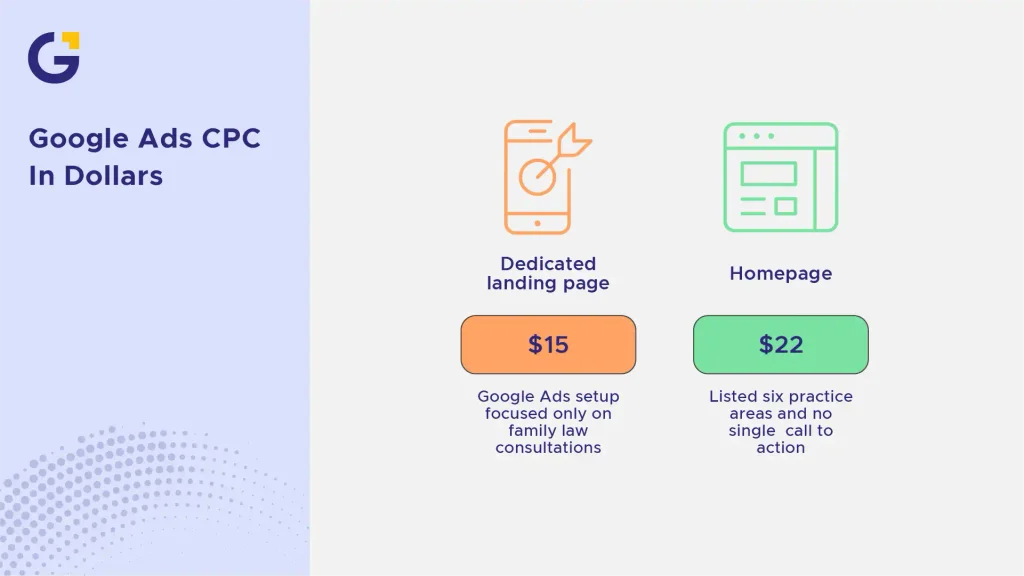
Example Case: A Melbourne-based law firm ran ads for “family lawyer consultation” but pointed all traffic to their homepage, which listed six practice areas and no single call to action.
- Their CPC averaged $22 with a 0.9% conversion rate.
- After building a dedicated landing page, Google Ads setup focused only on family law consultations, CPC dropped to $15, and conversions tripled.
What a Homepage Is Built to Do
A homepage exists to serve many different visitors at once: potential customers, existing clients, job applicants, and even competitors doing research. It’s designed for exploration, not for a single conversion goal.
Because of this broad purpose, homepages usually include full navigation menus, multiple CTAs, and general messaging about the whole business. That structure works well for organic visitors browsing your site, but it creates friction for someone who clicked a specific, intent-driven ad.
Example Case: A home renovation company’s homepage features sliders for kitchens, bathrooms, and extensions, plus a blog feed and newsletter signup.
- A visitor who clicked an ad for “bathroom renovation quotes Perth” lands here and has to hunt for relevant information.
- Most leave within seconds, which hurts both homepage conversion rate and Quality Score.
What a Dedicated Landing Page Is Built to Do
A dedicated landing page for Google Ads has one job: convert the visitor who clicked that specific ad for that specific offer. There’s no menu to wander through, no competing offers, and no reason to leave the page without taking action.
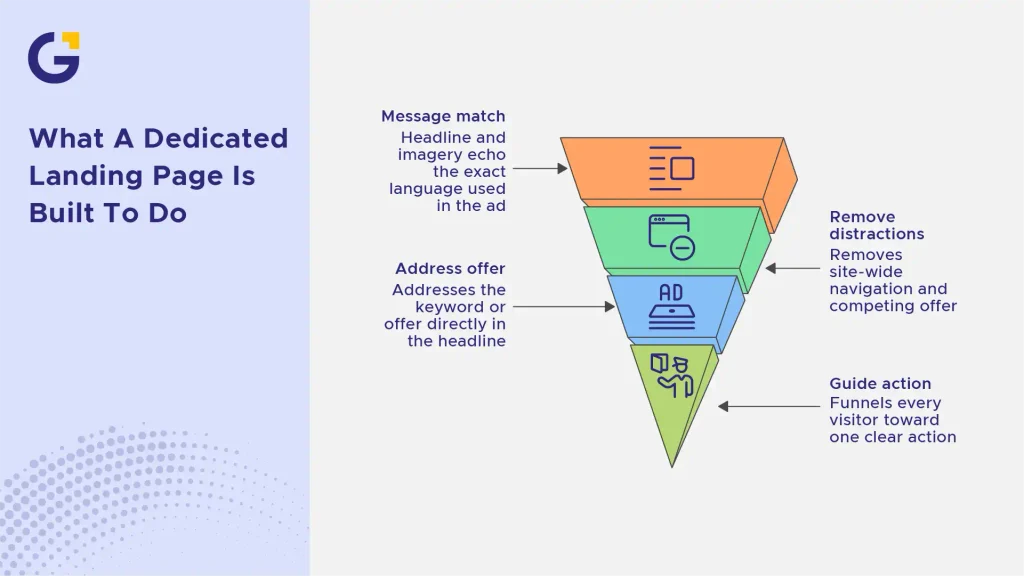
The strongest landing pages use message match: the headline and imagery on the page should echo the exact language used in the ad. This consistency builds trust instantly and is one of the most reliable landing page best practices used by high-performing PPC accounts.
A properly built landing page typically removes site-wide navigation, addresses the keyword or offer directly in the headline, and funnels every visitor toward one clear action: a form, a call, or a purchase. If you need help building high-impact assets, explore our specialised landing page design services to lift your campaign metrics.
How Landing Pages Affect Quality Score and CPC
Google Ads calculates Quality Score landing page metrics using three components: expected click-through rate, ad relevance, and landing page experience. That third factor is precisely where most homepages fail.
Google evaluates page load speed, mobile usability, and, most importantly, whether the page content is relevant and useful for the specific search query. A generic homepage rarely satisfies this, while a dedicated landing page built around the keyword almost always performs better. According to research by Unbounce, tailored landing pages consistently outperform general website pages in converting paid traffic.
Example Case: According to WordStream‘s PPC benchmark data, businesses using dedicated landing pages see average conversion rates of 2.35%, while homepage-driven traffic typically converts well below 1%. Ultimately, when evaluating a homepage vs. landing page for ad campaigns, a dedicated page ensures you lower cost per click and increase conversions from PPC.
When It’s OK to Send Traffic to the Homepage
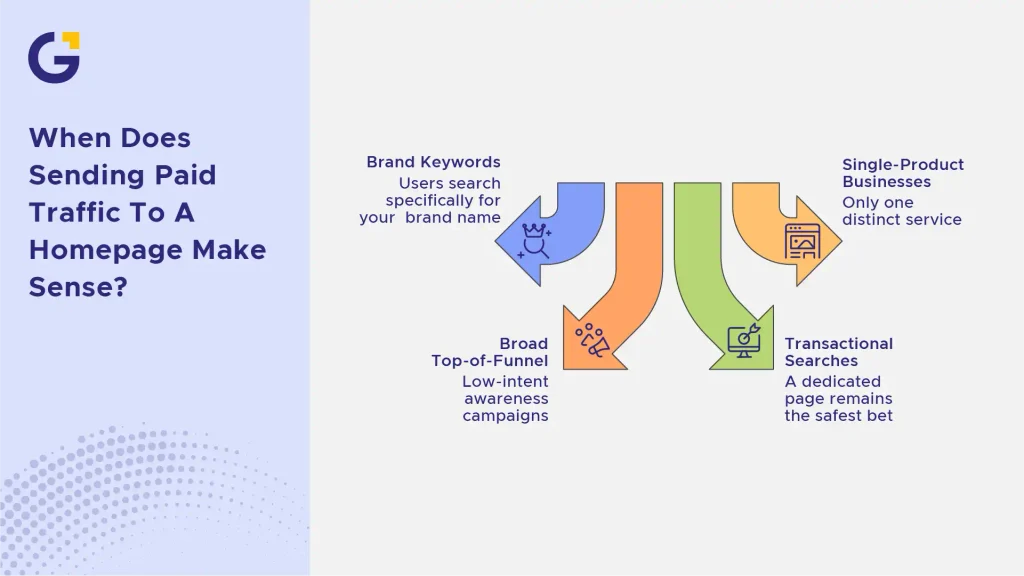
While dedicated landing pages are usually superior, there are specific scenarios where sending paid traffic to a homepage makes sense:
- Brand Keywords: When users search specifically for your brand name (e.g., “Genix Digital”), their intent is general. They want to learn who you are, browse your services, or contact you directly.
- Single-Product or Single-Service Businesses: If your company offers only one distinct service, your homepage may already function effectively as a dedicated sales funnel.
- Broad Top-of-Funnel Campaigns: When running low-intent awareness campaigns, visitors may prefer exploring your full brand story before making a decision.
However, for transactional searches, sticking to a dedicated page remains the safest bet. If you want to streamline your paid acquisition strategy, partner with our expert Google Ads management team.
Landing Page Structure That Actually Converts
To maximise your PPC ROI, your landing page requires a clear visual hierarchy and high-converting elements. Good PPC landing page design relies on these core components:
- Above the Fold Impact: A compelling headline matching your ad copy, a subheadline detailing your value proposition, and a prominent primary call to action (CTA).
- Clear Value Proposition: Bullet points highlighting key benefits rather than long walls of text.
- Trust Signals & Social Proof: Client testimonials, star ratings, certifications, and local case studies.
- Frictionless Lead Form: Keep form fields to a minimum to increase submission rates.
- Zero Navigation Distractions: Remove top navigation bars and footer links to keep visitors focused on one goal.
For a deeper dive into conversion optimisation strategies, check out our conversion rate optimisation guide.
Testing and Measuring Landing Page Performance
Optimising your ad landing pages isn’t a “set and forget” task. To continuously improve your conversion rate, you must measure key performance indicators and conduct regular split tests.
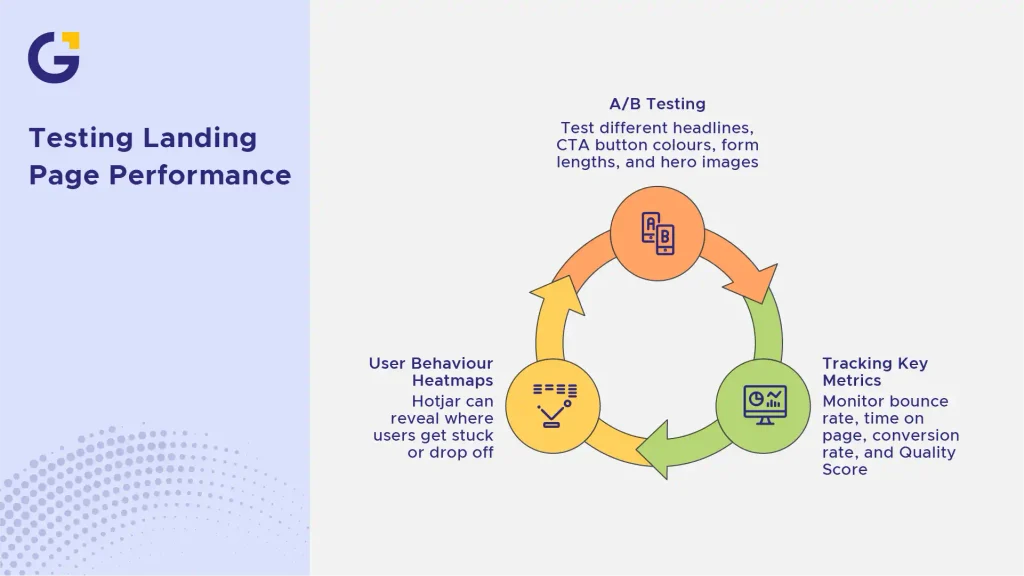
- A/B Testing: Test different headlines, CTA button colours, form lengths, and hero images to see what resonates best with your Australian audience.
- Tracking Key Metrics: Monitor bounce rate, time on page, conversion rate, and Quality Score directly inside Google Ads and GA4.
- User Behaviour Heatmaps: Tools like Hotjar can reveal where users get stuck or where they drop off on your page. Studies by Nielsen Norman Group emphasise that heatmaps are crucial for uncovering hidden user friction.
To ensure your paid search efforts align seamlessly with your broader organic strategy, review our guide on SEO vs Google Ads for Sydney Small Businesses: Which One Gives Faster ROI in 2026?
Frequently Asked Questions
1. Does Google Ads penalise sending traffic to a homepage?
Google doesn’t explicitly penalise homepages, but if your homepage lacks exact keyword relevance or loads slowly, your Quality Score will drop. A lower Quality Score results in higher ad costs and lower ad placements.
2. What makes a good landing page?
A good landing page features a clear headline aligned with the ad copy, a direct call to action, strong trust signals, fast loading times, mobile responsiveness, and zero navigation menus to distract the visitor.
3. Do landing pages improve Quality Score?
Yes. Because dedicated landing pages offer high ad relevance and focused content matching the searcher’s query, Google grants them higher Quality Score ratings, which directly reduces your CPC.
4. Should every campaign have its own landing page?
Ideally, yes. Each distinct ad group or target audience persona should land on a page tailored specifically to their search intent. Having tailored pages allows you to refine your message match and boost conversion rates across all campaigns.




 18 Mar 2026
 14 Min Read