


Many Sydney service businesses rank well close to their office but struggle to generate visibility in nearby suburbs where they regularly work. A plumber based in Parramatta may receive enquiries from Blacktown and Castle Hill, but rarely appears for searches in those locations. Likewise, an accountant in Chatswood may have clients across the North Shore while remaining difficult to find in neighbouring suburbs.
This happens because local SEO involves more than mentioning suburb names throughout a website. Google looks for evidence that a business genuinely serves a location and provides value to customers there. Service pages, Google Business Profile information, local proof, internal links, and website authority all contribute to that understanding.
For Sydney service businesses, successful local SEO starts with choosing the right suburbs to target rather than creating pages for every location on the map. This guide explains how to prioritise suburbs, decide when a dedicated suburb page is worthwhile, strengthen your service pages, and build location signals that support both organic search visibility and local enquiries.
Why Suburb-Level Visibility Matters for Service Businesses
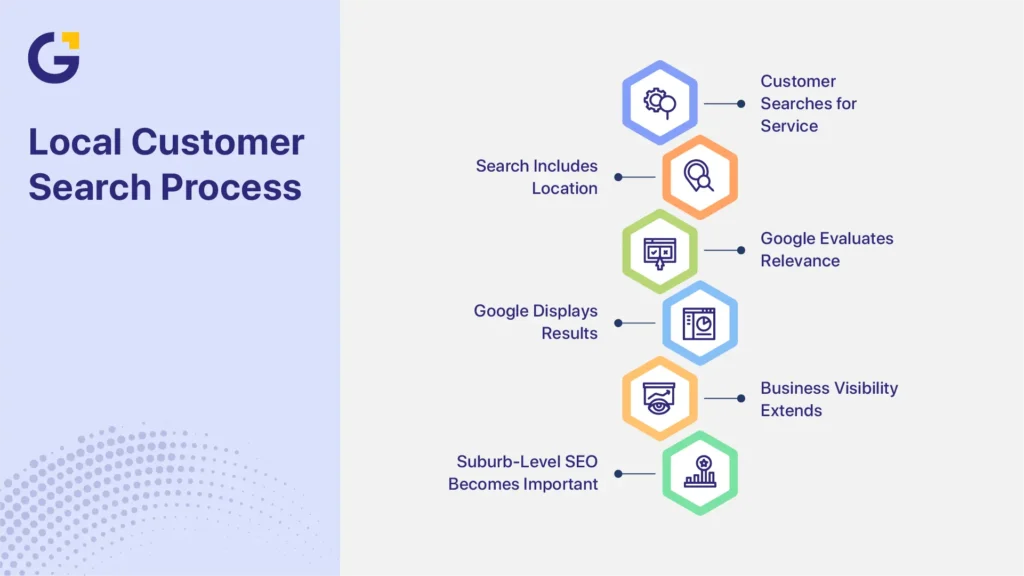
Most local customers search for businesses that can help them in a specific location. Rather than searching for a company name, they usually combine a service with a suburb or rely on Google’s location awareness.
Common examples include:
- Electrician Parramatta
- Accountant Liverpool
- IT support Chatswood
- Commercial cleaner North Sydney
- Emergency plumber near me
These searches tell Google that location is part of the user’s intent. Google then evaluates how relevant a business is to that service and location before deciding what to show.
For service-area businesses, visibility often extends well beyond one physical address. A landscaper may work across Western Sydney, a mobile physiotherapist may visit patients throughout the Inner West, while an IT consultant may support businesses across the Sydney CBD and North Shore.
Because of this, suburb-level SEO becomes an important part of attracting customers outside the immediate vicinity of your office.
Organic Visibility and Google Maps Are Not the Same
One of the biggest misconceptions in local SEO is that ranking well in Google’s organic results automatically leads to strong Google Maps visibility.
While the two support one another, they are driven by different signals.
| Organic Search | Google Maps / Local Pack |
| Website content | Business proximity |
| Service relevance | Google Business Profile |
| Internal linking | Relevance |
| Topical authority | Distance |
| Helpful content | Prominence |
For example, a well-written suburb page about plumbing services in Blacktown may rank organically for that search. However, if a searcher is located much closer to another plumbing business, Google’s Local Pack may still prioritise businesses nearer to the user’s location.
This distinction is important because suburb pages improve your website’s organic relevance, but they do not remove Google’s proximity limitations within Google Maps. Google’s own documentation confirms that local rankings are primarily influenced by Relevance, Distance, and Prominence, particularly for map results.
A strong local SEO strategy should therefore improve both your website and your Google Business Profile rather than relying on either one alone.
Different Types of Local Searches
Service businesses often appear across several types of local searches.
| Search Type | Example | Typical User Intent |
| Suburb search | Electrician Parramatta | Looking for a provider in one suburb |
| Area search | Roof repairs Western Sydney | Looking across several nearby suburbs |
| Near me search | Emergency plumber near me | Immediate assistance close to the searcher |
| Brand search | Genix Digital Sydney | Looking for a specific business |
Understanding these search patterns helps determine whether a suburb deserves its own page or should instead be included within a broader service-area page.
How to Choose Suburbs Without Creating Thin Pages
One of the most common mistakes in local SEO is assuming every suburb needs its own landing page.
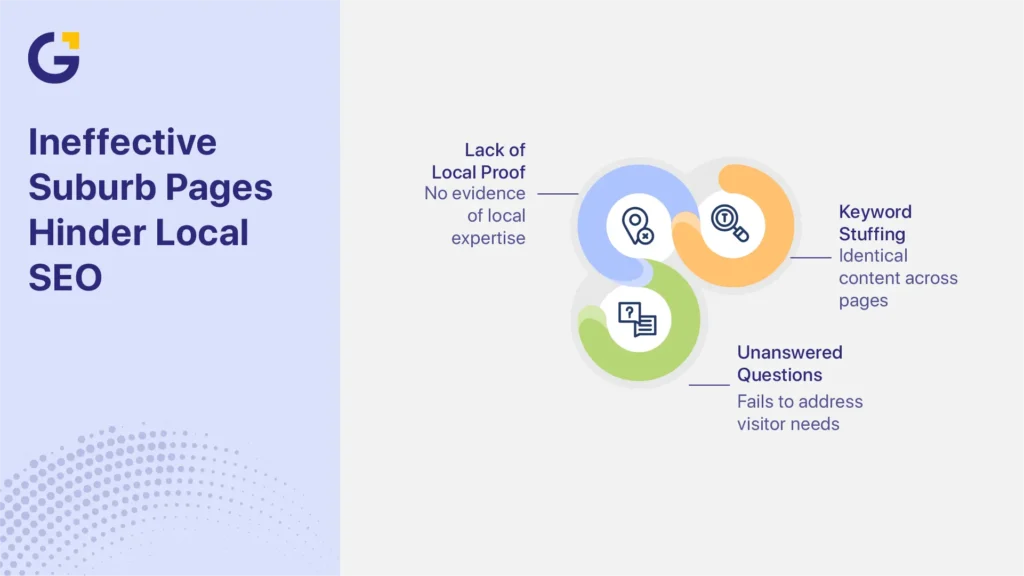
In reality, many suburb pages offer little value beyond replacing one suburb name with another. They contain the same service descriptions, identical headings, and generic calls to action with almost no information that helps local customers.
Google advises against creating doorway pages designed primarily to rank for multiple location variations without providing meaningful value to users. Instead, businesses should create location pages only when they can genuinely help customers understand the service offered in that area.
For most Sydney businesses, quality almost always outperforms quantity.
A Simple Framework for Prioritising Suburbs
Before investing time in a new suburb page, evaluate whether the suburb genuinely deserves dedicated content.
The following framework provides a practical starting point.
| Evaluation Factor | Questions to Ask |
| Search demand | Are people actively searching for your service in this suburb? |
| Service coverage | Do you already serve customers or complete projects in this suburb? |
| Travel time | Can you realistically provide services within your normal operating area? |
| Local proof | Do you have testimonials, photos, case studies or reviews from this suburb? |
| Competition | Can you realistically compete against existing local businesses? |
| Lead value | Does this suburb typically generate profitable enquiries? |
Score each suburb from 1 to 5 for search demand, service coverage, travel time, local proof, competition, and lead value. Add the scores together and prioritise the suburbs with the strongest totals, provided you can create useful and original content for each location.
Suburbs that score well across several of these factors are usually stronger candidates for dedicated landing pages.
If a suburb has very little search demand, no existing customer base, and no unique information to share, it is often better included within a broader service-area page.
This approach also helps prevent unnecessary content that competes with your own website.
Example: Consider a plumbing company based in Parramatta.
Rather than immediately creating pages for every suburb across Greater Sydney, it may prioritise:
- Parramatta
- Blacktown
- Castle Hill
- Merrylands
- Westmead
These suburbs may already generate enquiries, fall within normal travel times, and provide enough completed projects to support unique content.
Expanding gradually based on genuine business activity is usually more effective than launching dozens of nearly identical location pages.
Use Real Service Coverage, Not Keyword Lists
Many businesses still create suburb pages by inserting a location name into existing copy.
For example:
We provide plumbing services in Blacktown.
Our team also services Liverpool.
Penrith is another area we cover.
Although the suburb changes, the content remains identical.
This offers little additional value for customers and may make it difficult for Google to understand why separate pages exist.
Instead, each suburb page should explain how your service applies to that location.
Useful local proof may include:
- Completed projects
- Customer testimonials
- Case studies
- Before-and-after photographs
- Frequently requested services
- Local service considerations
- Travel or response time expectations
For example, a plumber servicing Parramatta may regularly assist apartment buildings, strata complexes, and older homes with ageing plumbing infrastructure. A commercial cleaning company servicing the Sydney CBD may discuss after-hours office cleaning, building access requirements, or compliance with commercial property management procedures.
These details make suburb pages genuinely useful rather than simply location-specific copies.
A strong suburb page should answer four basic questions:
- What service do you provide?
- Who is it designed for?
- Why is it relevant in this suburb?
- What should the visitor do next?
If the page cannot answer these questions with unique information, it probably does not need to exist.
Group Nearby Suburbs When Search Intent Is Similar
Dedicated suburb pages are not always necessary.
Many Sydney service businesses achieve better results by grouping suburbs with similar customer intent into one comprehensive service-area page.
Examples include:
- Western Sydney
- Inner West
- Northern Beaches
- Eastern Suburbs
- Hills District
- North Shore
Grouping locations works particularly well when:
- Customer needs are very similar.
- Search demand is relatively low.
- You do not yet have enough local proof for separate pages.
- Your service naturally covers multiple nearby suburbs.
Dedicated suburb pages generally make more sense when:
- Search demand is consistently strong.
- You have established customers in the suburb.
- The suburb has unique characteristics.
- You can provide genuinely original information.
| Better Approach | Poor Approach |
| Build pages around genuine service areas | Create pages only because a suburb has search volume |
| Include local proof where possible | Duplicate the same content across locations |
| Group nearby suburbs with similar intent | Create hundreds of nearly identical pages |
| Focus on customer needs | Focus only on keywords |
Should You Create a Service Page, Area Page or Suburb Page?
Choosing the correct page type is often more important than creating additional pages.
Use the following framework before publishing new location content.
| Situation | Recommended Page |
| One service offered across Sydney | Main service page |
| Multiple nearby suburbs with similar needs | Area page |
| Strong demand and genuine proof within one suburb | Dedicated suburb page |
| Limited local information available | Mention the suburb naturally on a broader page |
| Existing pages target the same service and location | Consolidate or improve the pages |
This is a guideline rather than a fixed rule. Search demand, competition, customer behaviour, and available local proof should all influence your decision.
Different industries may also approach suburb targeting differently.
| Business Type | Typical Strategy |
| Plumber or electrician | Multiple suburb pages supported by completed local projects |
| Commercial cleaner | Area pages covering major business districts and surrounding suburbs |
| Family lawyer | Focus on nearby suburbs around the office with strong local trust signals |
| B2B consultant | Fewer location pages supported by comprehensive service content |
| Mobile health provider | Area-based pages reflecting genuine travel coverage |
The goal is not to publish the highest number of suburb pages. The goal is to publish the pages that provide the greatest value to customers while accurately reflecting where your business operates.
What to Optimise on Your Main Service Pages
Strong service pages remain the foundation of local SEO.
Before expanding into suburb-specific content, your core service pages should clearly explain what you do, who you help, and where you provide those services.
Many businesses create dozens of location pages while neglecting the service pages that Google often considers the primary source of topical relevance.
A well-optimised service page should include:
- A clear explanation of the service.
- Common customer problems.
- The industries or customers served.
- Genuine service-area information.
- Reviews or testimonials where appropriate.
- Frequently asked questions.
- A clear call to action.
Rather than listing dozens of suburbs in one paragraph, naturally explain the regions you genuinely serve.
For example:
We provide commercial SEO services throughout Sydney, including businesses across the Inner West, North Shore, Western Sydney and surrounding metropolitan areas.
This approach reads naturally while reinforcing service coverage.
Internal linking also plays an important role.
Where appropriate, service pages should connect readers with more detailed resources. For example, businesses exploring suburb targeting strategies can learn more through local SEO support for Sydney service businesses, while broader discussions about search visibility can naturally reference a practical SEO strategy for service-area businesses.
Google Business Profile Signals That Support Local Visibility
Your website and your Google Business Profile (GBP) should work together to demonstrate where your business operates and the services it provides. While a well-optimised website strengthens organic search visibility, an accurate and complete Google Business Profile helps Google understand your business for local search and Google Maps.
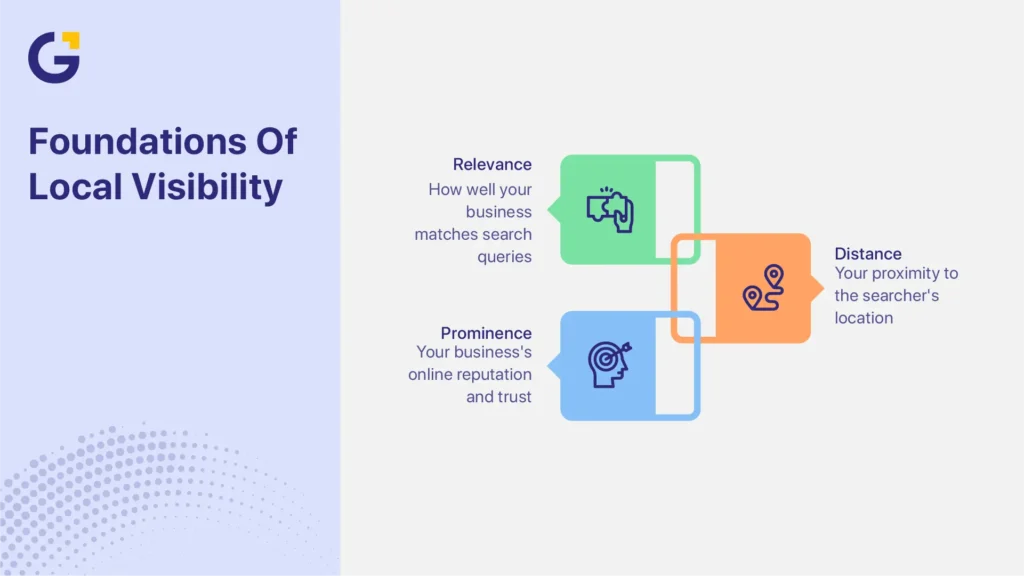
According to Google’s guidance, local rankings are primarily influenced by three factors:
- Relevance – How closely your business matches what someone is searching for.
- Distance – How close your business is to the searcher’s location or the location included in the search.
- Prominence – How well-known and trusted your business appears online.
These factors work together, meaning no single optimisation guarantees better rankings.
Google-Confirmed Local Ranking Concepts vs SEO Best Practices
It is helpful to distinguish between Google’s confirmed local ranking concepts and the broader SEO practices that support visibility over time.
| Google’s Confirmed Local Ranking Concepts | SEO Best Practices That Support Visibility |
| Relevance | High-quality service pages |
| Distance | Helpful local content |
| Prominence | Genuine customer reviews |
| Consistent business information (NAP) | |
| Local citations | |
| Authoritative backlinks | |
| Brand mentions | |
| Strong internal linking |
The second column supports trust and authority but should not be presented as direct ranking factors. Instead, they help reinforce your business’s overall online presence and make it easier for Google to understand and trust your website.
Optimising Google Business Profile for Service-Area Businesses
For businesses that travel to customers, Google provides specific guidance on setting up a service-area business.
Best practices include:
- Use a single Google Business Profile for your genuine business location.
- Do not create profiles for virtual offices, coworking spaces, or locations where your business is not permanently staffed.
- Only list service areas that you genuinely serve.
- Hide your business address if customers do not visit your premises.
- Select the most appropriate primary business category and relevant secondary categories.
- Keep your opening hours, phone number, website, and services up to date.
- Upload recent photos that accurately represent your work.
Following these guidelines helps maintain an accurate Business Profile and reduces the risk of violating Google’s policies for local businesses.
Reviews Build Trust More Than Rankings
Customer reviews are one of the strongest trust signals for both potential customers and search engines.
Helpful reviews often describe:
- The service provided.
- The customer’s experience.
- Communication throughout the project.
- The final outcome.
- The suburb or service area, where it occurs naturally.
For example:
“Genix Digital helped improve our local SEO strategy for our plumbing business across Parramatta and Blacktown. Their recommendations made it much easier for customers in those suburbs to find us.”
Businesses should encourage genuine customer feedback as part of their normal customer service process rather than trying to generate large bursts of keyword-rich reviews.
Google has not confirmed review velocity as a direct ranking factor. Instead, maintaining a consistent stream of authentic reviews and responding professionally to customer feedback helps demonstrate that your business remains active and engaged.
Support Your Website with LocalBusiness Schema
Structured data can help search engines better interpret the information already visible on your website.
For local businesses, the LocalBusiness schema may include:
- Business name
- Contact information
- Opening hours
- Business type
- Service areas
- Website URL
However, the schema should always match the visible content on your website. It should not be used to create misleading location signals or mark up reviews that your business controls, as this conflicts with Google’s structured data guidelines.
Schema is helpful because it improves Google’s understanding of your business information, but it does not replace a complete Google Business Profile or directly improve local rankings.
Internal Links, Reviews and Proof by Suburb
Creating suburb pages is only part of a successful local SEO strategy. Those pages also need to connect naturally with the rest of your website.
Internal links help search engines understand how your content relates while helping visitors move between useful resources.
Rather than following a rigid hierarchy, your pages should link wherever additional information genuinely benefits the user.
For example:
- A service page can link to relevant suburb pages.
- A suburb page can link back to the main service page.
- A case study can support both the suburb page and the service page.
- Blog articles can provide supporting information and direct visitors to relevant services.
This creates a stronger content network than relying on one fixed navigation path.
Use Local Proof Instead of Long Location Lists
Long suburb lists rarely help customers decide whether a business is right for them. Local proof is more useful because it shows genuine experience in the area.
Relevant proof may include:
- Customer testimonials
- Completed project photos
- Local case studies
- Common service requests in the area
For example, a Sydney CBD cleaning company could highlight after-hours office cleaning and building access requirements. A Parramatta law firm could explain consultation options and common questions from local clients.
Use specific evidence where available instead of repeating suburb names without context.
Simple Local SEO Checklist Before You Publish
Before publishing any suburb or service-area page, review the following checklist.
Content
- Does the page explain the service clearly?
- Does it provide unique information?
- Does it answer local customer questions?
- Does it avoid duplicate content?
Local Relevance
- Does the page accurately describe where you work?
- Have you included genuine local proof?
- Is the suburb relevant to your normal service area?
Google Business Profile
- Are your business details accurate?
- Are your service areas correctly configured?
- Are your business categories appropriate?
- Are customer reviews monitored and responded to?
User Experience
- Is there a clear call to action?
- Can visitors easily contact you?
- Is important information easy to find?
Tracking
Measure more than rankings.
For service-area businesses, useful metrics include:
- Phone calls
- Contact form submissions
- Quote requests
- Booking requests
- Website visits from Google Business Profile
- Organic enquiries by suburb
For storefront or hybrid businesses, you can also monitor:
- Direction requests
- Navigation clicks
- In-store visits, where available
Adding UTM parameters to your Google Business Profile website link also makes it easier to distinguish Google Business Profile traffic from other organic website visits.
The Service + Area + Proof + Action Framework
Before publishing any suburb page, ask four simple questions.
| Question | Purpose |
| Service | What service do you provide? |
| Area | Where do you genuinely provide it? |
| Proof | Why should customers trust you in this location? |
| Action | What should the visitor do next? |
If every page answers these four questions clearly, it is far more likely to support both customer enquiries and long-term local visibility.
Conclusion
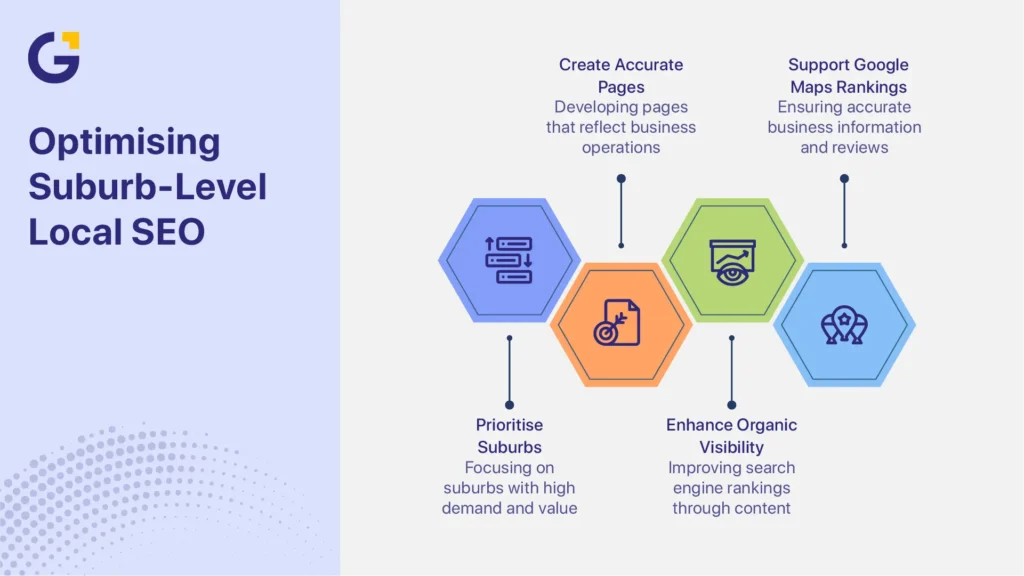
Suburb-level local SEO is not about creating as many location pages as possible. It is about building pages that accurately reflect where your business operates and provide useful information for potential customers.
By prioritising suburbs based on genuine service coverage, customer demand, local proof, and business value, Sydney service businesses can create stronger location pages without relying on thin or repetitive content.
It is also important to understand the difference between organic search visibility and Google Maps rankings. Strong suburb pages can improve organic relevance, while an accurate Google Business Profile, genuine reviews, and consistent business information support local visibility within Google’s broader ranking systems.
If you’re looking for expert guidance on improving suburb visibility and generating more qualified local enquiries, Genix Digital can help you build a practical local SEO strategy tailored to your business, service areas, and growth goals.
Frequently Asked Questions
How many suburb pages should a Sydney service business create?
There is no fixed number. Start with suburbs where you have genuine service coverage, local proof, and meaningful customer demand. A few strong pages usually outperform dozens of weak pages.
Can a service business rank in the suburbs without an office there?
Yes. Service-area businesses can rank in suburbs they genuinely serve through strong service pages, local proof, reviews, and Google Business Profile optimisation. However, proximity can still affect map-pack visibility.
What is the difference between a service page and a subpage landing page?
A service page focuses on the service itself, while a suburb page explains how that service applies to a specific location. Suburb pages should provide unique value beyond changing the suburb name.
How do I know if my suburb pages are too thin?
Pages may be too thin if they repeat content, provide no local proof, and exist mainly to target keywords. Useful suburb pages should answer local customer questions and provide relevant evidence.
Do service-area businesses need an address to rank?
Not necessarily. Google allows service-area businesses to hide their address and specify service areas instead. Rankings depend on many factors beyond the displayed address.
What should I track from local SEO campaigns?
Track calls, form submissions, quote requests, booking clicks, Google Business Profile actions, direction requests, and suburb-level enquiry sources. These metrics provide a clearer picture of business impact than rankings alone.





 1 Apr 2026
 15 Min Read