
Sydney businesses can improve their chances of appearing in Google AI Overviews and AI Mode by making their pages accessible to Google, publishing genuinely useful content, and building a trustworthy online presence. No business can force Google to cite a page in an AI-generated answer, but there are practical steps that can improve eligibility, clarity, and visibility.
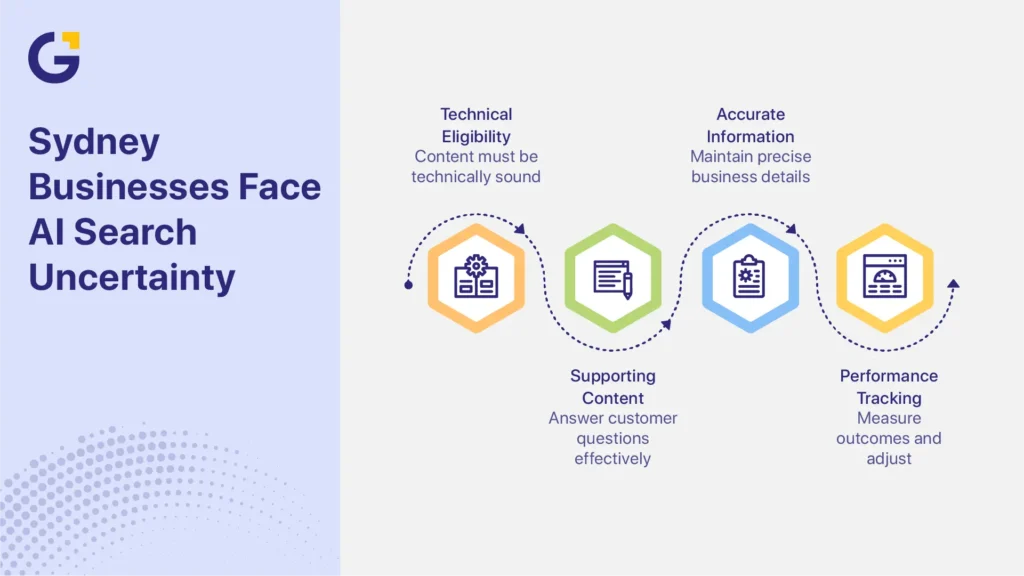
If you run a Sydney business, focus on the things you can control: technical SEO, helpful supporting content, accurate business information, and performance measurement. These foundations support both traditional search visibility and AI-powered search experiences.
What to Do First
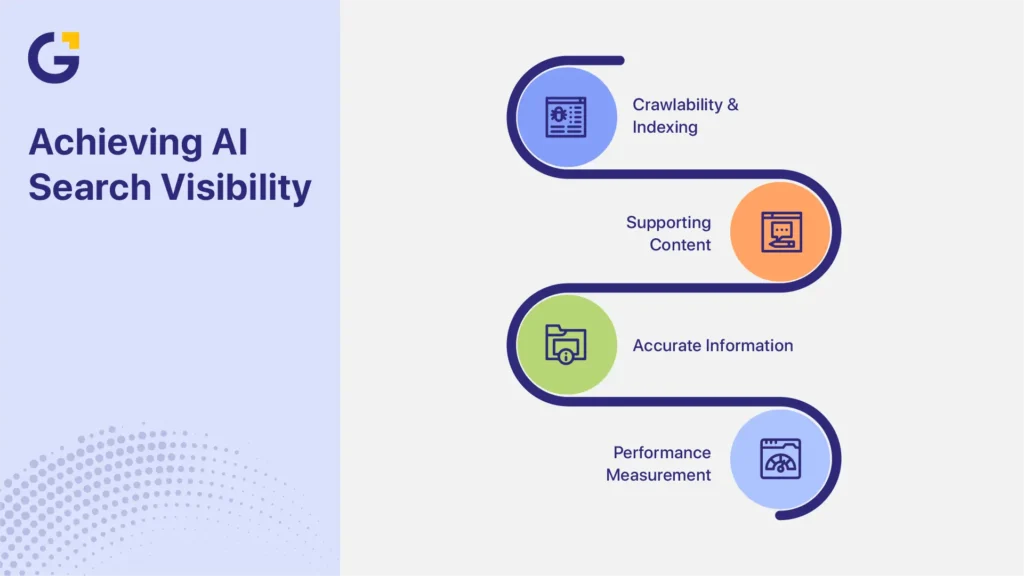
Before investing time in AI-focused content, work through these priorities in order:
- Confirm your important pages are crawlable and indexed.
- Create useful supporting content around customer questions.
- Keep business information accurate across your website and major platforms.
- Measure performance using Google Search Console before making further changes.
Many Sydney businesses start publishing AI-related content before checking whether Google can even access or index their most important service pages. Technical eligibility should come first because AI search visibility depends on pages that Google can discover, understand, and show in Search.
What Google AI Overviews Actually Use
Google AI Overviews and AI Mode use information from Google’s existing search systems. Business owners can review Google’s AI features documentation to understand how AI experiences in Search use standard search systems rather than a separate AI-only submission process.
Google may use multiple sources to answer a query. Instead of relying on one webpage, Google’s systems can retrieve information from several pages that help answer different parts of the user’s question.
This is why Sydney businesses should not focus only on ranking one broad service page. Supporting content that answers related customer questions can create additional opportunities for Google AI Overviews and AI Mode to understand what the business does.
For historical context, Google AI Overviews evolved from earlier experiments such as Search Generative Experience. Businesses that want background on that earlier system can read Genix Digital’s Google SGE optimisation guide for Australia, but this article focuses on today’s Google AI Overviews and AI Mode.
Search Index and Supporting Links
Google AI Overviews pull information from content that is already available through Google’s search systems. If a page cannot be crawled, indexed, or displayed in Search, Google is unlikely to use it as a supporting source.
Supporting links serve an important role. They allow users to verify information, compare options, and explore a topic further. A page does not need to rank first for a broad keyword to contribute useful information, but strong organic visibility remains beneficial because it can support relevance, trust, and discoverability.
The practical takeaway for Sydney businesses is simple: create pages that answer specific customer questions clearly and completely rather than trying to force every topic onto one service page.
Query Fan-Out
Google’s AI optimisation guide explains that AI-powered search experiences may expand a user’s query into related searches and subtopics. This is often called query fan-out SEO.
For example, a search such as “best commercial electrician Sydney” may lead Google to explore related questions such as:
- electrical compliance requirements
- Level 2 electrician services
- emergency call-out availability
- switchboard upgrade costs
- commercial electrical maintenance plans
A Sydney electrical business with helpful content on these topics gives Google more information to work with than a website that only has one generic service page.
The same applies to professional services. A Sydney accounting firm targeting “small business accountant Sydney” may benefit from supporting content around BAS lodgement costs, payroll setup, Xero bookkeeping, and business structure decisions.
An eCommerce business selling fitness equipment in Australia may create comparison content around home gym setups, equipment costs, delivery considerations, and product selection guides.
This approach supports a stronger AI search content strategy because it helps Google understand the broader expertise behind a local business.
Why There Is No AI-Only Hack
Many new terms have emerged over the past few years, including AI SEO, AI Overview optimisation, generative AI search optimisation, entity SEO, AEO, and GEO. These terms can be useful, but they should not distract businesses from the main goal: becoming a useful and trustworthy source.
| Approach | Main Focus |
| SEO | Technical accessibility, relevance, and authority |
| AI SEO | Applying SEO principles to AI-powered search experiences |
| AEO | Making answers easier to extract and understand |
| GEO | Improving visibility within generative search environments |
These approaches overlap significantly. Businesses that want a deeper breakdown can read Genix Digital’s guide to SEO, AEO and GEO in 2026.
Google has not introduced special AI-only schema, AI files, or hidden optimisation techniques that guarantee inclusion in AI Overviews or AI Mode. Structured data can help Google understand visible page content, but it should accurately describe information that already exists on the page.
Businesses should be cautious of any provider promising guaranteed AI citations or guaranteed placement inside Google AI Overviews. The realistic goal is to become a useful, trustworthy source that Google’s systems can retrieve when answering relevant questions.
Eligibility Basics Before Chasing AI Mentions
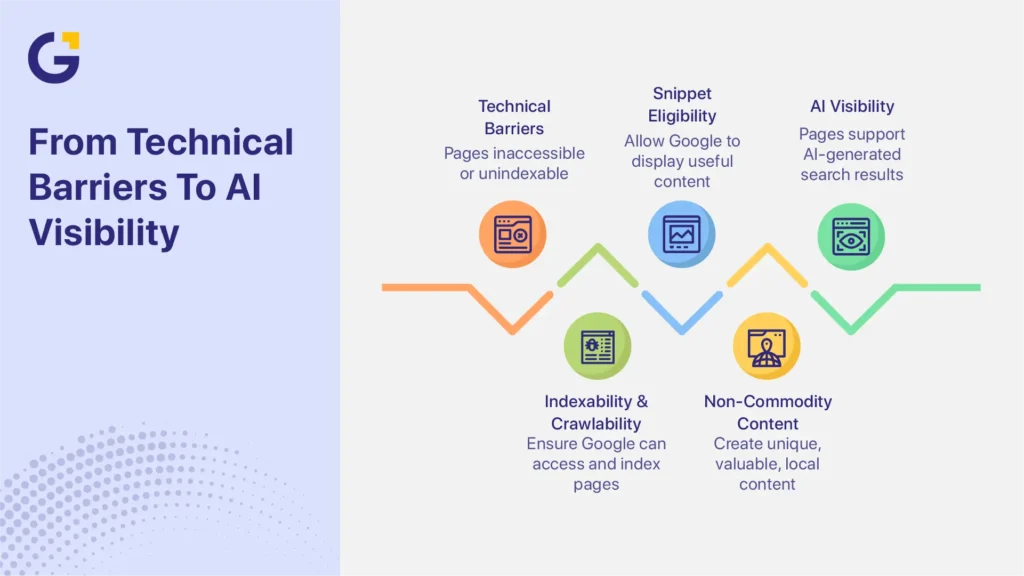
Many businesses invest heavily in content creation before confirming whether Google can properly access their pages. Before building an AI search visibility strategy, confirm that your important pages are technically eligible to appear in Search.
Businesses looking to strengthen technical SEO, content marketing, local SEO, and indexing foundations can review Genix Digital’s SEO services.
Indexability and Crawlability
Crawlability refers to Google’s ability to access a page. Indexability refers to Google’s ability to include that page within its search index. Both are required before a page can realistically contribute to Google AI Overviews or AI Mode. Google’s SEO Starter Guide explains the basic SEO foundations businesses should understand, including how Google discovers, crawls, and evaluates pages.
Start with:
- URL Inspection in Google Search Console
- robots.txt review
- noindex checks
- canonical tag review
- XML sitemap validation
- internal linking review
- JavaScript rendering checks
One of the most common issues we see during website audits is not poor content quality but technical barriers left behind after redesigns or migrations. A strong service page may still struggle if Google receives mixed signals from noindex tags, incorrect canonicals, weak internal links, or blocked resources.
First-Party Observation: Sydney SME Website Audits
Across multiple audits of Sydney small business websites completed over the past year, one recurring issue has been service pages that are technically accessible but isolated from the rest of the website.
In several cases, important service pages had very few internal links pointing to them, while supporting educational content was either missing or disconnected from commercial pages.
After strengthening internal linking and adding supporting content around customer questions, these businesses often saw stronger organic visibility across both informational and commercial searches.
This observation is based on internal audit work rather than a formal industry study, but it highlights a common issue affecting many Sydney SME websites: Google may be able to access a page, but the site structure may not clearly show how that page connects to customer questions, service expertise, and local relevance.
Snippet Eligibility
Google’s AI features rely on content that can be displayed and referenced within Search. Certain controls may restrict Google’s ability to use content, including nosnippet directives, restrictive max-snippet settings, and excessive use of data-nosnippet.
Google explains these controls in its snippet documentation, which is useful to review before rewriting a page that already appears to be indexed.
| Requirement | Why It Matters |
| Crawlability | Google must access the page |
| Indexability | Google must be able to include the page in Search |
| Snippet eligibility | Google must be allowed to display useful content from the page |
All three conditions need to be met before a page can realistically become a supporting source within AI-generated search experiences.
Helpful Non-Commodity Content
One of the strongest opportunities for Sydney businesses is creating content that competitors cannot easily duplicate.
Many websites publish generic articles that repeat the same advice already available elsewhere. Google’s people-first content guidance encourages content that is useful, reliable, and created to help people rather than only to attract search traffic.
Non-commodity content includes:
- first-party observations
- local expertise
- original research
- customer insights
- documented case studies
- practical implementation examples
A useful test is simple: if you remove the business name and location from the article, would the content still look identical to dozens of competing websites?
If the answer is yes, the content probably adds very little information gain.
The strongest pages often include real-world examples, clear recommendations, trade-offs, limitations, and lessons learned from actual client work rather than generic summaries of information already available elsewhere.
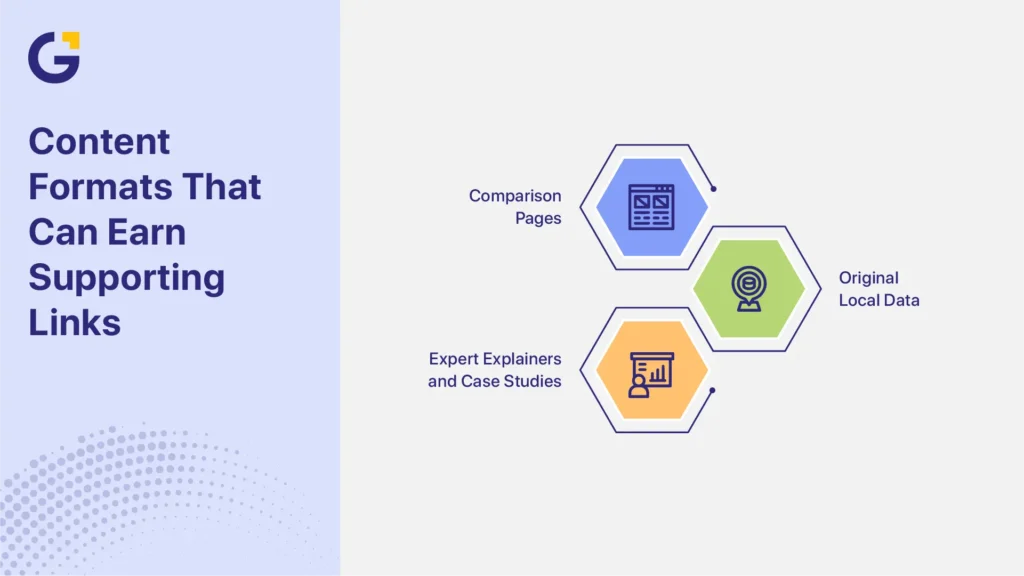
Content Formats That Can Earn Supporting Links
Google AI Overviews often pull information from pages that answer specific questions clearly and directly. For Sydney businesses, that usually means creating supporting content around the questions customers ask before making a decision.
Instead of publishing multiple articles targeting slight keyword variations, focus on content that helps people compare options, understand costs, evaluate eligibility, and make buying decisions.
Comparison Pages
Comparison content works well because it mirrors how customers research products and services before contacting a business.
Examples include:
- Local SEO vs Google Ads
- In-house marketing vs agency support
- Shopify vs WooCommerce
- Renovation vs knockdown rebuild
- Ducted air conditioning vs split systems
- Xero vs MYOB for small business accounting
A Sydney homeowner researching “ducted vs split system air conditioning” is much closer to making a purchase decision than someone searching for general information about air conditioning systems. Likewise, a Sydney business owner comparing Xero and MYOB is already evaluating solutions rather than simply gathering background information.
Good comparison content should explain:
- which option suits each type of customer
- the benefits of each choice
- the limitations of each choice
- the decision factors that matter most
The goal is not to force one option as the winner. The goal is to help users make an informed decision.
Original Local Data
Sydney-specific information is often more useful than generic advice because it reflects local conditions, customer behaviour, and business realities.
Potential sources include:
- Search Console query trends
- customer surveys
- anonymised website audits
- campaign performance data
- service enquiries
- local search behaviour observations
For example, a Sydney trade business might analyse which questions customers ask most frequently before requesting a quote. An accounting firm may identify recurring tax questions from small business owners. An eCommerce retailer may discover that product comparison searches consistently drive higher-quality traffic than broad product keywords.
When using local data, explain the source, timeframe, and limitations. Internal observations should be presented as observations rather than industry-wide conclusions.
Expert Explainers and Case Studies
Case studies often provide information that generic content cannot.
A useful case study should explain:
- the starting problem
- the constraints involved
- the process followed
- the decisions made
- the results achieved
- lessons learned along the way
For example, a Sydney builder could document how council approval requirements affected a renovation timeline. A financial adviser could explain how a client evaluated different investment options based on risk tolerance and long-term goals. An eCommerce retailer could show how comparison content generated more qualified traffic than generic category pages.
These examples often provide the context and decision-making detail that users find valuable when researching a topic.
Off-Site Signals That Support Credibility
Google’s systems attempt to understand whether a business is legitimate, relevant, and trustworthy. Information from outside your own website can help users verify who you are, what services you provide, and where you operate.
The goal is not to collect mentions simply because they exist. The goal is to make it easier for users to confirm that a business is real, experienced, and active within its industry.
Legitimate Mentions
Useful mentions may come from:
- industry publications
- business associations
- local chambers of commerce
- supplier websites
- event pages
- podcasts
- industry interviews
- relevant PR mentions
- expert quotes
The value comes from relevance and credibility rather than the mention itself.
For example, a Sydney accounting firm featured in a respected accounting publication provides stronger validation than dozens of unrelated directory listings. Similarly, a Sydney electrician referenced by an industry association provides more context than low-quality link placements created solely for SEO purposes.
These mentions can strengthen brand trust and help users verify a business, but they should not be viewed as guaranteed AI Overview ranking factors.
Reviews and Profiles
Reviews and business profiles can help users verify that a business serves real customers and operates in a specific location.
However, reviews should not be treated as direct Google AI Overview ranking factors.
Instead, think of reviews as customer proof. Accurate profiles and authentic customer feedback may help reinforce trust when users compare multiple businesses during their research process.
Keep information consistent across:
- Google Business Profile
- major industry directories
- social profiles
- business listings
- review platforms
Consistency makes it easier for customers and search engines to understand the business.
Local Business Details
Accurate local business information remains important for Sydney businesses.
Before creating additional listings, confirm that existing information is correct across your website and major platforms.
This includes:
- business name
- address
- phone number
- service areas
- business categories
- website URLs
Businesses should avoid creating location pages or business listings for areas where they do not genuinely operate.
For example, a Sydney plumbing company serving Parramatta, Penrith, Blacktown, and Liverpool should accurately describe those service areas rather than creating dozens of thin location pages with little unique information.
Consistency helps strengthen entity signals across the web and makes it easier for Google to connect references to the same real-world business.
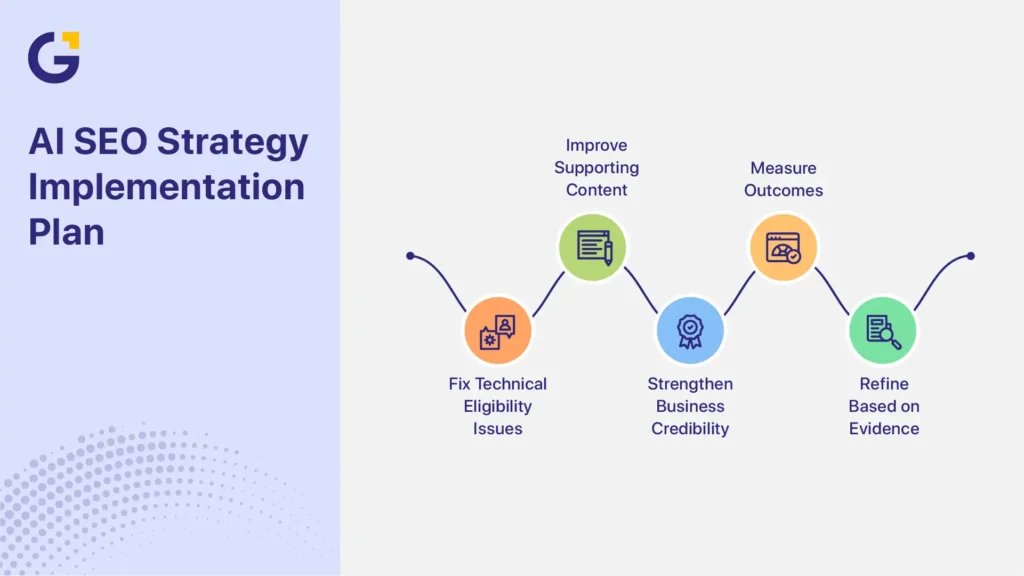
Action Plan for Sydney Businesses
Most Sydney businesses do not need a completely separate AI SEO strategy. They need a structured implementation plan that improves both traditional SEO and AI search visibility.
Follow this order:
- Fix technical eligibility issues.
- Improve supporting content.
- Strengthen business credibility.
- Measure outcomes.
- Refine based on evidence.
This sequence prevents businesses from investing heavily in content creation while important technical issues still limit visibility.
Which Queries Should Sydney Businesses Target First?
Not every search triggers a Google AI Overview.
Businesses often see better opportunities when targeting research-led searches that involve comparisons, costs, eligibility requirements, processes, and buying decisions.
| Query Type | Example |
| Comparison | Shopify vs WooCommerce |
| Cost | How much does bookkeeping cost in Sydney |
| Eligibility | Do I need council approval for a granny flat |
| Process | How does BAS lodgement work |
| Buying Decision | Best commercial coffee machine for a café |
These searches naturally require Google to pull together information from multiple sources.
By contrast, many highly transactional local searches, such as “electrician near me” or “plumber Sydney CBD” may not always generate AI Overviews because users often want immediate local results rather than detailed explanations.
This is why businesses should focus on creating content that supports the research stage of the customer journey rather than assuming every local keyword presents an AI Overview opportunity.
Audit Index Status
Start with the pages that matter most to your business.
This typically includes:
- service pages
- location pages
- comparison pages
- high-converting informational content
Use Google Search Console first.
Review:
- indexing status
- impressions
- clicks
- canonical issues
- crawl issues
- page-level performance
Search Console provides the most reliable evidence for understanding how Google currently views your website.
Manual observations should supplement Search Console data rather than replace it.
Map Service Pages to Support Blogs
Each core service should have supporting content around related customer questions.
For example, a Sydney accounting firm might structure content like this:
Core Page
- Small Business Accounting Services
Supporting Content
- BAS lodgement costs
- Sole trader vs company tax considerations
- Xero bookkeeping setup
- Small business tax deductions
A Sydney trade business might build supporting content around:
- service costs
- common problems
- comparison guides
- maintenance advice
- compliance requirements
This structure helps both users and Google understand the relationship between informational and commercial content.
Relevant internal links should connect supporting content back to the main service page. Businesses that want help implementing this framework can learn more about Genix Digital’s AI SEO services in Sydney.
Track Queries and AI Overview Appearances
Google Search Console should be your primary source of measurement.
Start by monitoring:
- impressions
- clicks
- landing pages
- query growth
- branded search growth
- conversion activity
Once priority queries have been identified, use manual tracking as a secondary process.
Record:
| Query | Date | Device | Location | AI Overview Present | Brand Cited | Cited URL |
| AI SEO agency Sydney | 15 June 2026 | Mobile | Sydney | Yes | No | — |
This allows you to identify recurring patterns over time.
AI Overviews can vary depending on:
- device type
- location
- search wording
- date
- user context
Avoid making decisions based on a single observation.
The goal is to identify which content contributes to qualified traffic, leads, enquiries, and revenue rather than focusing only on AI Overview visibility.
Conclusion
Sydney businesses cannot guarantee inclusion in Google AI Overviews or AI Mode. What they can do is improve the factors that make their content easier for Google to discover, understand, and use.
Start with technical eligibility. Build useful supporting content around customer questions. Maintain accurate business information. Then measure outcomes through Search Console and ongoing performance tracking.
Businesses that consistently answer real customer questions, demonstrate expertise, and provide useful information place themselves in a stronger position for both traditional search visibility and AI-powered search experiences.
If you would like a tailored review of your indexing issues, content gaps, internal linking opportunities, entity optimisation opportunities, and AI search visibility, you can book an AI SEO consultation with Genix Digital.
FAQs
How can a Sydney business appear in Google AI Overviews?
A Sydney business may appear when Google identifies indexed, accessible, and useful content that helps answer a user’s query. Technical SEO, helpful content, and strong business credibility can improve eligibility, but no business can guarantee inclusion.
Is AI Overview optimisation different from traditional SEO?
AI Overview optimisation builds on traditional SEO rather than replacing it. Crawlability, indexing, relevance, helpful content, and authority remain important foundations.
Does structured data guarantee AI Overview visibility?
No. Structured data can help Google understand page content, but it does not guarantee inclusion in AI Overviews or AI Mode.
Do reviews help with Google AI Overviews?
Authentic reviews can help users verify a business and may contribute to broader trust and credibility signals. However, Google does not identify reviews as a direct AI Overview ranking factor.
What should Sydney businesses prioritise first?
Start with technical eligibility. Confirm that important pages can be crawled and indexed, then build supporting content around customer questions before focusing on broader AI search visibility strategies.





 17 Sep 2026
 8 Min Read