If your online store isn’t showing up on Google, you’re leaving money on the table every single day. Whether you run a Shopify store or a WooCommerce site, having a practical ecommerce SEO checklist is the difference between local customers finding you or buying from your competitors instead.
Most Australian store owners focus heavily on paid ads or social media and treat SEO as an afterthought. But organic search traffic is free, compounds over time, and brings in high-intent shoppers who are actively ready to buy. The challenge is that ecommerce SEO comes with unique hurdles that standard blog or corporate site strategies don’t account for — such as duplicated product listings, thin category text, and complex faceted navigation.
This comprehensive guide and ecommerce SEO checklist walks you through exactly what needs fixing, step-by-step, to help you increase online store traffic, sell more online Australia-wide, and improve ecommerce conversion rate.
Not sure where your Aussie store currently stands? Genix Digital offers a tailored Shopify SEO audit to uncover structural roadblocks and help you dominate local search rankings.
Why Ecommerce SEO Is Different From Regular SEO
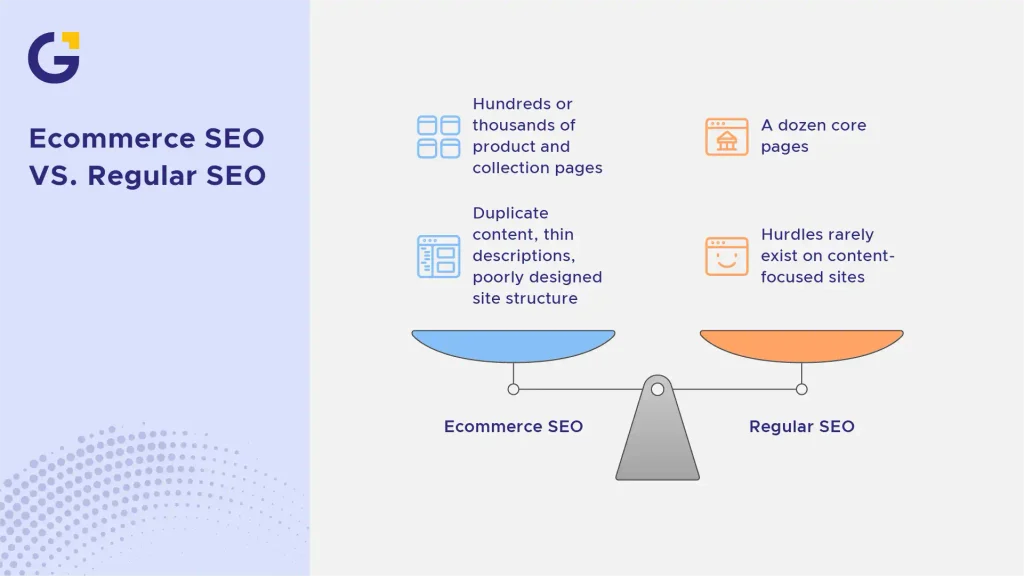
A standard business website typically manages a dozen core pages. In contrast, an online store often handles hundreds or thousands of product and collection pages all competing for overlapping commercial search terms.
This complex architecture creates technical and content hurdles that rarely exist on content-focused sites. Issues like duplicate content, thin descriptions, and poorly designed site structure can quietly destroy your rankings, even if your overall digital strategy looks brilliant on paper.
Real-World Example: A Melbourne-based fashion retailer listed over 2,000 items on Shopify but only ranked for their brand name. A thorough audit revealed duplicate meta descriptions across 80% of product pages and zero descriptive text on collection pages.
- Generic, templated descriptions copied verbatim from overseas suppliers.
- Category pages with no original copy, containing only product image grids.
- No structured internal linking strategy between complementary product lines.
Technical SEO Foundations for Shopify and WooCommerce
Before tweaking copy, your technical foundation must be rock-solid. This encompasses crawlability, indexation, mobile usability, and clean URL structures.
Platforms like Shopify and WooCommerce handle technical parameters differently. Shopify includes built-in constraints around URL structures and template file access, whereas WooCommerce provides full technical freedom on WordPress but demands active server management and performance maintenance.
As Google Search advocate John Mueller often highlights, search engines need clear structural signals to accurately crawl and evaluate large-scale ecommerce inventory.
Real-World Example: An Australian outdoor gear provider running WooCommerce had broken XML sitemaps that failed to update for 8 months. As a result, Google never indexed over 150 newly launched products.
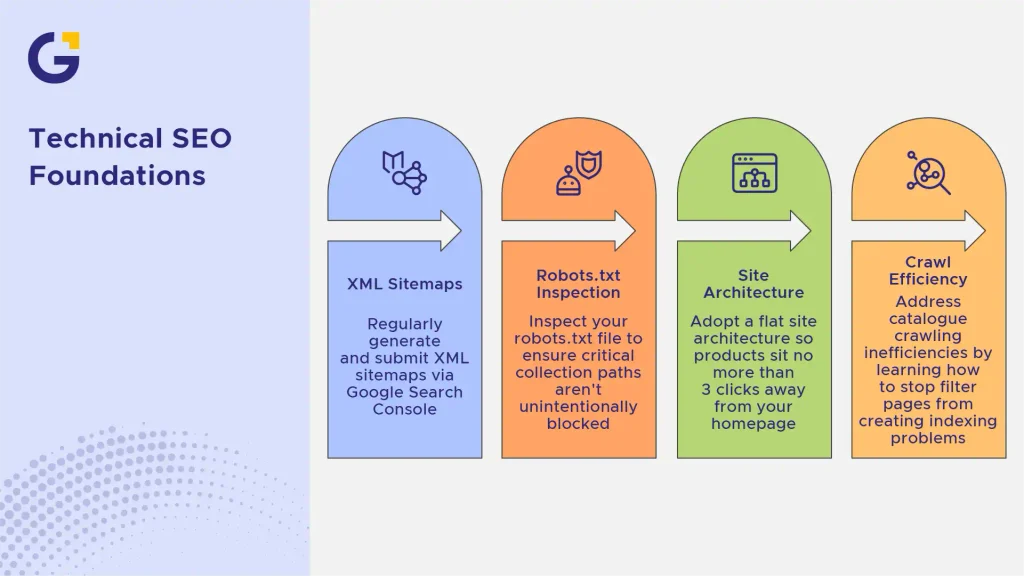
- Regularly generate and submit XML sitemaps via Google Search Console.
- Inspect your robots.txt file to ensure critical collection paths aren’t unintentionally blocked.
- Adopt a flat site architecture so products sit no more than 3 clicks away from your homepage.
- Address catalogue crawling inefficiencies by learning how to stop filter pages from creating indexing problems.
Optimising Product Pages for Search and Conversions
Your product pages must satisfy two distinct goals simultaneously: rank high on search engines and convert casual browsers into paying customers. Achieving this requires blending search engine best practices with persuasive, high-converting copy.
Creating unique descriptions matters far more than many Australian business owners realise. Relying on default supplier specs is one of the quickest ways to trigger sitewide duplicate content penalties.
Real-World Example: A Sydney skincare brand manually rewrote 50 core product descriptions, integrated customer FAQs, and optimised title tags around high-volume Australian search terms. Organic traffic jumped 34% within 4 months.
- Craft unique, keyword-rich product titles and meta descriptions tailored to local search intent.
- Incorporate specific product attributes (sizing, Australian materials, local use cases) rather than generic blurbs.
- Leverage professional product page copywriting to build instant buyer trust.
- Embed customer reviews directly on product pages to feed search engines fresh user-generated content.
- If you are re-architecting your catalogue, follow a proper SEO migration checklist to protect your hard-earned organic authority.
Category and Collection Page SEO
Category pages (known as collection pages on Shopify) are often the most valuable SEO assets in an online store. They naturally target broad, high-volume keywords like “men’s running shoes Australia” or “organic skincare Sydney” that individual item pages cannot comfortably capture.
Unfortunately, many Aussie merchants leave these pages empty, rendering them as plain grids of product thumbnails with zero introductory text.
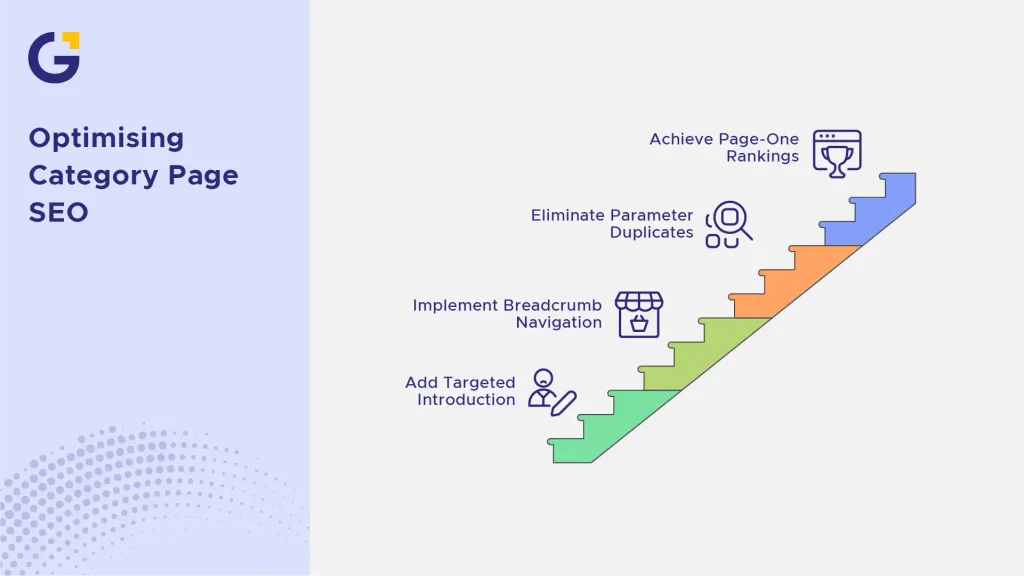
Real-World Example: By adding a short, 200-word targeted introduction above the product grid, adding clear H2 headings, and linking internally to sub-categories, a Sydney boutique earned page-one rankings for three major commercial keywords.
- Publish unique category overviews optimised for local commercial intent.
- Implement breadcrumb navigation according to official W3C Breadcrumb Design Patterns to improve navigation UX and crawl hierarchy.
- Eliminate parameter duplicates generated by custom sorting or filtering mechanisms.
- Read our guide on Shopify vs WooCommerce for Australian businesses to determine which ecommerce engine suits your store structure best.
Fixing Duplicate Content Issues
Duplicate content remains one of the most widespread issues damaging search performance for Australian ecommerce websites. It typically stems from faceted navigation (filters for colour, size, and price), HTTP/HTTPS conflicts, printer versions, and variants sharing isolated URLs.
Both Shopify and WooCommerce automatically generate parameter URLs that can confuse search bots if left unchecked.
- Implement strict canonical tags pointing all parameter variations back to the primary canonical URL (e.g., as outlined in Google Search Central Canonicalization Guidelines).
- Use noindex rules on low-value filter combinations to preserve crawl budget.
- Audit your site for disconnected pages using our tutorial on how to find and fix unlinked orphan pages.
Structured Data (Schema) for Product Listings
Structured data markup allows search engines to clearly comprehend product attributes, rendering your listings as rich snippets with visible star ratings, stock availability, pricing, and currency (AUD).
Without proper schema, search engines must guess your content structure, missing out on enhanced visibility in search results and emerging AI search features.
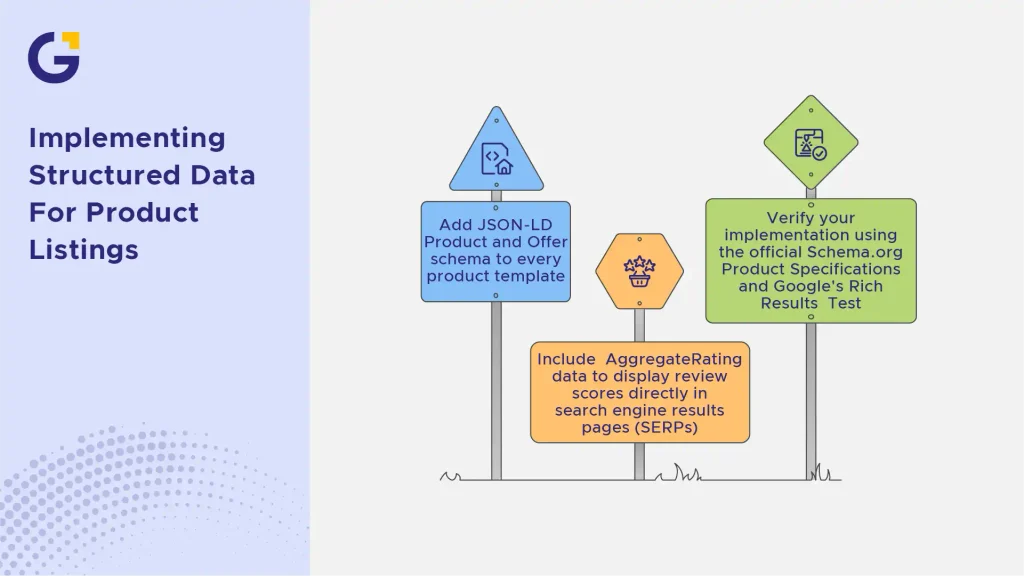
- Add JSON-LD Product and Offer schema to every product template.
- Include AggregateRating data to display review scores directly in search engine results pages (SERPs).
- Verify your implementation using the official Schema.org Product Specifications and Google’s Rich Results Test.
- Learn how structured data impacts AI discovery in our breakdown of Schema Markup for AI Search.
Site Speed and Core Web Vitals for Online Stores
Store performance directly influences both your Google rankings and your conversion rate. Slow-loading images, excessive Shopify apps, or unoptimized WordPress plugins hurt user experience and increase bounce rates.
According to benchmarking data from Google Web.dev Core Web Vitals, ecommerce sites that optimise Interaction to Next Paint (INP) and Largest Contentful Paint (LCP) enjoy significantly lower cart abandonment rates.
- Compress and serve images in modern formats like WebP or AVIF.
- Minify CSS and JavaScript assets while removing unused app scripts.
- Utilise a top-tier Content Delivery Network (CDN) with Australian edge servers to reduce latency for local shoppers.
- If technical bloat is bottlenecking sales, explore our custom web development services or review our guide on website speed optimisation for Sydney businesses.
Full Ecommerce SEO Checklist
Here is your actionable ecommerce SEO checklist to systematically optimise your online store:
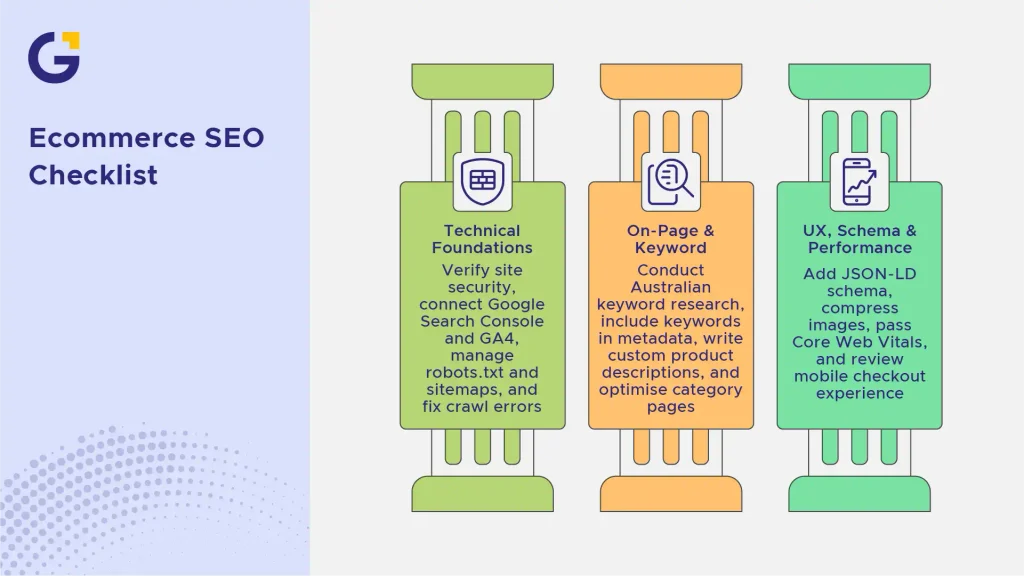
1. Technical Foundations
- Verify site security with a valid SSL certificate (HTTPS).
- Connect and audit Google Search Console and GA4.
- Ensure robots.txt and XML sitemaps are active and error-free.
- Fix crawl errors, 404 broken links, and redirect chains.
2. On-Page & Keyword Optimisation
- Conduct localised Australian keyword research targeting high-intent commercial terms.
- Include target keywords naturally in H1 titles, URL slugs, and meta descriptions.
- Craft custom product descriptions — no default supplier templates.
- Ensure category pages include descriptive body text and clear H2s.
3. UX, Schema & Performance
- Add JSON-LD Product, Offer, and BreadcrumbList schema markup.
- Optimise images with compressed WebP files and descriptive alt text.
- Pass Core Web Vitals (LCP, INP, CLS) across desktop and mobile devices.
- Review your mobile checkout experience using our mobile UX checklist for Australian stores.
Need Help Scaling Your Online Store in Australia?
SEO isn’t a one-off task; it’s an ongoing growth engine. If managing technical optimisation, schema markup, and content strategy feels overwhelming, the team at Genix Digital is here to help. Explore our specialised ecommerce SEO services or get in touch for a free strategy session today.
Frequently Asked Questions
1. Is Shopify good for SEO out of the box?
Yes, Shopify offers solid baseline SEO capabilities including automatic XML sitemaps, SSL certificates, and customizable meta tags. However, it presents native structural challenges such as forced URL directories (/products/ and /collections/) and automated duplicate variant URLs. Overcoming these limitations requires custom canonical tagging and tailored store optimisation.
2. How do I stop duplicate content on Shopify?
Duplicate content on Shopify frequently occurs when product pages are linked through collection URLs (e.g., /collections/mens/products/shoe). You can resolve this by adjusting your theme code so internal links point directly to the primary product URL (/products/shoe). Additionally, ensure your canonical tags point back to the main canonical version.
3. What schema markup do I need for products?
At a minimum, online stores should implement Product and Offer schema markup using JSON-LD. Key properties include name, image, description, SKU, price, priceCurrency (AUD for Australia), and availability. Adding AggregateRating markup helps display review star ratings directly in Google search listings.
4. How often should I update product descriptions?
Review and refresh product copy whenever consumer trends shift, seasonal promotions launch, or inventory updates occur. For top-selling core products, re-optimise descriptions every 6 to 12 months to incorporate fresh customer terms, update FAQs, and maintain competitive rankings.




 17 Aug 2026
 9 Min Read