


If you run an NDIS business, you already know the search results are crowded. Every provider seems to be fighting for the same suburb keywords, and the usual advice is to build a page for every location you service. But this is exactly where SEO for NDIS providers goes wrong for so many businesses.
Mass-producing suburb pages with near-identical content doesn’t build trust with participants, families, or Google. It creates thin location pages that dilute your authority instead of strengthening it. The better path is a structure built on strong NDIS service pages, genuine local proof, and content that actually helps the people searching for support.
This guide walks through why that shift matters, what to avoid, and how to build local SEO NDIS authority the right way.
If you want a second opinion on your current site structure, this SEO strategy for NDIS and service providers breaks down where most providers lose visibility.
Why NDIS SEO Needs More Than Suburb Pages
Most NDIS providers assume NDIS provider marketing means one page per suburb, stuffed with the same service list and a swapped location name. Google has become very good at spotting this pattern.
Participants and families searching for support aren’t just looking for a suitable match. They’re looking for clarity on what the service involves, who it suits, and whether the provider can be trusted with something personal.
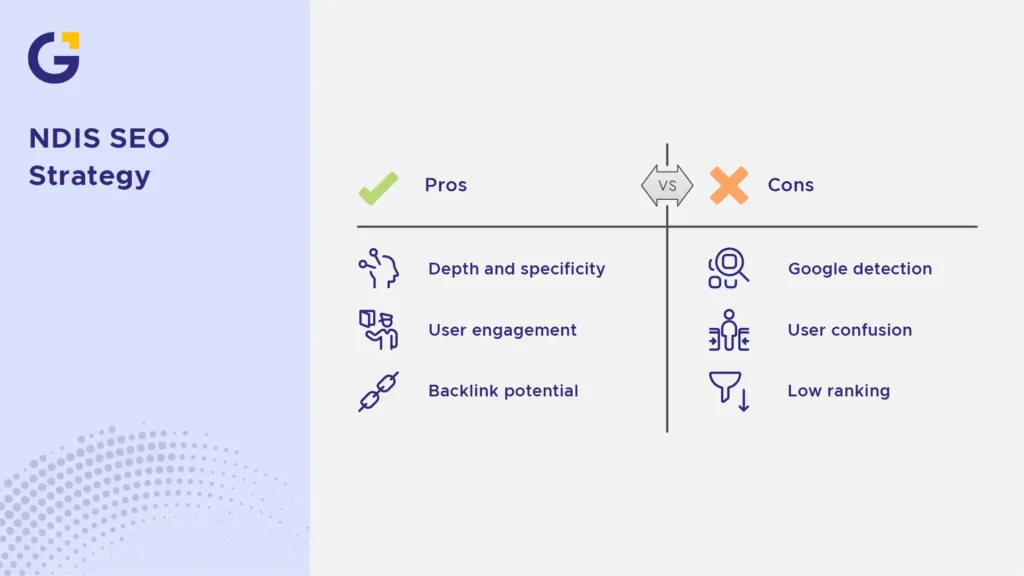
Search engines reward pages that answer these questions in depth, not pages that repeat a template with minor edits.
Example Case: A Melbourne-based support coordination provider had 14 suburb pages, each with the same 200 words reworded slightly. None of them ranked. After consolidating into three strong regional pages with real detail, two started ranking on page one within three months.
- Thin pages rarely earn backlinks or engagement signals
- Duplicate structures confuse both users and search crawlers
- Depth and specificity outperform volume in most disability services SEO niches
The Problem With Thin Location Pages
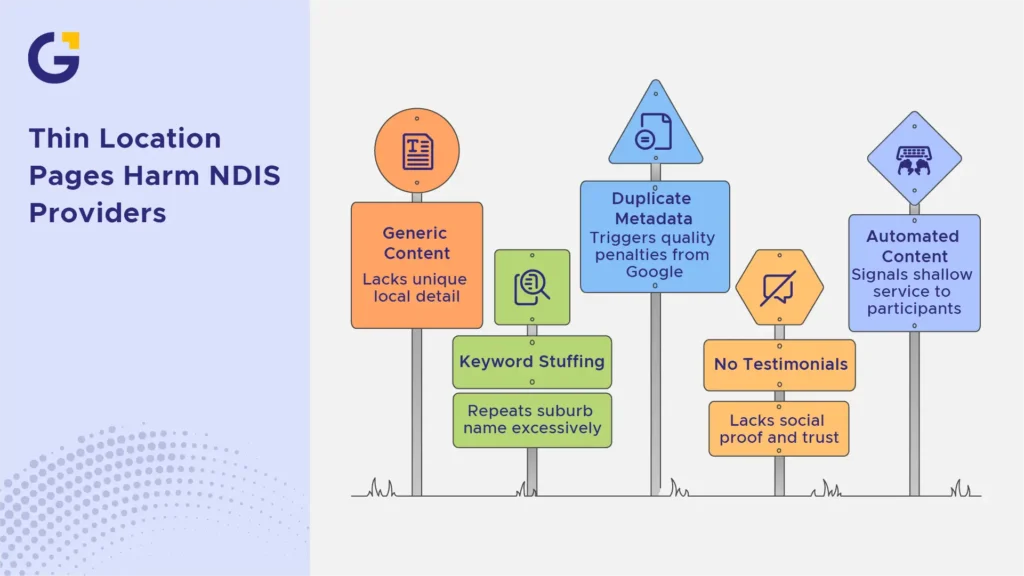
A thin location page usually has a short intro, a generic service list, and a suburb name repeated a few times for keyword targeting. It offers almost no unique value to the reader.
For an NDIS provider specifically, this is a bigger risk than most industries. Participants often research support providers carefully, sometimes with help from family, support coordinators, or plan managers. A shallow page signals a shallow service.
Google’s helpful content systems are specifically designed to detect and suppress pages built for search engines rather than people. As Harry Sanders (founder of StudioHawk, Australia’s largest dedicated SEO agency) often emphasizes when discussing Australian search trends, relying on automated or near-duplicate location pages actively hurts your site’s broader search authority. Multiple templated NDIS location pages fall directly into this trap by triggering quality penalties:
- Duplicate meta descriptions and headers across suburb pages
- No unique local detail, testimonials, or context
- Content that reads like a template rather than a real answer
The fix isn’t to abandon local strategy. It’s to rebuild it around genuinely useful pages supported by real local signals, which is exactly where local SEO support without thin location pages becomes valuable.
Better Ways to Build Local Relevance
Building a strong local authority doesn’t require dozens of repetitive pages. By focusing on deep core pages and authentic location signals, you can capture local search intent while keeping your site structure clean and high-performing.
Strong core service pages
Every core service, whether it’s support coordination, community access, or personal care, deserves its own detailed page. This page should explain what the service includes, who it’s suitable for, and how the process works from enquiry to delivery.
This single page can then serve multiple service areas if it clearly states its coverage and includes local trust signals, rather than needing a duplicate for every suburb.
Service-area proof and FAQs
Instead of separate pages per suburb, list your service areas clearly on relevant service pages, supported by FAQs that address location-specific questions.
Example Case: A disability support provider added a “Do you service [region]?” FAQ block directly on their core service pages instead of creating new location pages. Enquiries from surrounding suburbs increased without adding a single duplicate page.
- Add a clear, scannable service-area list
- Include FAQs addressing travel, availability, and regional coverage
- Reference specific suburbs naturally within FAQ answers, not as page titles
Useful local content without doorway pages
Blog content, guides, and resource pages can mention local context without becoming doorway pages. A guide on choosing a support coordinator in a specific region, for example, offers genuine value while naturally reinforcing local relevance.
This is where NDIS SEO overlaps with content strategy rather than pure technical SEO.
Trust, Accessibility and Participant-Focused Content
NDIS audiences often include participants with diverse access needs, along with family members and support coordinators researching on their behalf. Every page needs to be written and designed with participant intent in mind.
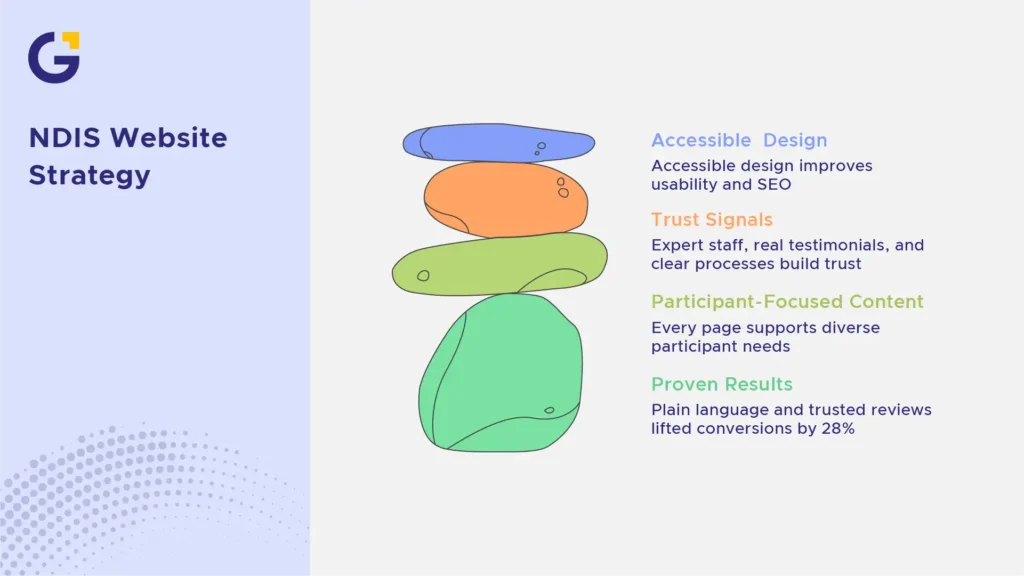
Research from the Web Accessibility Initiative (WAI) shows that accessible design directly improves usability for all visitors, not just those with specific access requirements. Implementing an accessible website design for service providers also supports stronger engagement signals for search engines.
Trust signals matter just as much as accessibility. Clear staff qualifications, transparent processes, genuine testimonials, and compliance-aware language all help participants feel confident before they even make contact. For a closer look at how client feedback builds search authority, read our article on How Reviews Help Sydney Businesses Rank in Google, Maps and AI Results.
Example Case: A provider added plain-language summaries and verified participant reviews across their main NDIS service pages. Their conversion rates improved by 28% over two months because visitors could immediately verify their quality and E-E-A-T signals.
Internal Links That Support NDIS Service Pages
Your blog posts and resources shouldn’t sit in isolation. A strong internal linking structure connects informational readers directly to your core money pages, distributing authority across your site naturally. Learn more about this architecture in our guide to Internal Linking Strategy.
When structuring internal links for NDIS platforms, aim to guide users from broad research topics into actionable service enquiries.
- Link contextually: Connect articles about NDIS plan reviews or support categories directly to your dedicated support coordination page.
- Vary anchor text: Use natural variations like “our support coordination team” or “explore our disability services SEO guidance” instead of repetitive exact matches.
- Reinforce location strategy: Use informational blog content to answer regional questions, then direct readers to your primary service pages to view coverage across all targeted suburbs.
NDIS Local SEO Checklist
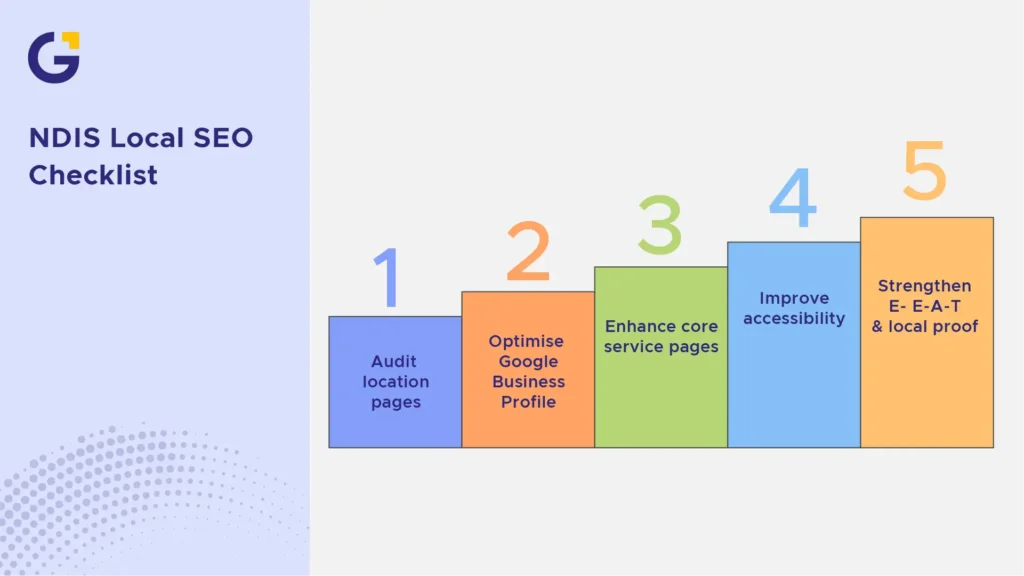
Use this quick checklist to review your NDIS provider SEO strategy and ensure your pages are built for long-term organic visibility:
- Audit location pages: Identify and consolidate thin, near-duplicate suburb pages into comprehensive regional service pages.
- Optimise Google Business Profile: Align your Google Business Profile primary and secondary categories with your core NDIS support categories.
- Enhance core service pages: Add clear service areas, local testimonials, and detailed FAQ blocks to every main service offering.
- Improve accessibility: Ensure your site complies with WCAG standards to create an accessible, inclusive experience for all participants.
- Strengthen E-E-A-T & local proof: Display compliance certifications, staff credentials, and verified participant reviews adjacent to enquiry forms.
FAQ
What is SEO for NDIS providers?
It is the process of improving visibility for disability service searches through strong service pages, local relevance, trust signals, accessibility, and helpful content.
Should NDIS providers create pages for every suburb?
Only when each page offers unique, useful information. Repeating the same copy with subtle swaps can create thin pages.
What should an NDIS service page include?
It should explain the service, who it helps, eligibility or suitability, service area, process, trust proof, accessibility, and enquiry options.
How can NDIS providers build local relevance?
Use clear service areas, local proof, reviews, case examples where appropriate, FAQs, and internal links from related content.
Why is accessibility important for NDIS websites?
NDIS audiences may include people with different access needs, so a readable, accessible design is both practical and trust-building.
Can blog content support NDIS SEO?
Yes. Helpful content can answer participant, family, and referrer questions while linking naturally to relevant service pages.





 17 Aug 2026
 9 Min Read