
If your Sydney business isn’t showing up in the Google Maps “local pack” when nearby customers search for what you offer, you’re losing business to competitors who are. Google Business Profile optimisation is one of the fastest, most cost-effective ways to fix that, and most business owners are only using a fraction of what the platform actually offers.
Many Sydney businesses create a profile once, add a logo and phone number, and never touch it again. Meanwhile, competitors are posting updates, collecting fresh reviews, and selecting precise categories that signal relevance to Google. The result is a visibility gap that compounds every single month.
This guide walks through every element of Google Business Profile optimisation, from verification and categories to reviews and citation consistency, so you can take practical, immediate action to rank in Google Maps and win local clients.
Not sure where your profile currently stands? Genix Digital’s local SEO Sydney services include a free audit to help you get found on Google near me, hassle-free.
Why Google Business Profile Matters for Sydney Businesses
Google Business Profile (GBP) is often the very first impression a potential customer has of your business before they ever visit your website. It appears in Google Search, Google Maps, and the local “3-pack” that sits right above organic search results.
For Sydney businesses specifically, local competition is fierce across suburbs like Parramatta, Bondi, and the CBD. A well-optimised profile is frequently the deciding factor in whether a nearby customer calls you or a competitor. In an era where search engines prioritise proximity and intent, proper Google Business Profile optimisation bridges the gap between online searches and offline foot traffic.
Example Case: A Sydney plumbing business optimised its GBP with accurate categories, weekly photo uploads, and consistent review responses. Within three months, it moved from page two of local results into the top three local pack positions for “emergency plumber Sydney.”
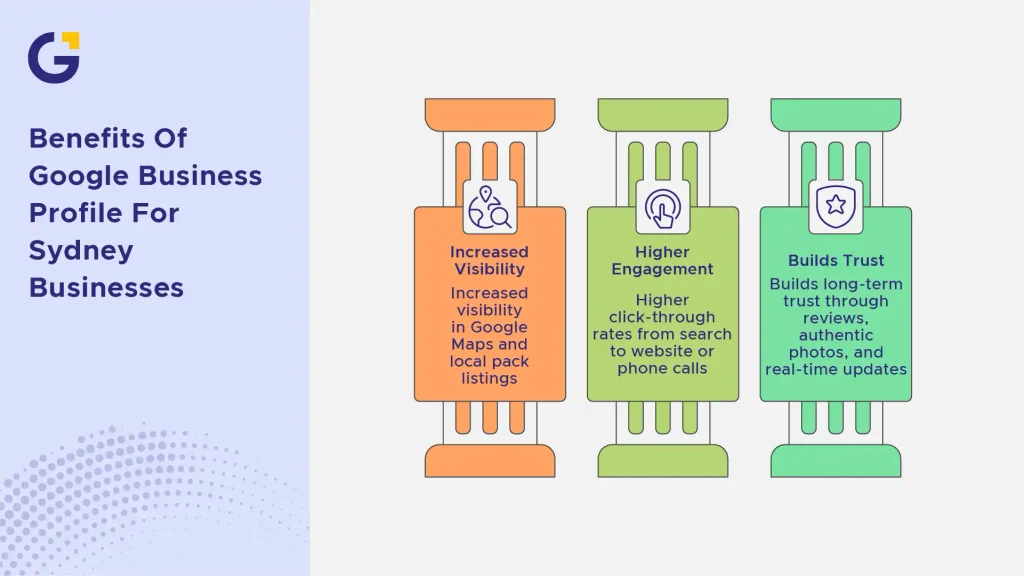
- Increased visibility in Google Maps and local pack listings
- Higher click-through rates from search to website or phone calls
- Builds long-term trust through reviews, authentic photos, and real-time updates
Setting Up and Verifying Your Profile Correctly
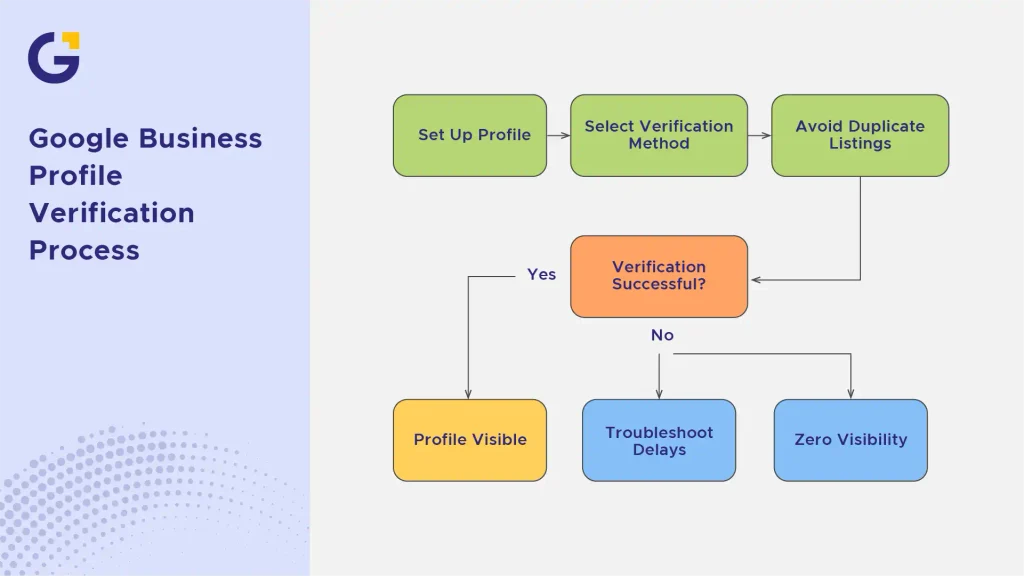
Verification confirms to Google that your business is real and located where you claim. Without it, your profile won’t appear in local search results or Maps at all.
GBP verification in Australia typically happens via phone, email, or postcard, depending on your business type and history with Google. Video verification is also increasingly used for service-area businesses across New South Wales. If you experience delays during this stage, reviewing our local pack ranking factors guide can help troubleshoot common listing issues.
Example Case: A new Sydney café attempted to rank locally before completing verification and saw zero visibility in Maps for six weeks a common and completely avoidable mistake.
- Use your exact legal business name, matching your website and physical signage
- Select a verification method suited to your business structure
- Avoid creating duplicate listings, which can delay or block verification permanently
Choosing the Right Primary and Secondary Categories
Categories are one of the strongest local pack ranking factors, yet people often choose them incorrectly. Google uses your primary category heavily to decide which searches your business should appear for.
Your primary category should reflect your core service precisely, not broadly. Secondary categories can then capture additional relevant services without diluting your main focus.
Example Case: A Sydney electrician initially listed “Contractor” as their primary category. Switching to “Electrician” as primary, with “Electrical Installation Service” as secondary, dramatically improved local pack rankings within weeks.
- Research competitor categories using official Google Business Profile category lists
- Choose the most specific primary category available for your business model
- Add up to 9 secondary categories relevant to actual services offered
Optimising Your Business Description and Services List
Your business description is a chance to naturally include relevant keywords while clearly explaining what you do and who you serve. Google also uses this section, along with your Services list, to understand relevance for Google My Business SEO.
The Services section should mirror the offerings on your website, using consistent language, written content marketing, and specific service names rather than vague terms.
Example Case: A Sydney accounting firm added detailed service listings “Tax Return Preparation,” “BAS Lodgement,” and “Small Business Bookkeeping” instead of a generic “Accounting Services” entry, resulting in far more relevant search impressions.
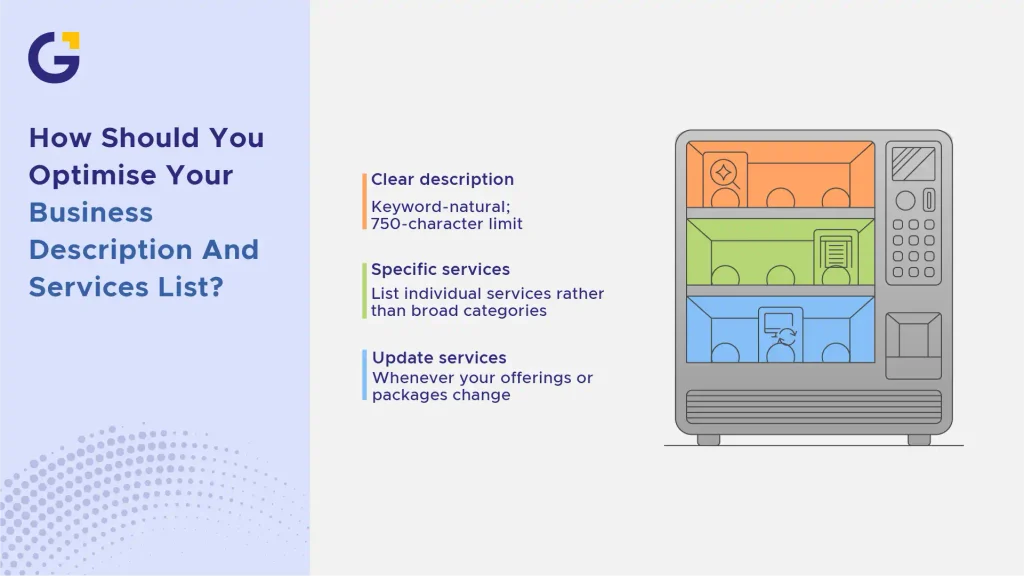
- Write a clear, keyword-natural description adhering to the 750-character limit
- List specific individual services rather than broad categories
- Update your services list whenever your offerings or packages change
Photos, Posts and Products: Keeping Your Profile Active
An inactive profile signals stagnation to both Google and potential customers. Regularly uploading geotagged Google Business Profile photos, published work, and store atmosphere builds visual proof that your business is active and thriving.
Additionally, leveraging GBP posts for SEO allows you to broadcast promotions, seasonal offers, and company announcements directly within search results. Utilising structured listings for products and featured services ensures visitors convert faster right from the search page.
Managing and Responding to Reviews
Google reviews SEO ranking power cannot be understated. Customer reviews are both a critical conversion factor and a primary signal for Google’s local algorithm.
As prominent local search expert Darren Shaw from Whitespark highlights in his annual industry research, the quantity, velocity, and diversity of steady Google reviews remain top-tier ranking signals for local pack placement.
When managing reviews for Sydney businesses, always keep these practices in mind:
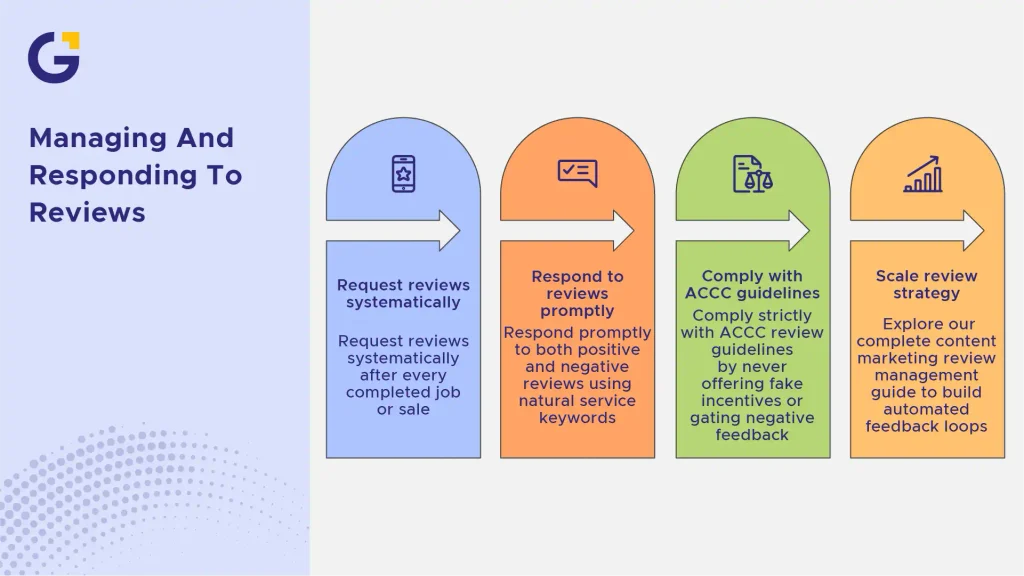
- Request reviews systematically after every completed job or sale.
- Respond promptly to both positive and negative reviews using natural service keywords.
- Comply strictly with ACCC review guidelines by never offering fake incentives or gating negative feedback.
To scale your review strategy, explore our complete content marketing review management guide to build automated feedback loops.
NAP Consistency and Local Citations
NAP consistency (Name, Address, Phone number) across the web is fundamental to establishing search engine trust. If your business details vary between True Local, Yellow Pages, Hotfrog, and your own website, Google becomes hesitant to rank your listing confidently.
Building authoritative local citations across Australian business directories reinforces your geographical location in Sydney. To future-proof your presence across conversational engines, implementing schema markup for AI search on your site guarantees structured data matches your GBP exactly.
Tracking Your Local Pack Rankings
Effective Google Business Profile optimisation requires continuous tracking. Relying on basic search queries from your personal phone will give skewed results due to personalised search history and physical proximity.
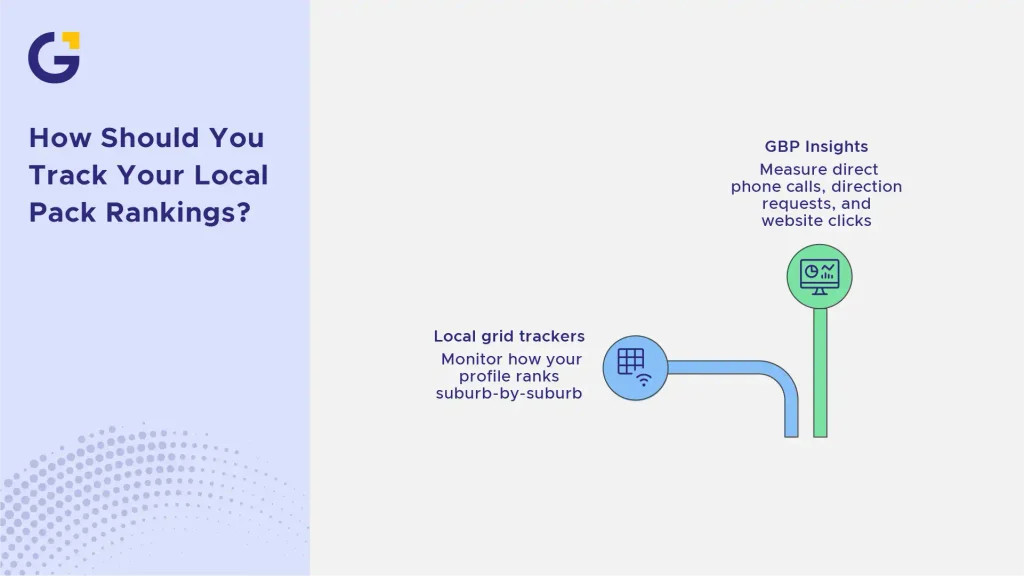
Use specialised local grid rank trackers to monitor how your profile ranks suburb-by-suburb across Sydney (e.g., searching for your services from Surry Hills versus Chatswood). Combine grid tracking with GBP Insights to measure direct phone calls, direction requests, and website clicks.
Frequently Asked Questions
1. How long does Google Business Profile verification take?
Verification via postcard typically takes 3 to 6 business days to arrive at your Sydney address. Immediate verification methods like phone, email, or live video verification can take anywhere from a few minutes to 48 hours once approved by Google.
2. Does responding to reviews improve rankings?
Yes, actively responding to reviews improves your local rankings. Regular responses signal to Google that your business is active, while incorporating relevant service terms naturally in your replies enhances context and search relevance.
3. How often should I post on Google Business Profile?
Publishing a post at least once a week is recommended for Sydney businesses. Regular updates keep your profile fresh, showcase active offers, and signal ongoing activity to Google’s ranking algorithm.
4. What’s the difference between GBP and Google My Business?
Google My Business (GMB) was rebranded by Google to Google Business Profile (GBP). While the core purpose remains local listing management, GBP offers streamlined management directly within Google Search and Maps interfaces alongside advanced AI search integrations.





 3 Aug 2026
 10 Min Read