
Australian businesses are under pressure to do more with the same budget. The benefits of AI in digital marketing matter now because search habits are changing, ad platforms are using more automation, and buyers expect faster, more relevant experiences. Google rolled out AI Overviews in Australia in late 2024 and AI Mode in Australia in October 2025, and many brands are already using AI assistants to help customers online.
That shift is changing how businesses attract leads, run campaigns, and measure performance. For Australian SMEs, AI is no longer just a topic for big tech brands like Canva, Shopify, Google, or Meta. It is now part of daily marketing work, from ad bidding and email timing to content planning and customer support. If you are looking to scale your operations efficiently, partnering with an agency offering AI-powered digital marketing services in Australia can bridge the gap between technical complexity and real-world results.
A Quick View Of Where AI Helps Most
| Area | What AI Does | Business Impact |
| Reporting | Pulls and sorts data faster | Saves hours each week |
| Paid Ads | Adjusts bids and audiences | Cuts wasted spend |
| Personalises timing and content | Lifts opens and clicks | |
| SEO and Content | Finds topics, patterns, and gaps | Speeds up production |
| Customer Support | Handles simple questions | Improves response time |
What Are The Benefits Of AI In Digital Marketing?
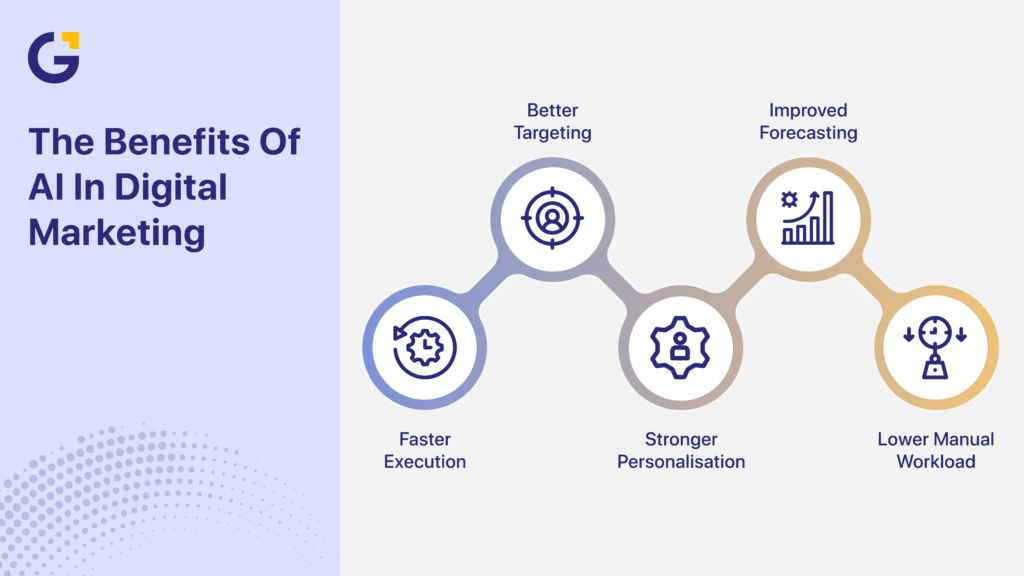
The benefits of AI in digital marketing include faster execution, better targeting, stronger personalisation, improved forecasting, and lower manual workload. AI helps marketers process more data, spot useful patterns, and act faster across every stage of campaign management.
Some of the biggest benefits businesses gain from using AI include:
- Faster Execution: AI reduces the time needed to launch, monitor, and adjust campaigns.
- Better Targeting: AI helps businesses identify high-intent audiences more accurately.
- Stronger Personalisation: AI tailors content and offers to each user’s behaviour and interests.
- Improved Forecasting: AI can predict trends and likely outcomes using historical data.
- Lower Manual Workload: AI automates repetitive tasks across reporting, email, and campaign management.
This matters in Australia because digital use is already near saturation. DataReportal says Australia had 26.2 million internet users at the end of 2025. In a market this connected, better speed and better relevance can change campaign results fast.
AI also helps close the gap between small and large brands. A local clinic, trade business, or ecommerce store can now use many of the same systems that bigger brands use, such as automated ad optimisation, content drafting, or audience segmentation. That does not remove the need for strategy, but it does lower the cost of doing solid marketing work at scale. For a broader strategic overview, explore our guide on Top Digital Marketing Strategies for Australian Businesses.
How Does AI Improve Marketing Efficiency For Australian Businesses?
AI improves marketing efficiency by automating repeated tasks, speeding up reporting, and reducing admin. The best way to use AI marketing automation is to remove low-value manual work so teams can spend more time on messaging, planning, testing, and conversion improvement.
AI Automates Repetitive Marketing Tasks
A common example is email and CRM workflow setup. AI can trigger welcome emails, lead nurture sequences, abandoned cart reminders, and follow-up messages based on user actions. Mailchimp says 88% of marketers believe they need more automation and AI to meet customer expectations and stay competitive.
AI Speeds Up Reporting And Performance Analysis
Many teams still waste time exporting campaign data, cleaning spreadsheets, and writing the same weekly notes. AI-powered digital marketing tools can surface trend changes, flag anomalies, and build summaries much faster. McKinsey’s 2025 survey says almost all respondents report some AI use in their organisations, but scaled value comes when AI is tied to workflow redesign, not isolated experiments.
For an Australian SME, that can look very simple. A service business running Google Ads, social ads, and email flows can use AI to route leads, summarise call outcomes, and update remarketing lists in near real time. The gain is not just time saved. It is cleaner follow-up, fewer missed leads, and faster learning between channels.
How Does AI Help Businesses Target The Right Audience?
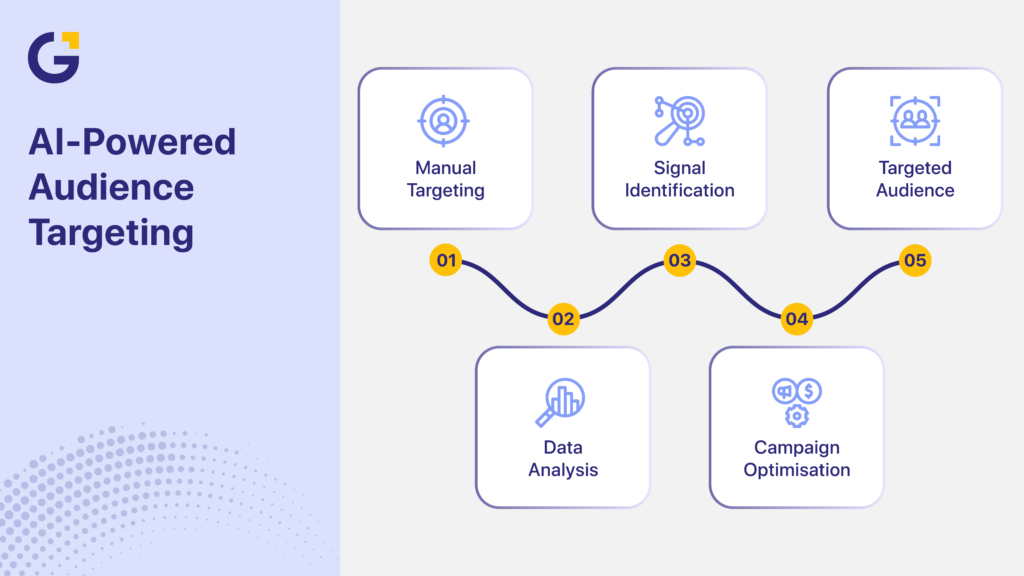
AI helps businesses target the right audience by analysing behaviour, intent, and engagement data at a scale that manual review cannot match. To do this well, AI in advertising uses signals such as clicks, page depth, form actions, past purchases, and timing patterns to improve who sees what.
This is where artificial intelligence marketing tools have become highly useful. Google Ads can optimise bidding toward likely conversions, Meta can expand delivery beyond narrow manual targeting, and ecommerce platforms can recommend products based on on-site behaviour.
That makes a real difference for Australian businesses with limited budgets. A Sydney dental clinic, for example, may not want to pay for clicks from users outside its service area or from people researching but not ready to book. AI can help tighten audience quality by learning which users behave like past leads and which users bounce quickly. That means less waste and clearer signals for future campaigns.
How Does AI Improve Personalisation In Marketing Campaigns?
AI improves personalisation by matching content, offers, and timing to the user’s behaviour and stage in the buying process. The best use of AI-powered digital marketing is not adding a first name to an email. It is making the whole journey more relevant from first click to final conversion.
Northwestern’s Medill article points out that personalisation now goes well beyond email and includes several tailored touchpoints, such as:
- Landing Pages: Content can adjust based on user interests, traffic source, or previous interactions.
- Website Content: Businesses can show different messaging based on browsing behaviour or buyer stage.
- Video Content: Brands can deliver personalised video recommendations or messaging based on audience segments.
- Special Offers: Promotions can be shaped around browsing history, past purchases, or likely purchase intent.
That matches how major platforms already work. Netflix, Amazon, and Spotify trained users to expect relevant suggestions, not generic blasts.
For Australian brands, AI personalisation can be applied in practical ways, including:
- Showing a stronger booking CTA when a visitor reads multiple service pages
- Sending product restock reminders based on past purchase timing
- Delivering more advanced content when a B2B lead downloads a guide
- Adjusting offers based on where the user is in the buying journey
Good personalisation feels helpful, not intrusive, and it often improves both conversion rate and customer experience.
How Does AI Improve Advertising Performance And ROI?
AI improves advertising performance by adjusting bids, testing variations, forecasting likely outcomes, and matching spend to stronger conversion signals. AI in advertising helps businesses reduce waste and improve return on ad spend when campaign goals, tracking, and inputs are set up properly.
It also improves speed in testing. Instead of waiting weeks to learn which headline, creative, or audience wins, platforms can shift delivery faster. That does not mean marketers should hand over control. It means marketers can spend less time on manual bid edits and more time on offer quality, landing page strength, and lead handling. To see how automation enhances paid campaigns, read our insights on How AI Is Changing Google Ads for Sydney Businesses.
AI Ad Optimisation for E-Commerce Remarketing and Customer Retention
For Australian e-commerce brands, relying solely on top-of-funnel acquisition is no longer enough. Modern AI ad optimisation platforms compare user touchpoints across channels to refine remarketing audiences automatically. Instead of showing generic banner ads to every past visitor, machine learning models evaluate real-time intent signals such as time spent on category pages, cart abandonment triggers, and historical purchase intervals—to deliver hyper-targeted retargeting ads.
This capability drastically reduces cost-per-acquisition (CPA) and improves customer lifetime value (LTV). By automating segmentation for repeat buyers versus window shoppers, brands can allocate ad spend more intelligently, ensuring higher engagement and retention across Australian digital channels.
Benefits of AI for Social Media Marketing in Australia
Social media algorithms across Meta, TikTok, and LinkedIn rely heavily on machine learning to distribute content. Incorporating AI into social media workflows offers distinct advantages for local businesses:
- Automated Trend Spotting: AI tools analyse real-time conversation spikes to help brands jump on viral topics early.
- Creative Variation Testing: Platforms can automatically mix and match headlines, hooks, and visuals to find the highest-performing combination for Australian audiences.
- Enhanced Scheduling & Analytics: Predictive analytics determine exactly when your specific follower base is most active, maximising organic reach and engagement.
How Does AI Help With SEO And Content Strategy?
AI helps with SEO and content marketing by speeding up topic research, content planning, SERP analysis, and on-page improvement. To do this well, businesses need to use AI for support work, then apply human judgment to accuracy, originality, and brand fit.
This matters more because search itself is changing. Google says people are asking longer, more specific questions in its AI search experiences, and Google recommends creating unique, non-commodity content that directly satisfies user needs. HubSpot’s 2026 marketing statistics page says 80% of marketers now use AI for content creation, while 75% use AI for media production.
For Australian businesses, building a comprehensive AI content strategy australia means content now needs to answer real questions clearly, use tight structure, and support both search rankings and AI citation visibility. To streamline your production pipeline, check out our guide on AI-Powered Content Marketing for Australian Brands: Tools & Strategies.
What Are The Risks And Limitations Of AI In Digital Marketing?
AI has clear upside, but it also has limits. The main risks of using AI in digital marketing include quality control issues, privacy concerns, and over-reliance on automation without human oversight.
Common Limitations Of AI In Digital Marketing
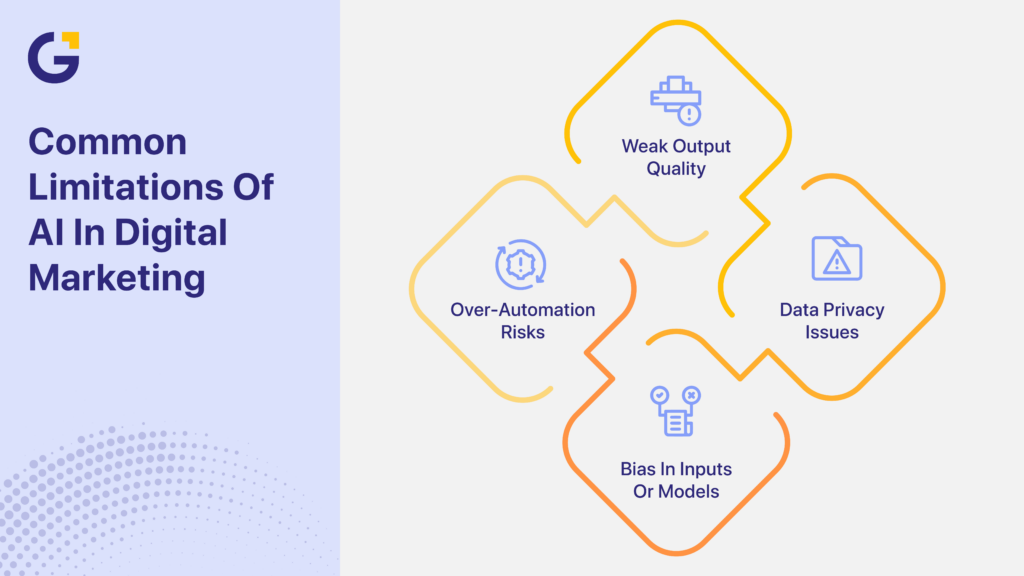
Some of the most common limitations businesses face include:
- Weak Output Quality: AI can produce inaccurate, generic, or low-quality content if prompts or inputs are poor.
- Data Privacy Issues: AI tools often process large amounts of user and business data, which can create compliance and security concerns.
- Bias in Inputs or Models: AI systems can reflect biased or flawed data, leading to poor targeting or inaccurate recommendations.
- Over-Automation Risks: Too much automation can make campaigns feel impersonal and weaken brand voice or customer trust.
Australian businesses should take these risks seriously. Cyber.gov.au warns small businesses to think about cyber risks when adopting cloud-based AI tools.
The practical fix is human review. AI can draft ad copy, group keywords, or summarise campaign patterns, but people still need to check facts, compliance, tone, and strategic fit. This is one reason high-performing businesses stand out: they treat AI as part of managed workflow change, not a shortcut with no oversight.
How Will AI Impact Digital Marketing Jobs In Australia?
AI will change digital marketing jobs more than it will erase them. The best way to think about job impact is task change: AI handles more routine work, while human marketers spend more time on planning, testing, creative direction, client communication, and decision-making.
This pattern already shows up in Australian data. The RBA says many firms expect AI to reshape staffing and tasks, but Jobs and Skills Australia estimates only a small share of the workforce is highly exposed to full AI automation, while a far larger share is exposed to augmentation.
In plain terms, more jobs will be changed by AI than fully removed by it.
How Genix Digital Helps Australian Businesses Use AI Better
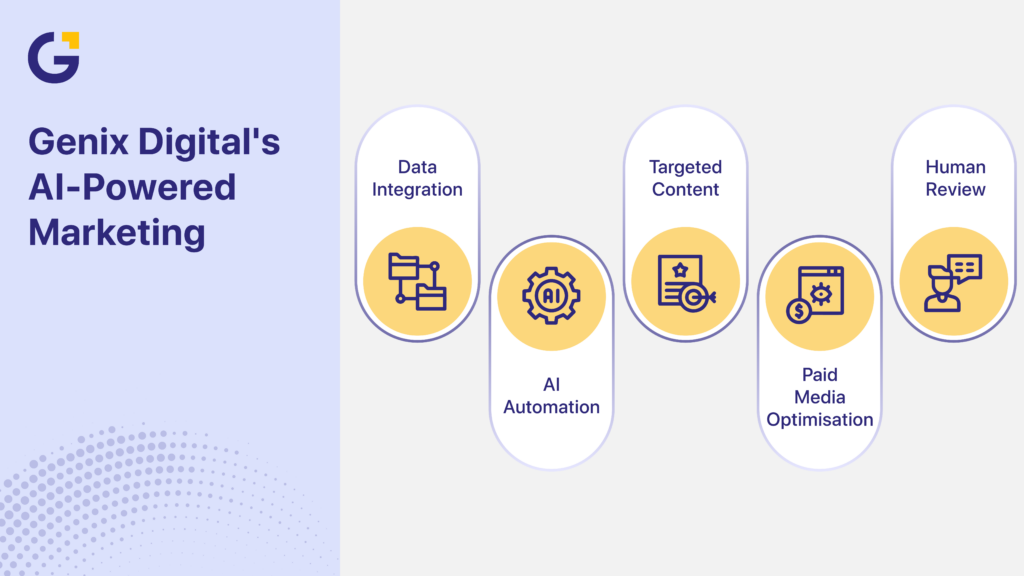
The benefits of AI in digital marketing are real, but results depend on how well the tools are applied. Australian businesses need more than software access. They need the right mix of data, targeting, content, paid media, and human review. Genix Digital positions itself as a Sydney-based agency built to help SMEs stop wasting money on marketing that does not work, with services across SEO, paid ads, content, email, and broader strategy.
At Genix Digital, AI for business marketing is treated as a practical tool, not a magic fix. The team can help you use automation, targeting, search strategy, and content systems in a way that supports leads, sales, and clearer ROI. Discover how our Best Marketing Automation Tools for Australian Businesses in 2026 solutions can integrate seamlessly into your workflow.
If you want an AI-powered digital marketing strategy built for your Australian business, book a free consultation with Genix Digital.
FAQs
1-What are the benefits of AI in digital marketing?
The benefits of AI in digital marketing include faster execution, better targeting, stronger personalisation, and clearer reporting. AI can automate repeated work, improve audience quality, and help businesses act on data faster. It works best when paired with good tracking and human review.
2-What are 5 benefits of AI?
Five common benefits are automation, better targeting, personalisation, faster analytics, and stronger ad optimisation. These gains can reduce manual work and improve campaign efficiency. For many Australian businesses, the biggest early win is time saved on repetitive tasks.
3-What are the 4 advantages and 4 disadvantages of AI?
Four advantages are speed, scale, pattern detection, and lower admin workload. Four disadvantages are poor output quality, bias, privacy risk, and over-automation. AI is most useful when a team has clear rules for review, compliance, and brand control.
4-How will AI impact digital marketing jobs?
AI will shift many marketing jobs toward higher-value work. Teams will spend less time on manual sorting, drafting, and reporting, and more time on strategy, testing, and customer insight. Most roles are more likely to be reshaped than replaced.
5-How do AI ad optimisation platforms compare for ecommerce remarketing and customer retention in Australia?
AI ad platforms dynamically evaluate real-time user intent, browsing depth, and purchase intervals across channels. This allows Australian e-commerce stores to automate personalised remarketing segments, cut wasted ad spend, and boost repeat customer retention far more effectively than static manual retargeting rules.
6-What is an AI content strategy for Australian brands?
An AI content strategy involves using machine learning tools for keyword clustering, topic research, and structural outlining while maintaining strict human editing and brand voice guidelines. In Australia, this ensures content satisfies Google’s helpful content standards and ranks effectively in AI Overviews.




 19 Aug 2026
 9 Min Read