
If you have spent any time researching schema markup AI search recommendations lately, you have probably noticed a lot of conflicting advice. Some sources claim that schema is a ranking factor. Others insist it does nothing at all. Neither claim is quite accurate.
The real answer sits in the middle. Schema markup does not directly boost rankings, but it does help search engines and AI systems understand what your business is, what it offers, and how its pages relate to each other. As AI-driven search results become more common, clarity matters more, not because schema is magic, but because ambiguous, poorly structured content is harder for machines to summarise accurately.
This guide breaks down what structured data for business websites genuinely does, which types are worth implementing on an Australian business website, and where the common mistakes happen.
If you want a comprehensive website and SEO audit support that checks your current structured data SEO setup, that’s a practical first step before adding anything new.
What Schema Markup Actually Does
Schema markup is structured data, usually written in JSON-LD, that sits in a page’s code and describes its content using a standardised vocabulary from Schema.org. It does not change what a visitor sees. It gives search engines a machine-readable explanation of what that content represents.
Think of it as labelling. A phone number on a page is just text to a browser. With the Organisation schema, that same number is explicitly labelled as a business contact number, linked to a named entity, address, and set of services.
Example Case: A Melbourne plumbing business lists its phone number, service area and opening hours in the page footer.
- Without a schema, search engines infer this information from surrounding text and formatting.
- With the LocalBusiness schema, the same information is explicitly tagged, reducing the chance of misinterpretation across search and AI search optimisation summaries.
This is the core function of structured data SEO work: reducing ambiguity, not manipulating rankings.
Why AI Search Makes Entity Clarity More Important
Traditional search engines have long combined keyword matching with structured data and other ranking signals. AI search tools and AI-generated overviews work differently. They often synthesise information from multiple sources to produce a direct answer, which means they need to quickly identify what a business is, what it does, and where it operates.
This is where entity clarity becomes practically important. If a page’s content structure, headings, and markup consistently reinforce the same business name, service list, and location details, AI systems have less work to do when deciding whether to reference that business in a generated answer (entity SEO). This seamless alignment forms the foundation of a robust AI SEO strategy for business websites, ensuring your brand is easily recognised by next-generation search engines.
Example Case: Two competing accounting firms in Brisbane offer near-identical services.
- Firm A has consistent NAP (name, address, phone) details, Organisation schema, and Service schema listing “tax return preparation” and “business advisory”.
- Firm B describes the same services only in unstructured paragraph text, with inconsistent business names across pages.
Firm A gives AI search tools a cleaner, less ambiguous knowledge graph entity to reference. This does not guarantee inclusion in AI-generated results, but it removes one avoidable barrier.
Useful Schema Types for Business Websites
Not every schema type suits every page. The goal is to match the markup to what the page genuinely contains, not adding as many types as possible for the sake of it.
Organisation and LocalBusiness
Organisation schema establishes the core identity of the business: name, logo, website, social profiles, and contact details. LocalBusiness schema extends this for businesses with a physical location or defined service area, adding fields like address, opening hours, and geo-coordinates.
For most Australian small and medium businesses, the local business schema Australia implementation should sit on the homepage and contact page at a minimum.
- Business name, exact match across all pages and directories
- Address and service area, consistent with your Google Business Profile
- Phone number, opening hours, and price range, where applicable
Service, FAQ and BreadcrumbList
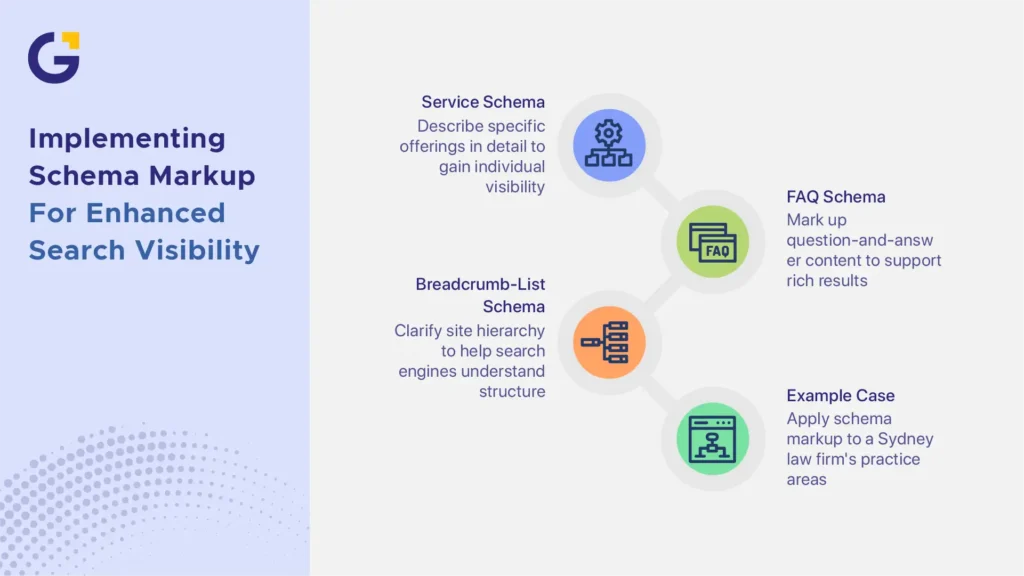
Service schema describes specific offerings in detail, useful for businesses with multiple distinct services that deserve individual visibility rather than being buried in one generic page.
FAQ schema marks up genuine question-and-answer content, which can support rich results and give AI systems pre-formatted answers to reference.
BreadcrumbList schema clarifies site hierarchy, helping search engines understand how a page fits within the broader site structure.
Example Case: A Sydney law firm has separate pages for family law, commercial litigation, and estate planning.
- Each page uses schema markup service fields naming that specific practice area.
- Each page includes a short FAQPage block answering three to five real client questions.
- BreadcrumbList schema shows the path: Home > Services > Family Law.
Article and review-related markup where appropriate
Article schema suits blog posts, guides, and news-style content, providing publish dates, author information, and headline data that helps search engines understand editorial content.
Review-related markup, such as aggregate rating data, should only be used where genuine, verifiable review data exists. Ensuring these elements are correctly configured is a vital part of your overall technical SEO and schema implementation, preventing validation errors and maximising your rich snippet potential.
Frequently asked questions about Schema markup for AI search
What is schema markup?
Schema markup is structured data added to a webpage to help search engines understand information such as business details, services, FAQs, products, or articles.
Does schema guarantee higher rankings?
No. Schema can help search engines understand content and may support rich results, but it does not guarantee rankings.
What schema should a small business use?
Common options include Organisation, LocalBusiness, Service, FAQPage, BreadcrumbList, and Article, depending on the page and content.
Is JSON-LD the best format for schema?
Google generally recommends JSON-LD where supported because it is easier to implement and maintain than inline markup.
Can schema help AI search?
A schema can make business entities and page meaning clearer, but AI visibility also depends on content quality, authority, structure, and consistency.
Should every page have schema?
Important pages should have relevant schema, but adding irrelevant or misleading markup can create quality problems.





 3 Jun 2026
 11 Min Read