

Every click from a Google Ads campaign costs money. Whether that visitor becomes an enquiry depends on the strength of the offer, the relevance of the page, and how easy it is to take the next step.
A Google Ads landing page for a Sydney business should match the ad that brought the visitor there. It should explain the service clearly, provide useful proof, load quickly on mobile devices, and guide visitors towards one primary action.
Not every landing page needs to be a standalone page. Depending on the campaign, it could be a focused service page, a dedicated campaign landing page or, in some cases, a homepage that closely matches the search intent. The goal is to create the shortest and clearest path between the visitor’s search and the action you want them to take.
Campaign targeting, bids, and ad copy still matter. However, even a well-built campaign may struggle when it sends visitors to a slow, generic, or confusing page. Effective Google Ads landing page optimisation connects the search term, ad, offer, landing page and conversion path.
Use this Google Ads landing page checklist to review your page before launching a campaign or increasing your advertising budget.
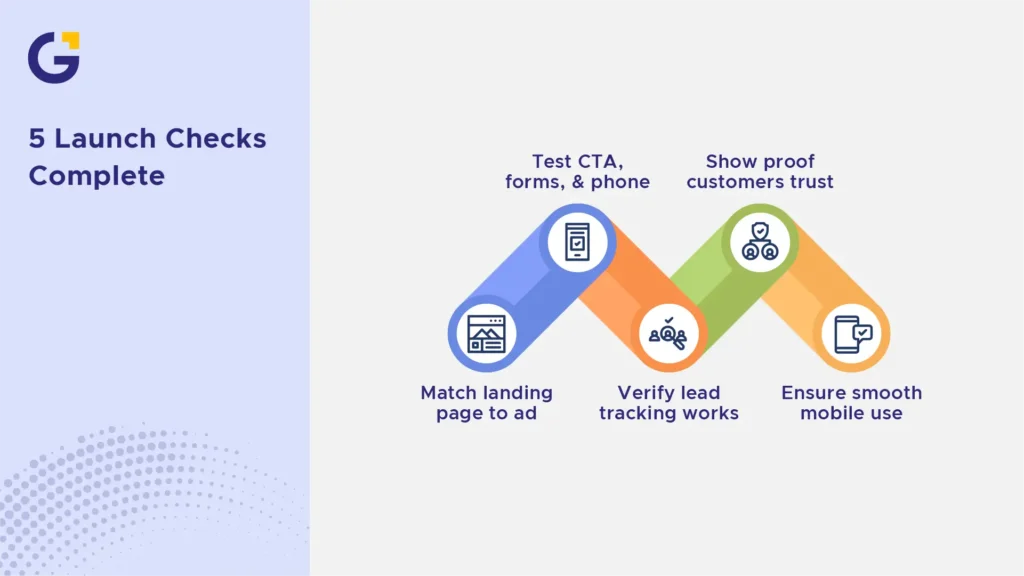
Do Not Launch Until These Five Checks Pass
Before spending money on Google Ads, make sure these five essentials are working correctly. They carry the highest business risk and should always be checked before less critical improvements, such as fine-tuning PageSpeed.
- The landing page matches the ad’s promise. Visitors should immediately recognise the service, offer, and location they clicked.
- Your CTA and form work properly. Test every button, form, and phone number on desktop and mobile before launching.
- Conversion tracking records leads correctly. Confirm that forms, calls, and bookings appear in your reporting before spending on ads.
- The page clearly explains why customers should choose you. Relevant reviews, credentials, project examples, or guarantees should support the claims made on the page.
- The mobile experience is easy to use. Many Google Ads visitors use mobile devices, so the page should load quickly, remain easy to navigate, and make contacting the business straightforward.
Once these five checks pass, you can continue refining speed, testing headlines, and improving other conversion opportunities.
Why Landing Pages Matter More Than More Clicks
More clicks do not automatically produce more customers. A campaign can attract relevant traffic and still underperform when visitors cannot quickly understand the offer, confirm that the business is credible, or find a suitable contact option.
A paid ads landing page should help visitors answer a few questions immediately:
- Am I in the right place?
- Does this business provide the service I searched for?
- Does it serve my location?
- Why should I trust this business?
- What should I do next?
Not every landing page needs to be a standalone page. Depending on the campaign, it could be a focused service page, a dedicated campaign landing page or, in some cases, a homepage that already matches the visitor’s search intent. The right choice depends on how closely the page aligns with the ad, offer, and desired conversion, not whether it exists separately from the rest of the website.
The landing page also contributes to campaign relevance. Google describes Quality Score as a keyword-level diagnostic based on expected click-through rate, ad relevance, and landing page experience. Rather than trying to improve Quality Score itself, businesses should focus on creating a better user experience and stronger alignment between the search intent, ad, and landing page.
Google recommends ensuring the landing page is relevant and useful for people who click the ad. It should deliver on the promise made in the advertisement instead of forcing visitors to search through the website for the advertised service.
For Sydney service businesses, improving the campaign conversion rate often creates more value from existing traffic than simply increasing advertising spend.
Core Landing Page Checks
A strong lead generation landing page should create a clear path from the visitor’s search to the intended conversion. The page does not need to include every detail about the business, but it should provide enough information to support a confident decision.
Review the message match, CTA, form, contact options, mobile experience, speed, and trust signals before sending paid traffic to the page.
Message Match Between Ad and Page
Message match means the landing page continues the promise made in the ad. The headline, service, location, offer, and next step should feel consistent with what the visitor clicked.
For example, an ad promoting emergency plumbing in Parramatta should lead to a page that immediately confirms emergency plumbing is available in that service area. Sending visitors to a general plumbing homepage with a generic enquiry form creates unnecessary friction.
Message match should continue throughout the entire customer journey:
Search term → Ad promise → Landing page headline → Supporting proof → CTA → Form → Confirmation message
Every step should reinforce the same offer. If an ad promotes same-day emergency plumbing, the landing page, CTA, form, and confirmation message should all reflect that promise rather than switching to a generic enquiry process.
Strong message match should cover:
- The service named in the ad
- The customer problem being addressed
- The targeted location
- The advertised offer or benefit
- Supporting proof that matches the offer
- The expected next action
- The confirmation after conversion
The landing page H1 does not need to repeat the ad headline word for word, but it should communicate the same intent so visitors immediately know they have reached the correct page.
Different ad groups can sometimes share one page when they target closely related searches with the same intent. Create separate landing pages only when the offer, audience, proof requirements, qualification process or conversion journey is meaningfully different.
For Sydney Google Ads campaigns, location claims should accurately reflect the business’s genuine service area, call-handling capability and response availability. Businesses should not create suburb-level messaging simply because suburb names can be inserted into headings. Local relevance should help customers make informed decisions rather than create misleading expectations.
CTA, Form, and Contact Path
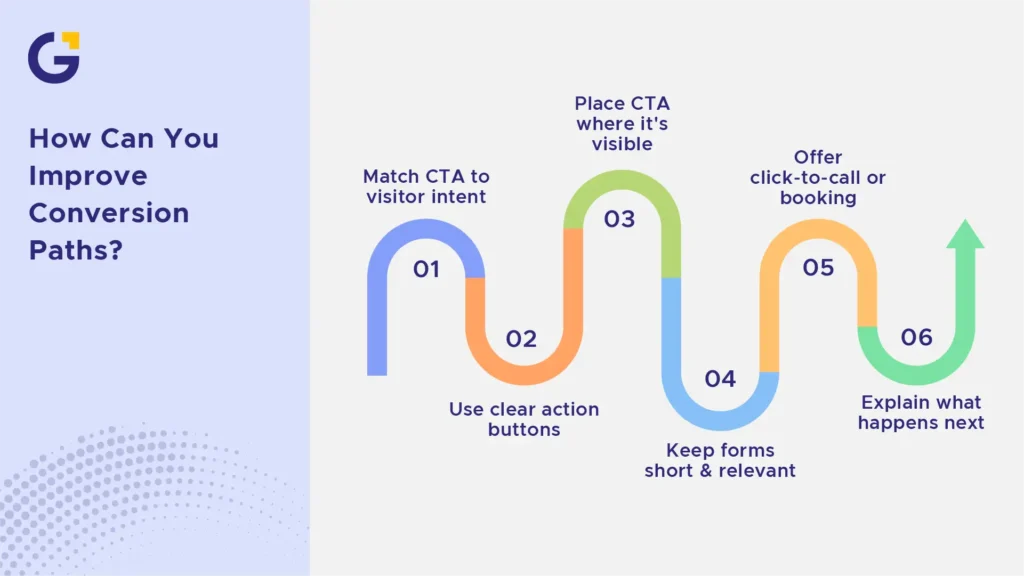
The primary call to action (CTA) should match what the visitor is ready to do. Someone searching for a quote should see an action such as “Request a Quote.” Someone looking to book a service may respond better to “Book an Appointment” or “Check Availability.”
Vague buttons such as “Learn More” can create unnecessary uncertainty on a high-intent PPC landing page. Instead, the CTA should clearly explain what happens after the visitor clicks.
Place the primary CTA where visitors can find it without searching. It should appear near the opening offer and be repeated after key supporting information where appropriate. Repeating one clear CTA is more effective than presenting several competing actions.
Forms should collect only the information needed to respond to or qualify the enquiry without creating unnecessary friction. Depending on the service, useful fields may include:
- Name
- Phone number or email address
- Required service
- Suburb or postcode
- A short description of the enquiry
Longer forms may be appropriate for complex or high-value services, but every additional field should have a clear business purpose. On mobile devices, use readable labels, suitable input types and clear validation messages so visitors can complete the form easily.
Service businesses should also accommodate visitors who prefer to call. Display a visible phone number and make it clickable on mobile devices. Where appropriate, include an online booking option that matches the business’s sales process.
The page should also explain what happens after the form is submitted. A confirmation message such as “Our team will contact you within one business day” sets expectations and reassures visitors that their enquiry has been received.
Businesses reviewing their conversion journey should also consider whether broader website conversion improvements for paid campaigns are limiting campaign performance. In many cases, successful Google Ads landing page optimisation works alongside broader website conversion improvements for paid campaigns, particularly when refining service pathways, improving mobile usability or simplifying conversion flows.
Landing Page Speed
A visitor cannot evaluate the offer if the page is slow, unstable, or difficult to use. Test the landing page on real mobile devices and typical mobile connections rather than reviewing it only on a desktop computer.
Use Google PageSpeed Insights to review both field data and laboratory data where available. The report can help identify issues involving image sizes, scripts, layout shifts, loading performance, and responsiveness.
Common improvements include:
- Compressing and correctly sizing images
- Removing unused scripts and plugins
- Reducing unnecessary third-party tools
- Improving hosting and server response
- Preventing page elements from shifting during loading
- Loading only the assets required for the page
Speed should not be judged by one performance score alone. A better measure is whether visitors can quickly see the main content, interact with buttons, and complete forms without noticeable delays.
Trust Signals
Trust signals should support the specific claim being made. A generic five-star review does not prove a same-day service claim, a licence or a fixed-price offer. Match your reviews, credentials, and project examples to the promise made in the advertisement.
Depending on the business and industry, useful trust signals may include:
- Customer reviews
- Relevant licences or accreditations
- Industry memberships
- Completed project examples
- Clear contact information
- Privacy information
- Service guarantees with accurate conditions
- An Australian Business Number (ABN)
Customers can use the official ABN Lookup service to verify publicly available Australian business information. Businesses should present accurate company details rather than relying on decorative trust badges that cannot be verified.
Mobile Usability
Mobile usability extends beyond responsive layouts. The page should make it easy for visitors to read information, complete forms, and contact the business without frustration.
The WCAG Quick Reference provides practical guidance for improving accessibility. Relevant landing page checks include:
- Sufficient colour contrast
- Clear form labels and instructions
- Descriptive button text
- Keyboard-accessible controls
- Helpful validation messages
- Alternative text for informative images
- Content that remains readable when enlarged
Avoid intrusive pop-ups that interrupt the visitor before they have understood the offer or reached the primary CTA. A simple, focused page often converts better than one overloaded with animations, banners, and competing messages.
Tracking Setup Before Campaign Scaling
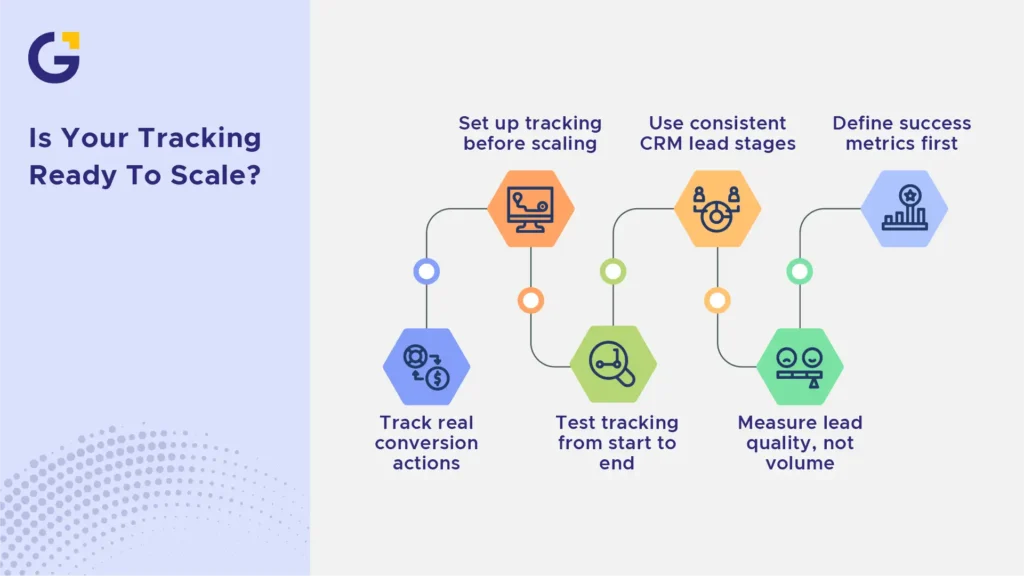
Before increasing advertising spend, confirm that your tracking accurately measures the outcomes that matter. Clicks and impressions indicate whether ads attract attention, but they do not show whether campaigns generate valuable enquiries or customers.
Track the actions that represent genuine progress towards a sale, including:
- Form submissions
- Phone calls
- Appointment bookings
- Quote requests
- Live chat enquiries
- Relevant button clicks
- Purchases
- Qualified offline conversions
Google Ads conversion tracking can record actions completed after an ad interaction, while GA4 provides additional behavioural and attribution insights. Google Tag Manager can simplify tag management without requiring repeated website code changes.
For businesses investing in Google Ads landing page optimisation, conversion tracking should be configured before campaigns are scaled, not afterwards. A landing page that generates leads without accurate measurement makes optimisation significantly more difficult. Businesses looking to improve campaign performance should review both their landing pages and their overall Google Ads strategy together through professional Paid Ads management rather than treating them as separate activities.
Track Calls and Campaign Sources Accurately
Call tracking is particularly valuable for service businesses that receive a significant number of phone enquiries. Dynamic number insertion or campaign-specific tracking numbers can help identify which campaigns generate calls, provided the implementation maintains accurate business information and complies with applicable privacy requirements.
Google Ads auto-tagging can pass campaign information into connected Google products. UTM parameters may also support CRM reporting or multi-channel analytics when used consistently. Avoid mixing different tracking conventions without first deciding how attribution will be managed.
Tracking should be tested from beginning to end. Complete a test form, make a test phone call, and, where applicable, finish the booking process to confirm that:
- Each conversion is recorded only once
- The correct conversion category is assigned
- Thank-you pages or confirmation events fire correctly
- Phone calls are attributed accurately
- Campaign data reaches reporting platforms
- Lead source information reaches the CRM
Qualified offline conversions also depend on consistent CRM processes. Before relying on lead-quality reporting, businesses should define clear lead stages such as:
- Contacted
- Qualified
- Quoted
- Booked
- Won
Without consistent CRM stages, it becomes difficult to distinguish valuable enquiries from unqualified leads, making campaign optimisation less reliable.
Tracking lead volume alone is not enough. Review whether enquiries are qualified, reachable and commercially relevant. Campaign analytics should connect advertising activity with real business outcomes rather than treating every click or form submission as equally valuable.
Before scaling campaigns, establish a measurement plan that identifies:
- The primary success metric
- Supporting metrics
- How qualified leads will be measured
- Which reports will guide optimisation decisions
Having this framework in place allows businesses to make informed improvements instead of reacting to incomplete or misleading performance data.
Common Mistakes on Sydney Service Landing Pages
Many landing page problems become visible in campaign data before they are obvious on the page itself. Rather than making random changes, identify what the data is telling you and investigate the most likely cause first.
| What You See in Campaign Data | Likely Landing Page Problem | First Thing to Check |
| High click-through rate (CTR) but low form completion | The page does not continue the ad’s promise, or the CTA is weak | Review message match, headline, CTA, and form placement |
| Strong form volume but poor lead quality | The offer attracts the wrong audience, or the form does not qualify enquiries | Review targeting, offer clarity, and qualification fields |
| Mobile conversion rate is much lower than the desktop conversion rate | Mobile usability issues or slow page performance | Test page speed, mobile layout, buttons, and forms |
| Many phone calls but few qualified enquiries | Call handling or expectations do not match the advertisement | Review the call answering process, opening hours, and messaging |
| High engagement but few conversions | Visitors cannot easily identify the next step | Review CTA visibility, trust signals, and page hierarchy |
| High bounce rate from paid traffic | Weak message match or irrelevant landing page | Compare the search term, advertisement, and landing page content |
| Conversion rate suddenly drops after website updates | Tracking or functionality may be broken | Test forms, phone links, conversion tracking, and thank-you pages |
One of the most common mistakes is sending every Google Ads campaign to the homepage. A homepage introduces the business, multiple services, and general navigation. While this may work for branded searches, it often creates unnecessary distractions for visitors looking for one specific service or offer.
Another common issue is using vague headlines such as “Quality Solutions You Can Trust.” While positive, they do not explain what the business offers, who the service is for, or why the visitor should continue reading.
A stronger headline usually communicates:
- The service being provided
- The customer’s need is being solved
- The service area, where appropriate
- The next action the visitor can take
Sydney Google Ads campaigns should also use location references carefully. Rather than inserting suburb names throughout the page, explain the actual service coverage, response times or availability. Location claims should reflect genuine business operations, including the areas your team services and your ability to respond to enquiries.
Other issues that frequently reduce campaign performance include:
- Hiding the phone number on mobile devices
- Asking for unnecessary information in the first form
- Using several competing CTAs
- Making claims without supporting evidence
- Placing reviews too far from the related claim
- Using stock images that do not represent the actual business
- Failing to explain what happens after an enquiry
- Leaving forms or buttons untested
- Measuring clicks without reviewing lead quality
- Adding new scripts that slow the page over time
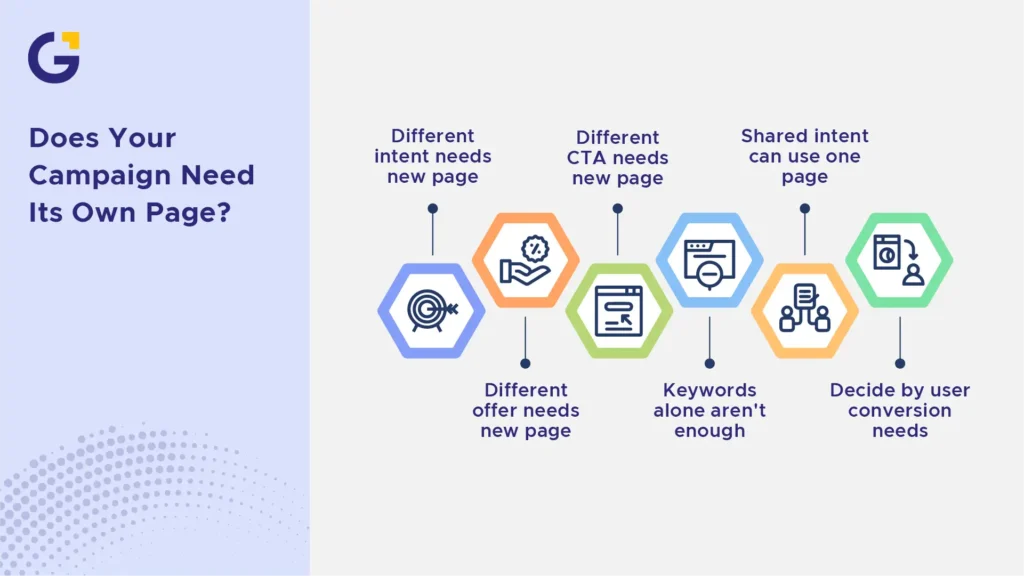
When to Use a Dedicated Landing Page
Not every Google Ads campaign requires its own landing page. The decision should be based on whether visitors need a meaningfully different experience rather than simply targeting a different keyword.
A dedicated landing page is usually worthwhile when the ad group has a different:
- Service
- Offer
- Audience
- Proof requirements
- Qualification process
- Primary CTA
- Conversion journey
For example, a business running separate campaigns for commercial cleaning and end-of-lease cleaning would often benefit from separate landing pages because each audience has different priorities, proof requirements and reasons for making contact.
Likewise, a campaign promoting a limited-time offer or a specialised service may justify its own page if visitors need unique information before converting.
However, keyword variation alone is not enough reason to build another landing page. Several closely related ad groups can often perform well using one well-optimised page when they share the same intent, offer, and conversion path.
A homepage or existing service page may be the better option when:
- The campaign targets branded searches
- Visitors are likely to compare several services
- The existing service page already matches the advertisement closely
- The conversion journey is already clear
- Tracking can separate campaign performance accurately
The decision should always be based on user intent, message match, and conversion requirements rather than a rule that every campaign needs its own page.
Google Ads Landing Page Checklist
Use this Google Ads landing page checklist before launching a campaign and whenever lead performance changes.
Message and Offer
- The page clearly explains the advertised service.
- The main headline supports the promise made in the ad.
- The offer, audience, and location are accurate.
- The primary benefit appears near the top of the page.
- The content answers the visitor’s likely questions.
- Claims are specific, accurate, and supported by evidence.
- The page does not force visitors to search for the advertised service.
- Supporting proof reinforces the offer made in the advertisement.
CTA and Contact Path
- The primary CTA matches visitor intent.
- The CTA clearly explains what happens next.
- The main action is easy to find on desktop and mobile.
- Repeated CTAs use consistent wording.
- Competing actions do not distract from the main goal.
- Phone numbers are visible and clickable on mobile.
- Booking tools function correctly when used.
- Confirmation messages set clear expectations.
Forms
- Every required field has a clear business purpose.
- The form is practical to complete on mobile devices.
- Visible labels are used instead of placeholders alone.
- Validation messages explain how to correct errors.
- Submitted enquiries reach the correct person or CRM.
- Spam protection does not create unnecessary friction.
- Test submissions have been completed successfully.
Speed
- The page has been tested with Google PageSpeed Insights.
- Images are compressed and appropriately sized.
- Unnecessary scripts and plugins have been removed.
- Important content loads without unnecessary delay.
- Layout shifts are minimised during loading.
Trust
- Reviews, credentials, or project examples support the claims being made.
- Business details are accurate and easy to verify.
- Privacy information appears near forms collecting personal information.
- Guarantees clearly explain any conditions.
- Relevant licences, memberships or certifications are displayed where appropriate.
Mobile Usability
- Buttons are easy to tap.
- Text remains readable without zooming.
- Forms are simple to complete on smaller screens.
- Pop-ups do not block important content.
- The layout works consistently across common mobile devices.
Tracking and Analytics
- Google Ads conversion tracking is installed and tested.
- GA4 events are configured correctly.
- Form submissions are recorded only once.
- Phone calls are tracked where appropriate.
- Booking completions are measured.
- Auto-tagging or UTM conventions are documented.
- Campaign data reaches reporting platforms correctly.
- Lead source information reaches the CRM.
- CRM lead stages are consistently applied.
- Qualified leads can be connected to campaign performance.
Ongoing Optimisation
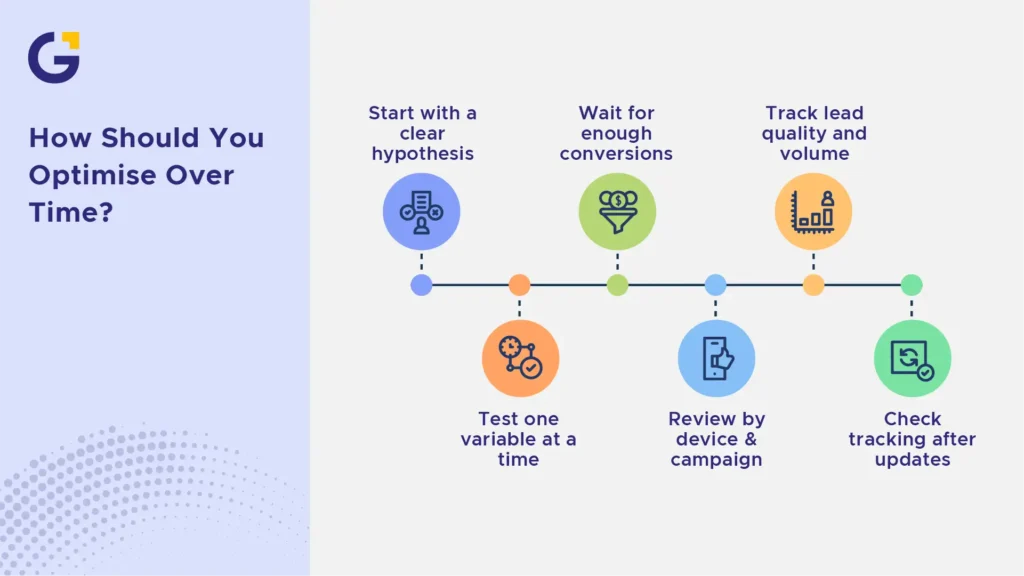
Landing page optimisation should be an ongoing process rather than a one-time task. Before making changes, write a clear hypothesis and decide which metric will define success. Test one meaningful variable at a time, avoid changing the ad, audience, offer, and landing page simultaneously, and collect enough conversions before deciding on a winner.
Record significant page changes, review performance by device, service and campaign, compare lead quality alongside conversion volume, and retest conversion tracking after website or plugin updates. Investigate underperforming pages before increasing advertising spend.
Conclusion
A Google Ads landing page connects your paid campaign with the action you want visitors to take. Every part of the journey should work together, from the search term and ad copy through to the landing page, CTA, form, confirmation message and lead follow-up process.
Before increasing your advertising budget, review your landing page for message match, mobile usability, trust signals, conversion tracking, and lead quality. Small improvements in these areas can often generate more qualified enquiries without increasing ad spend.
Landing page optimisation should also continue after launch. As customer behaviour, offers and campaigns evolve, regularly reviewing your pages helps identify opportunities to improve conversion rates and make better use of your advertising budget.
If you want an experienced Sydney team to review your message match, conversion path, tracking setup and lead quality before you scale your campaigns, speak with the Genix Digital team about a Google Ads landing page review.
FAQs
What should a Google Ads landing page include?
A Google Ads landing page should include a clear offer, a headline that matches the ad, relevant proof, a simple CTA, a fast mobile experience, useful content, easy contact options and working conversion tracking. Every element should help visitors confidently take the next step.
Can I send Google Ads traffic to my homepage?
Sometimes. A homepage can work for branded or broad-intent campaigns when it closely matches the visitor’s expectations and provides a clear conversion path. However, campaigns promoting a specific service, audience or offer often perform better when they direct visitors to a focused service page or dedicated landing page.
Does landing page speed affect Google Ads?
Yes. Slow pages create a poorer user experience and can reduce conversion performance. Google also considers landing page experience as one component of its Quality Score diagnostic, making page speed and usability important factors when evaluating campaign performance.
What is message match in Google Ads?
Message match means the landing page consistently delivers what the advertisement promised. The search intent, ad copy, headline, supporting proof, CTA, form, and confirmation message should all reinforce the same offer and encourage visitors to complete the intended action.
Should every ad group have its own landing page?
No. Create a dedicated landing page only when the ad group has a meaningfully different service, offer, audience, proof requirement, qualification process or CTA. Keyword variation by itself is rarely enough reason to build another page.
How can I tell whether the problem is my ad, landing page, or lead handling process?
Start by reviewing the campaign data before making changes. A high click-through rate with low conversions may indicate a landing page issue, while strong conversion volume but poor lead quality often points to the offer or qualification process. If qualified enquiries are not becoming customers, review your call handling, response times, and sales process before increasing your advertising budget. Comparing click-through rate, landing page engagement, form completion, call handling, and qualified lead rates together provides a clearer picture of where improvements are needed.





 13 Oct 2026
 7 Min Read