
Search is changing fast. AI-powered tools, answer engines, and generative platforms are transforming the way people find information. Ranking on Google is no longer the only goal. Businesses now need visibility across SEO, AEO, and GEO to stay competitive.
This guide explains what each approach means, how they work together, and what your business should focus on to stay visible in 2026.
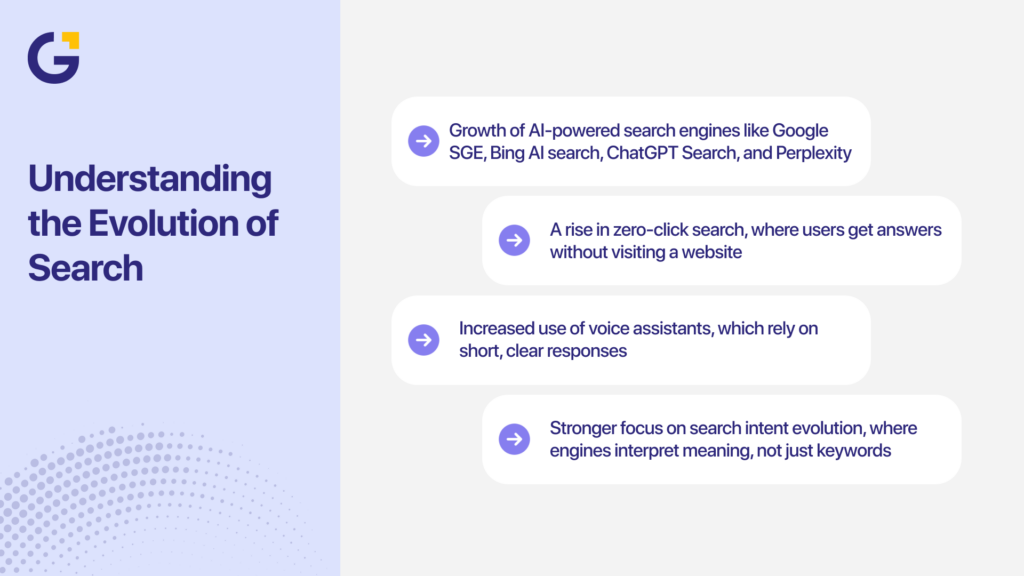
Understanding the Evolution of Search
Search has changed quickly as people rely more on AI-powered search engines, voice assistants, and instant answers rather than scrolling through long results pages.
According to a 2026 survey by Google and IPSOS, 49 percent of Australians used Generative AI in the last year, a sharp increase from 38 percent in 2023. This surge highlights how quickly people are shifting toward AI-driven tools for finding information, making it even more important for businesses to optimise for SEO, AEO, and GEO.
How Search Has Shifted
Search has moved from simple keyword matching to intent-based and conversational results. Users now expect search engines and AI systems to understand questions in natural language and return accurate answers immediately. This shift is driven by:
- Growth of AI-powered search engines like Google SGE, Bing AI search, ChatGPT Search, and Perplexity
- A rise in zero-click search, where users get answers without visiting a website
- Increased use of voice assistants, which rely on short, clear responses
- Stronger focus on search intent evolution, where engines interpret meaning, not just keywords
Instead of ranking ten blue links, search tools now produce summaries, answer blocks, and generative responses. This widens the channels brands must optimise for and creates new challenges for traditional SEO models.
Why Traditional SEO Alone Is No Longer Enough
Keyword-focused SEO is no longer enough because users interact with search results in new ways. Search engines now favour:
- Content that answers questions directly
- Structured pages that support answer engine optimisation
- Clear information that AI models can summarise and cite through generative search optimisation
- Content written in natural, conversational language
- Verified, trusted sources supported by strong authority signals
If a business relies only on ranking positions, it loses visibility when AI search tools extract answers and bypass traditional pages. Brands that fail to optimise for AEO and GEO risk losing traffic, impressions, and brand authority as more users shift to AI search.
This is why SEO, AEO, and GEO strategies now work together. SEO drives visibility, AEO supports answer delivery, and GEO increases the chance of being used in generative responses across AI-powered search engines.
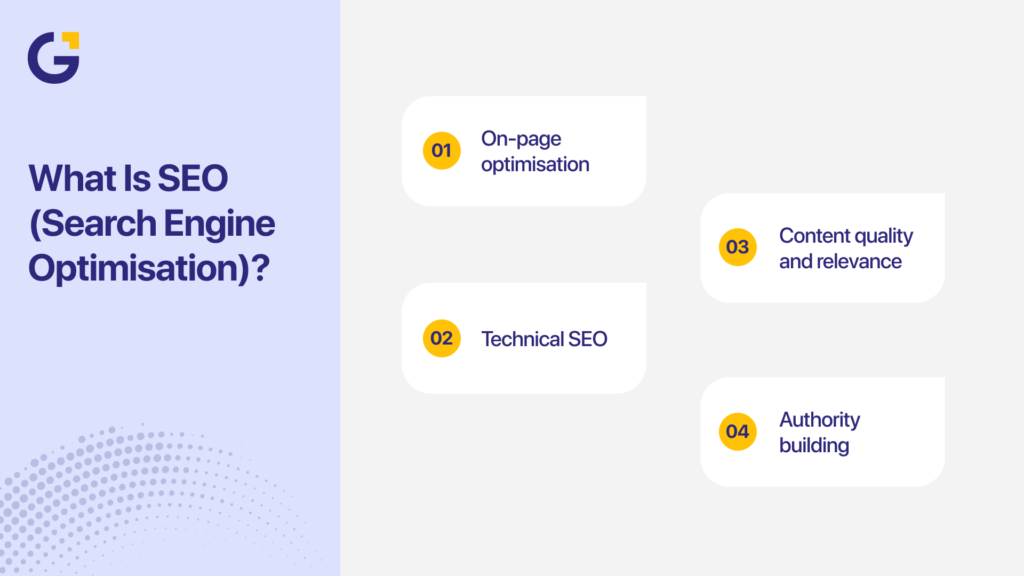
What Is SEO (Search Engine Optimisation)?
SEO is the practice of improving a website so search engines can understand its content and recommend it to users. It helps businesses appear for searches that match their products, services, or expertise. While SEO has expanded over the years, its foundation remains visibility, relevance, and authority.
Core Principles of SEO
SEO focuses on helping search engines identify content that best matches a user’s intent. Strong SEO performance is usually built on four key areas:
- On-page optimisation: This covers elements search engines read to understand a page, including:
- Title tags and structured headings
- Clear keyword targeting
- Informative copy that answers the query
- Internal links that help search engines map your content
- Technical SEO: Search engines rely on structure and performance signals, including:
- Fast page load times
- Mobile-first page experience
- Crawlable site architecture
- Clean code and structured data
- Content quality and relevance: Search engines prioritise pages that offer value. Content needs to:
- Match search intent
- Present accurate information
- Provide depth through examples, steps, or explanations
- Help users complete a task
- Authority building: SEO rankings improve when a website earns trust signals through:
- Backlinks from credible sites
- Mentions on reputable platforms
- Strong entity signals across the web
SEO still forms the base of search visibility, but its influence has shifted as AI-powered search engines reshape search behaviour.
Limitations of SEO in 2026
SEO continues to be important, but it no longer controls the entire visibility journey. Shifts in how people search have introduced new limits:
- Zero-click search reduces traditional traffic. Many queries on Google now produce instant answers through featured snippets, People Also Ask boxes, and AI Overviews. Users get the answer without clicking through.
- AI search engines create answers instead of showing links. Tools like ChatGPT Search, Perplexity, and Bing AI search generate summaries that replace search result pages. This reduces the impact of ranking positions.
- Keyword-focused content does not always match conversational queries. AI-powered search engines evaluate meaning, context, and clarity. Pages that rely only on keyword matching struggle to appear in conversational search ranking systems.
- Search engines prefer structured and short-form answers. Traditional long-form content performs well, but AI models often pull short, concise sections. Pages that lack clear segments fall behind competitors using answer engine optimisation.
These limitations show why businesses now must combine SEO with answer engine optimisation and generative engine optimisation to remain visible across all AI-powered search engines.
Why SEO Still Matters
Even as search behaviour changes, SEO remains a foundation for search visibility. It plays a key role in helping businesses:
- Build trust and authority. Strong SEO signals tell both Google and AI search systems that your content is credible and reliable.
- Support AEO and GEO. SEO improves site structure, content quality, and authority. These are the same elements AI engines use to select sources for answers and generative summaries.
- Capture commercial searches. When users look for services, products, or local providers, traditional search results still influence buying decisions.
- Strengthen long-term search visibility. SEO helps businesses appear in Google search, Google SGE optimisation, Bing AI search, and voice search optimisation.
SEO forms the base of modern search strategy. AEO and GEO build on it, increasing a brand’s presence in instant answers and generative responses across AI-powered search engines.
What Is AEO (Answer Engine Optimisation)?
AEO is the process of structuring content so search engines and AI systems can extract clear, direct answers. Instead of focusing only on ranking, AEO focuses on being selected as the source for instant responses, featured snippets, voice answers, and AI-generated summaries.
AEO has become essential because users now expect fast, accurate information without needing to click through multiple pages.
How AEO Works
AEO works by helping search engines and AI tools find direct, well-structured answers on a page. It relies on:
- Clear question-and-answer formatting. Search engines scan pages for headings that match common queries.
Example:
H3: What is generative search optimisation?
Followed by a short, direct answer.
- Concise response blocks. AI-powered search engines prefer short paragraphs (40–60 words) that state the answer upfront, followed by supporting details.
- Structured data and schema markup. Elements such as FAQ schema or HowTo schema help Google interpret sections and present them in zero-click formats.
- Natural language patterns. AEO aligns content with how users speak, not how they type. This improves visibility in voice search and conversational search ranking.
AEO helps a page become the “answer source” for Google Search, Google SGE optimisation, Bing AI search, and AI-powered search engines like ChatGPT Search.
Why AEO Supports Zero-Click Search
Zero-click search occurs when users get an answer directly on the results page or in an AI summary without visiting the site. AEO directly influences this trend because:
- Featured snippets replace traditional rankings. Google extracts short answers from AEO-friendly pages and displays them above organic results.
- Voice assistants read the fastest and clearest answer. Siri, Google Assistant, and Alexa rely on short, structured responses that AEO provides.
- AI engines summarise answers from multiple sources. ChatGPT Search and Perplexity look for factual, clear content they can quote or summarise.
- People prefer instant information. Users searching “what is answer engine optimisation” expect a short answer, not a long article.
This is why AEO is now a core part of search visibility in the AI era. If a website does not structure content for answer extraction, it loses presence in zero-click environments.
Tactics That Improve AEO Visibility
AEO requires deliberate formatting and clear information architecture. The most effective tactics include:
- Add question-based headings. Use H2s and H3s that match real questions users ask.
Examples:
- What is generative engine optimisation?
- How does voice search optimisation work?
- Provide short, direct answers first. State the answer within the first one or two sentences. Add supporting detail after.
- Use structured data markup. FAQPage schema, HowTo schema, and Article schema help search engines identify answers more accurately.
- Include lists, tables, and step summaries. Search engines often extract formatted sections for quick answers.
- Optimise for People Also Ask queries. Target common questions using natural phrasing to match conversational search.
- Strengthen entity signals. Clear branding and consistent terminology help AI-powered search engines understand context.
- Keep information accurate and updated. AI prefers current data because it reduces the risk of inaccurate summaries.
AEO helps websites gain visibility in featured snippets, People Also Ask boxes, voice search answers, and generative responses. It is now one of the strongest ways to improve search visibility in the AI era.
What Is GEO (Generative Engine Optimisation)?
GEO is the practice of improving content so generative AI systems can understand it, trust it, and use it when creating summaries or answers. It focuses on making information clear, structured, and authoritative enough for tools like Google SGE, Bing AI search, ChatGPT Search, and Perplexity to reference.
GEO does not replace SEO or AEO. It adds a new layer that prepares websites for search results powered by generative models instead of ranked lists.
How Generative Engines Evaluate Content
Generative engines do not evaluate content the same way as traditional search engines. Instead of scanning for keywords, they assess the meaning and clarity of content. They also evaluate whether the source is safe to use in an automated response.
The main factors they consider include:
- Accuracy and factual consistency. Generative AI avoids sources that contain vague claims, outdated data, or unclear statements. It prefers content with facts, definitions, and clear explanations.
- Clarity of structure. AI models look for structured headings, small content blocks, and sections that can be summarised easily.
- Depth and context. Engines choose content that explains concepts clearly and provides supporting context without unnecessary wording.
- Authority signals across the web. AI systems cross-check brand visibility, mentions, and citations to avoid using unreliable sources.
- Machine readability. Clean HTML, proper formatting, schema markup, and consistent term usage all help an AI engine process and interpret content accurately.
Generative engines rely on meaning, structure, and trust signals rather than keyword density. GEO aligns content with these requirements.
Why GEO Is the Missing Layer for 2026
Many businesses have strong SEO and AEO foundations, but still do not appear in generative summaries. GEO fills this gap by preparing content for AI models that generate answers instead of listing links.
GEO is essential in 2026 because:
- AI summaries are replacing traditional search results. Google SGE, Bing Copilot mode, and ChatGPT Search produce detailed responses that pull from multiple sources. Brands that lack GEO visibility are excluded from these answers.
- AI assistants influence buying decisions. People now ask AI tools for recommendations, comparisons, and providers. GEO helps businesses appear in these decision-making conversations.
- Generative engines prefer content with clear meaning. If content is unclear or overly long, AI models avoid it. GEO helps businesses rewrite content so AI engines can summarise it confidently.
- GEO supports search visibility in the AI era. As more users rely on generative AI for advice or instructions, GEO becomes a direct visibility pathway for brands.
It is now one of the strongest ways to appear in AI-generated summaries, answer panels, and conversational responses.
Signals AI Uses to Select Sources
AI systems use a combination of quality, structure, and authority signals to decide which websites to include in generative responses. The key signals include:
- Clear definitions and well-structured explanations. Content that explains concepts in a straightforward way is easier for AI to use.
- Short, direct answer segments. AI models often extract 40–80 word blocks that can be summarised or quoted.
- Consistent terminology and entity signals. Clear references to services, products, locations, and topics help AI engines identify a website as a reliable source.
- Strong authoritativeness (EEAT signals). AI systems weigh:
- Website reputation
- Backlink quality
- Mentions on trusted platforms
- Expertise demonstrated through content
- Structured data markup. Schema helps AI models interpret sections, FAQs, and definitions.
- High factual accuracy. AI models avoid pages with misleading claims or outdated references.
- Content freshness. Recent updates increase the chance of being selected, especially for tech, finance, and health topics.
These signals help generative engines decide which websites are safe to reference and which ones to ignore. GEO strengthens these signals so businesses can appear across multiple AI-powered search engines.
How SEO, AEO, and GEO Work Together
These strategies do not replace one another. They build on each other.
| Strategy | Goal | Where It Appears | Optimisation Focus |
| SEO | Improve organic rankings | Google, Bing | Technical, content quality, and backlinks |
| AEO | Provide direct answers | Featured snippets, SGE, voice search | Clear answers, structure, schema |
| GEO | Influence AI-generated responses | AI chat, summaries, generative engines | Authority, entity optimisation, credible data |
Why Integration Matters
Search journeys now move between engines. A user may begin in Google, shift to ChatGPT for comparisons, then return to Google for local results. Businesses need visibility across each layer.
The Shift from Keywords to Conversations
AI-powered search engines use natural language understanding. This means queries are longer, conversational, and intent-focused.
Examples of conversational search queries:
- “Which agency can help me optimise for AI search?”
- “What is the difference between SEO, AEO, and GEO?”
- “How do I prepare my business for the future of search 2026?”
Why This Shift Matters
Content must answer questions clearly. Pages built around short keywords alone no longer work. Businesses must support conversational ranking signals, including:
- Question-based headings
- FAQ blocks
- Definitions
- How-to sections
- Step-by-step guidance
- Contextual explanations
Why Businesses Need to Adapt to Generative Search
Generative search is changing how users interact with results, which affects how much traffic websites receive.
Loss of Traffic from Zero-Click Results
More search engines answer queries directly without requiring website visits. Without GEO, traffic may decline even if rankings stay strong.
AI Systems Prefer Authority
Generative engines prefer:
- Government sources
- Educational institutions
- Organisations with strong author signals
- Websites with consistent topical history
Businesses must build these signals deliberately.
Generative Engines Influence Buying Decisions
Users often trust AI-powered answers because they appear factual and convenient. This increases the value of being referenced or cited inside those answers.
According to Gartner, 65 percent of CMOs say advances in AI will dramatically transform their role within the next two years. This reinforces how quickly search and customer journeys are shifting toward AI-driven engines, making SEO, AEO, and GEO essential for visibility.
Practical Strategies for SEO, AEO, and GEO in 2026
Businesses need clear, actionable steps to stay visible across traditional, answer-driven, and generative search.
SEO Strategies
- Improve page speed and mobile performance
- Strengthen internal linking
- Use a clear H1-H3 hierarchy
- Write helpful content with expert input
- Build authoritative backlinks
- Add schema markup and structured data
AEO Strategies
- Add FAQ sections to key pages
- Write short, clear answer paragraphs
- Use question-based headings
- Include tables and lists
- Add how-to steps where relevant
- Use schema for FAQs and definitions
GEO Strategies
- Publish original data, research, or case studies
- Build strong author profiles with real credentials
- Strengthen entity signals across the web
- Maintain consistent branding on all platforms
- Use structured HTML for readability
- Keep content updated regularly
Tools and Technologies Powering the New Search Era
Modern optimisation relies on tools that support analysis, structure, and AI-driven content improvements.
SEO Tools
- Google Search Console
- Semrush
- Ahrefs
- Screaming Frog
- Sitebulb
AEO Tools
- AnswerThePublic
- AlsoAsked
- Google’s People Also Ask extractor
- Schema generators
GEO Tools
- Knowledge graph tools
- Entity optimisation platforms
- Fact-checking tools
- Structured data testing tools
- AI model output testing (ChatGPT, Bing Copilot, Gemini, Perplexity)
Measuring Success Across SEO, AEO, and GEO
Measuring performance helps you understand how each optimisation layer contributes to overall visibility.
SEO Metrics
- Organic traffic
- Rankings
- Click-through rates
- Indexed pages
- Backlinks
AEO Metrics
- Featured snippet wins
- Voice search placements
- FAQ impressions
- Zero-click visibility
GEO Metrics
There are no formal dashboards yet, but you can track:
- How often AI models cite your content
- Whether AI tools summarise your pages correctly
- Branded search growth
- Entity recognition status
- Mentions across external platforms
- Structured data validation for health
Common Pitfalls and How to Avoid Them
Many businesses lose visibility across SEO, AEO, and GEO because they rely on methods that no longer match how AI search engines work.
Pitfall 1: Only focusing on keywords
Fix: Add questions, short explanations, and conversational phrasing so content aligns with how people speak and how AI systems interpret intent.
Pitfall 2: Publishing unstructured, long paragraphs
Fix: Use clear headings, smaller paragraphs, lists, and tables so AI tools can extract answers for AEO and GEO.
Pitfall 3: Weak author signals
Fix: Add author bios, credentials, relevant experience, and clear entity information to strengthen EEAT and brand authority.
Pitfall 4: Only relying on Google
Fix: Check visibility across ChatGPT Search, Bing AI search, Perplexity, and Gemini because users now depend on multiple AI-powered search engines.
Pitfall 5: Ignoring entity optimisation
Fix: Keep business information consistent across your website, socials, listings, and press mentions so AI engines can validate your identity.
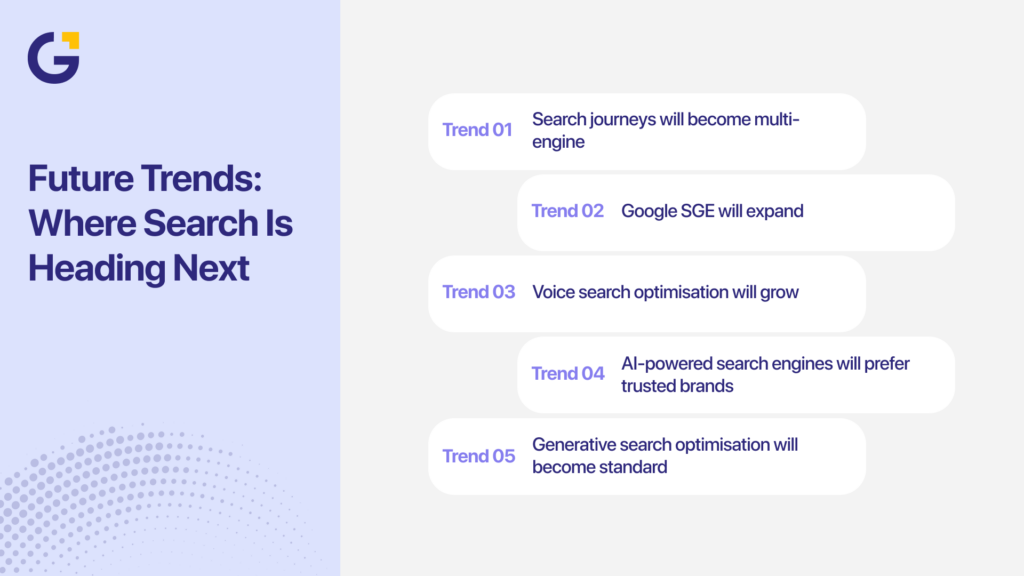
Future Trends: Where Search Is Heading Next
Search is moving toward an AI-first model where users rely on multiple tools, not just Google, to find answers, compare options, and make decisions.
Trend 1: Search journeys will become multi-engine
Users will move between Google, AI chat tools, voice assistants, and social search depending on the task.
Trend 2: Google SGE will expand
More queries will trigger AI-generated summaries, reducing clicks to traditional results.
Trend 3: Voice search optimisation will grow
Short, direct answers will matter more as people continue using voice assistants for everyday tasks.
Trend 4: AI-powered search engines will prefer trusted brands
Entity strength, consistency, and credibility will influence rankings more than backlink volume alone.
Trend 5: Generative search optimisation will become standard
Businesses will need GEO as a core part of their search strategy to appear in AI-generated responses.
How Genix Digital Helps Businesses Stay Visible in the AI Era
Genix Digital supports businesses through search optimisation strategies designed for AI-powered engines. This includes SEO for AI search, answer engine optimisation, and generative engine optimisation.
What Genix Digital Provides
- Technical SEO audits and fixes
- AEO-ready content structure
- GEO-focused authority building
- AI search optimisation strategies
- Ongoing monitoring across Google, Bing AI search, and generative tools
- Support for conversational search ranking
- Search visibility in the AI era
Why Businesses Choose Genix Digital
- Expertise in future-focused optimisation
- Clear tactical recommendations
- Experience working with Australian SMEs
- Practical support across all search layers
Conclusion
SEO, AEO, and GEO now work together to shape how people discover information, compare options, and make decisions across both traditional and AI-powered search engines. Businesses must optimise for rankings, answer delivery, and generative summaries at the same time to stay visible as search becomes more conversational and AI-driven. Companies that build these capabilities early gain stronger visibility, more qualified traffic, and greater trust across every major search platform, while those who wait risk losing momentum as zero-click and AI results continue to grow.
Genix Digital helps businesses strengthen their presence across SEO, AEO, and GEO with strategies designed for AI-powered search in 2026. If you want your website to appear in organic results, answer boxes, and generative summaries, book a strategy session with our team and start building a future-ready search approach today.
FAQs
Q1. What is the difference between SEO and AEO?
SEO focuses on helping pages rank in traditional search results. AEO focuses on structuring content so search engines and AI tools can extract direct answers. Both work together to improve search visibility across organic listings, snippets, and AI-driven results.
Q2. What does GEO mean in SEO?
GEO stands for Generative Engine Optimisation. It prepares content so AI-powered search engines like Google SGE, Bing AI search, and ChatGPT Search can use it in generated answers. GEO helps a website appear inside summaries, recommendations, and conversational responses.
Q3. Is GEO more important than SEO?
GEO is becoming more important as users rely on AI summaries instead of clicking search results. SEO is still the foundation because AI engines rely on clear, structured, trustworthy pages. The strongest results come from using SEO, AEO, and GEO together.
Q4. Is AEO just a new name for SEO?
No, AEO focuses specifically on answer delivery, not ranking positions. It helps websites appear in featured snippets, People Also Ask results, voice answers, and AI-generated responses. AEO is a layer that complements SEO, not a replacement.
Q5. How do I do an AEO for my website?
Start by adding question-based headings and short, direct answers. Use structured data like FAQ and HowTo schema to help search engines extract information. Keep paragraphs short and present clear facts so AI tools can summarise your content accurately.



 30 Mar 2026
 17 Min Read